
Most AI content fails before the first prompt is written. Not because Google hates AI — but because the people publishing it treat the output as the finished product. That’s the mistake. And it’s fixable. Figuring out how to make AI content rank is less about which tool you fire up and more about the system you build around it.
If you’ve already read our breakdown of whether Google penalizes AI content, you know the answer is no — provided the content meets quality thresholds. Google’s own position makes the line explicit: AI used primarily to manipulate rankings is spam, but AI used to help produce genuinely useful content for people is not. This article is about hitting those thresholds, every single time you publish. The difference between content that climbs and AI slop that flatlines isn’t the tool. It’s the process: a research doc built before any AI session, a structure Google can parse as a semantic outline, a hard editorial gate before anything gets scheduled, and a clean on-page layer to finalize the signal. Four steps. Here’s how to run them.
- Research before AI: The ceiling of your AI output is set by the quality of your brief. Build a research doc — with intent analysis, SERP gaps, and 3–5 primary sources — before you open any AI tool.
- Structure signals topical depth: Your H2/H3 tree works as a semantic outline that Google parses independently from body copy. A structurally complete header hierarchy tells crawlers your content covers the full query space.
- Editorial review is a hard gate: Human review is a pass/fail checkpoint, not light cleanup. Every factual claim needs a traceable citation; every article needs at least one piece of first-hand evidence missing from the top-10 results.
- On-page closes the loop: Primary keyword in the title and first 100 words, LSI entities in H2s, at least two contextual internal links, and a meta description written for intent — not keyword density.
- The failure mode is not using AI. It’s treating the AI draft as the finished product and hitting publish without a system around it.
Step 1: Build the Research Doc Before You Open Any AI Tool
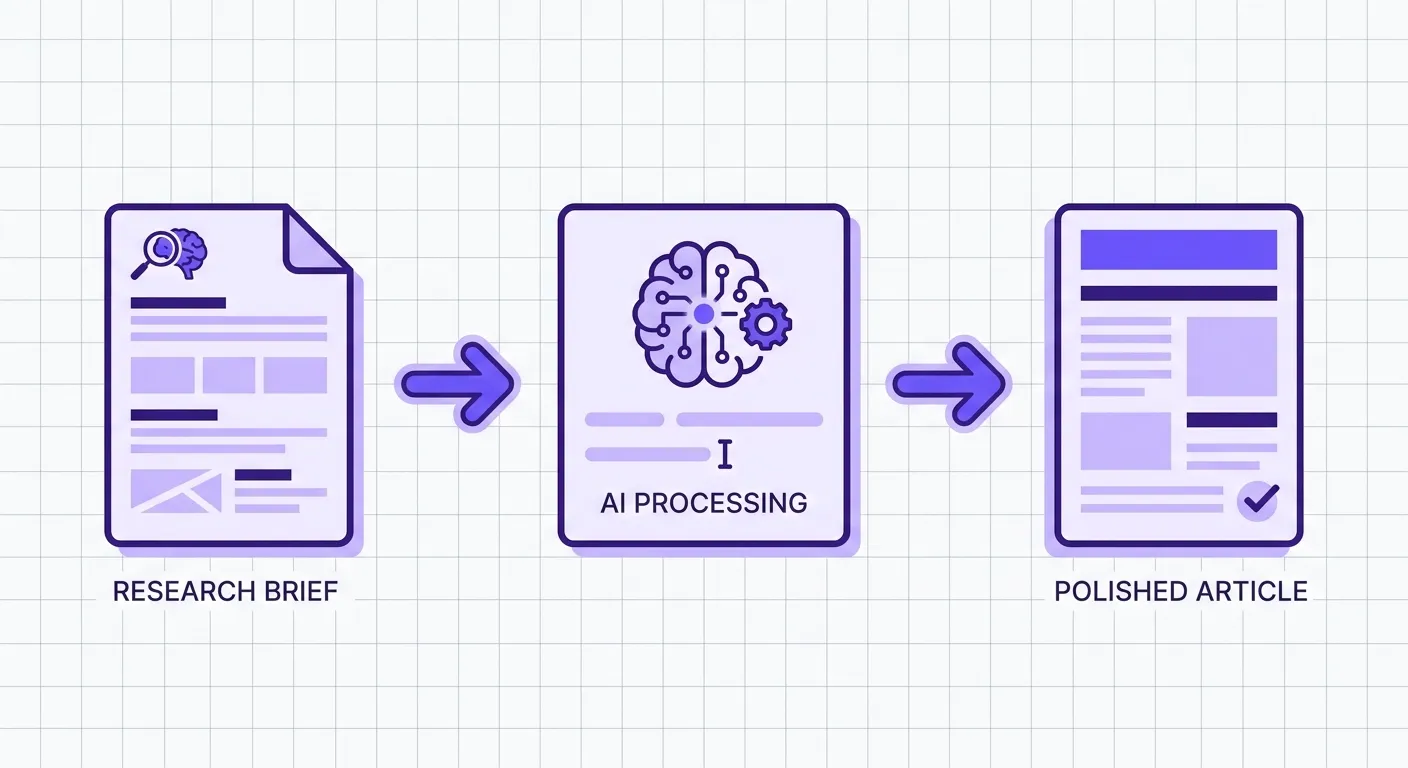
The single biggest reason AI content fails to rank is not the prose quality — it’s the input. Your AI tool can only synthesize what you give it. Feed it a vague topic and a keyword, and you get a generic summary of whatever dominated its training data. Feed it a structured research brief with original data, documented SERP gaps, and a clearly articulated angle, and the output ceiling rises dramatically. Before you write a single prompt, you need a document that contains: the primary keyword and its verified search intent, a list of what the current top-10 results are NOT covering (your differentiation points), at least one piece of first-hand evidence you own (a personal test result, a screenshot, real data from your niche), and 3–5 authoritative external sources you’ve actually read. That last point matters more than people admit. The research doc is where you decide what the article will say. The AI is just the drafting engine.
Google’s self-assessment questions for content quality are worth reading before you build this doc, because they define what “original information, reporting, research, or analysis” means in algorithmic terms. The question isn’t whether you used AI — it’s whether the finished article provides something a reader could not get from any other page currently ranking. If your research doc contains genuine insight gaps and primary evidence, the AI draft will reflect that. If it doesn’t, no amount of prompt engineering compensates. Most AI content fails at this stage, before the tool is even opened.
Step 2: Structure That Signals Topical Depth to Google
Header hierarchy is usually discussed as a readability convention. It’s not just that. Your H2/H3 nesting functions as a semantic outline that crawlers parse independently from your body copy — it’s one of the primary signals Google uses to infer whether a page addresses a topic completely or only skims it. Read your H2/H3 tree in isolation. Does it answer the full set of implied subtopics the query carries? Does it progress logically from definition to context to method to outcome? A shallow H2 tree — four generic headings with no H3 specificity — signals surface-level treatment. A semantically complete tree signals depth, even before a crawler processes a single paragraph. This is where most AI-generated articles leave ranking signal on the table: the AI writes reasonable body copy but produces a flat, generic structure because the prompt didn’t specify otherwise.
For a practical illustration: an article targeting “how to make AI content rank” with only H2s like “Use the Right AI Tool,” “Write Good Content,” and “Optimize for SEO” signals almost nothing. An H2/H3 tree that covers research methodology, structural completeness, editorial review criteria, and on-page signals — with H3s that name specific steps — communicates topical authority at the structural level before Google reads a word of body text. Article structured data, specifically the author field with a linked, verifiable author URL, adds another layer here: it tells Google’s crawlers at the machine level who wrote the piece and where to verify that author’s credentials. This is an underused E-E-A-T lever that most AI-content guides never mention, because they treat E-E-A-T as purely an editorial concept rather than a technical implementation.
Step 3: The Editorial Review — The Gate Between AI Draft and Publish
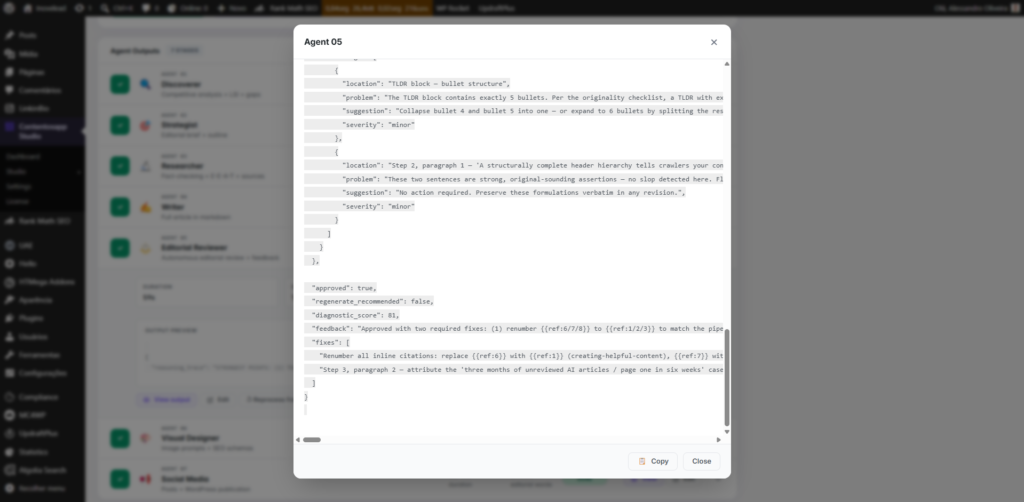
The editorial review is not a polish pass. It’s a hard gate. Treat it that way, and you’ll publish less content — but what you publish will rank. Call it a Rank-Ready Review: a structured checklist with yes/no criteria that every article must pass before it gets scheduled. Here’s what the checklist covers. Does every factual claim in the article link to a primary source you can verify? Is there at least one piece of first-hand evidence — a real example, a personal test, original data — that does not appear anywhere in the current top-10 results? Does the author bio or byline establish relevant experience for this specific topic? And critically: is this article demonstrably more useful than the current number-one result for the query? If any of those is a “no,” the article isn’t ready. It goes back for revision, not to the publish queue.
This framing matters because Google’s ranking systems explicitly reward content demonstrating expertise, experience, authoritativeness, and trustworthiness — not content that was produced efficiently. The editorial review is where E-E-A-T actually gets built. Not in the AI prompt. A content operation without a defined review gate isn’t a system; it’s a publication queue with no quality control. Picture the failure pattern most solo publishers fall into: months of unreviewed AI drafts going live, and almost no organic traction to show for it — not because the writing is bad, but because nothing in the process forces originality, real sourcing, or first-hand proof onto the page. Now add a genuine editorial gate to that same workflow: an introduction rewritten in a real voice, a first-hand example the top-10 results don’t have, every factual claim traced to a source. That’s the difference between content that’s merely indexable and content that’s actually rankable. The draft was never the bottleneck. The gate is what decides whether any of it earns a position.
Step 4: The On-Page Signals That Finalize Rank-Readiness
Once the research is solid, the structure is semantically complete, and the editorial gate has been passed, the on-page layer is what finalizes the ranking signal. This is not where you compensate for weak content — it’s where you ensure strong content is properly indexed and understood. The non-negotiables: your primary keyword appears in the title tag and within the first 100 words of body copy (naturally, not forced). LSI entities and topically related terms appear organically in H2s and throughout the body — not stuffed, but present enough that a crawler can confirm the page’s subject. You have a minimum of two contextual internal links pointing to semantically related content on your site, including your pillar article where relevant. Your meta description is written to match search intent for the specific query, not to pack in keyword variations.
The deeper principle here is that on-page optimization only multiplies content that already has value. Apply it to AI slop and you’re wasting time. Apply it to a research-backed, editorially reviewed article with a clean semantic structure, and every signal reinforces the others. This system — research doc, structural completeness, editorial gate, on-page layer — is not four separate tasks. It’s one workflow, designed to produce content that meets Google’s quality bar at every checkpoint. The goal isn’t to publish more articles. It’s to build a repeatable process where every article you do publish has a legitimate shot at ranking.
Frequently Asked Questions
How much human editing does AI content actually need to rank?
There’s no universal answer, but a practical baseline is this: every factual claim needs to be verified and sourced, the introduction often needs a complete rewrite to establish genuine voice and context, and at least one section needs original first-hand evidence inserted. For most AI drafts, that’s a 30–45 minute editorial pass per article — not a full rewrite, but not a quick proofread either. The common failure mode is treating the AI output as 95% done. It’s usually 60–70% done. The final 30–40% is where the ranking signal lives.
What’s the difference between rank-ready AI content and AI slop?
Rank-ready AI content has a research-backed brief behind it, a defined editorial gate it passed before publishing, verifiable citations, and at least one piece of evidence or insight not found in competing results. AI slop is what happens when the output is published without any of those steps — generic, sourceless, indistinguishable from the other ten articles covering the same topic in the same way. Google’s self-assessment checklist for content quality is the fastest way to benchmark where your content falls on that spectrum.
Does AI content need backlinks to rank, or is on-page enough?
For lower-competition informational queries — which is where most solo bloggers and affiliate marketers should be starting — on-page quality and topical authority within your site structure can get you to page one without significant external links. But backlinks accelerate that process, especially for queries with established, high-authority incumbents. Don’t treat on-page work as a substitute for link acquisition. Treat it as the prerequisite: content that isn’t rank-ready won’t benefit from backlinks anyway.
How do I add E-E-A-T to AI-generated articles without having expert credentials?
You don’t need formal credentials — you need demonstrated experience. First-hand examples, real test results, documented experiments, and named sources all signal experience to Google’s quality systems. Beyond editorial content, implementing Article structured data with a linked author profile tells crawlers at the machine level who wrote the piece and where to verify that person’s background. Most AI-content guides skip this entirely. It’s one of the most actionable E-E-A-T levers available, and it takes about 20 minutes to implement correctly.
Can I use AI for the research phase, or only the writing phase?
You can use AI to assist with research — generating topic outlines, identifying subtopic gaps, summarizing source material you’ve already gathered — but it should not be your primary research tool. AI models hallucinate citations, invent statistics, and summarize training data rather than current SERP reality. Use AI to structure and draft; use your own reading and source gathering to fill the research doc. The research doc should contain information you’ve personally verified before the AI touches it.
How long does it take for AI content to rank after publishing?
For informational queries with moderate competition, expect 3–6 months for meaningful organic movement, assuming the content passes a legitimate editorial review and the site has some existing authority. Fresh sites with no backlink profile or topical authority signals can take longer. Publishing frequency matters less than publishing quality — one well-executed, research-backed article per week outperforms five AI drafts pushed live without editorial review. Patience plus a repeatable system beats volume every time.
The system described here is not complicated. But it does require discipline — specifically, the discipline to not treat the AI output as done when it comes out of the tool. Research before prompting. Structure before drafting. Editorial review before scheduling. On-page optimization before publishing. Run that loop consistently, and AI content becomes a genuine competitive advantage. Skip any of those steps, and you’re producing content that will be outranked by whoever doesn’t skip them. The question isn’t whether AI content can rank. It already does, for sites that build a system around it. The question is whether yours will.

References
External sources
- Google Search’s guidance about AI-generated content | Google Search Central Blog | Google for Developers — https://developers.google.com/search/blog/2023/02/google-search-and-ai-content
- Creating Helpful, Reliable, People-First Content | Google Search Central | Documentation | Google for Developers — https://developers.google.com/search/docs/fundamentals/creating-helpful-content
- Learn About Article Schema Markup | Google Search Central | Documentation | Google for Developers — https://developers.google.com/search/docs/appearance/structured-data/article