
You paste a paragraph into a checker, get a score like “87% AI”, and have no idea what that number actually means or whether you can trust it. AI content detection works by scanning text for patterns, like predictable word choices and flat sentence rhythm, that machine models tend to produce more often than people do. No detector reads minds, but the better ones give you a reasonable signal, especially when you understand what they’re actually measuring.
If you’re trying to figure out how to detect AI writing before you publish, submit an assignment, or approve a freelancer’s draft, this article walks through exactly what these tools check and how reliable the results really are. You’ll see how detection scores are calculated, why they sometimes flag human writing as AI, and which free AI content detection tools are worth your time.
We’ll also cover why detection alone won’t save a mediocre article from ranking poorly, and what actually matters if you want content that reads as genuinely useful rather than generic. That distinction matters more than any percentage score a detector spits out.
Why AI content detection matters
Detection isn’t just an academic curiosity. Teachers use it to decide whether to fail a student. Editors use it to decide whether to fire a freelancer. Google’s helpful content systems, whether directly or indirectly, shape whether an article ever gets found at all. AI content detection sits at the center of decisions that affect grades, paychecks, and traffic, which is exactly why so many people search for ai generated content detection tools before they hit publish or submit.
Academic integrity and the classroom problem
Schools adopted detectors fast once ChatGPT went mainstream in late 2022, and the stakes for students are real: plagiarism boards, failed courses, even expulsion in serious cases. Turnitin’s AI writing indicator, built into the platform many universities already used for plagiarism checks, became a default gatekeeper almost overnight. The problem is that these systems were never trained to be courtroom-grade evidence. A student who writes plainly, uses short declarative sentences, or learned English as a second language often triggers the same flags as someone who copy-pasted from a chatbot. Several university writing centers have pushed back publicly, arguing that detectors punish clarity and reward stylistic flourish that has nothing to do with authorship.
A single AI detection score should never be the only evidence used to accuse someone of not writing their own work.
Search rankings and what Google actually penalizes
Here’s where a lot of confusion creeps in. Google has stated plainly that it doesn’t penalize content simply for being AI-generated, and what the data actually shows about AI content penalties backs that up. What it penalizes is content made primarily to manipulate rankings, regardless of how it was produced. The Search Central guidance on helpful content focuses on whether content demonstrates real expertise, answers the reader’s question fully, and reads like something a person would bookmark or recommend, not on whether a human or a model typed the words. So when someone searches how to detect ai writing hoping it’ll tell them if their blog is about to get deindexed, the honest answer is: detection scores and ranking penalties are two separate problems. Thin, generic, unhelpful content ranks poorly whether a person or a model wrote it. That’s the real filter to worry about.
Trust with clients, editors, and readers
Beyond grades and rankings, detection matters because trust is fragile. Freelance writers get dropped by agencies over a single flagged paragraph, even when the score came from a tool with a documented false-positive problem. Content marketers get asked by clients to run every draft through a checker before invoicing, turning a creative process into a pass/fail gate. Readers, too, have grown wary of generic AI output; plenty of people now say they can
How to detect AI writing: key signs and methods
Before you run anything through a checker, train your own eye. Most people who read a lot of AI output develop a gut sense for it within a few months, and that instinct is often more reliable than a percentage score. How to detect AI writing manually comes down to noticing patterns that repeat across paragraphs: the same sentence length over and over, transitions that feel inserted rather than earned, and a strange evenness of tone that never gets excited, frustrated, or specific. Real writers wander a little. Models rarely do.
The telltale signs to watch for
When you’re trying to detect ai in writing without any software, work through a short checklist. None of these signs alone proves anything, but three or four together are a strong signal.
- Vocabulary that leans generic: words like “landscape,” “delve,” “tapestry,” and “unlock” showing up in contexts where a specific noun would fit better.
- Perfectly balanced paragraphs: three sentences, then three more, then three more, with almost no variation in length or rhythm.
- Hedging without commitment: statements that say “it’s important to consider” or “there are many factors” instead of naming the factor.
- Missing specifics: no named tools, no dates, no numbers, no first-hand detail that only someone who did the thing would know.
- Overly tidy structure: an intro, three even body sections, and a conclusion that just restates the intro, with no digressions or asides.
- Transition phrases that feel templated: “in conclusion,” “moreover,” and “furthermore” used at a rate no human editor would allow.
If a paragraph could have been written about almost any topic with a few nouns swapped out, it probably wasn’t written by someone who actually knows the subject.
Reading for missing lived experience
One of the most reliable ai content detection methods costs nothing and needs no software: ask whether the piece contains anything the writer could only know from doing the thing themselves. A genuine product review mentions a specific defect, an unexpected shipping delay, or a comparison to a competitor model by name. A genuine how-to guide mentions the step that tripped the writer up. AI-generated drafts, especially unedited ones, tend to describe outcomes in the abstract because the model has no memory of ever actually doing anything. This is also the exact gap Google’s guidance points to when it talks about content demonstrating real expertise rather than just covering a topic.
Combining manual review with a tool check
Manual review catches things software misses, but it’s slow and subjective, which is why most people searching tools to detect ai writing want a second opinion they can point to. The two methods work best together: skim for the signs above first, then run anything borderline through a checker to confirm your instinct. If you’re vetting freelancer submissions or auditing your own site at scale, that combination matters more than either method alone.
| Method | Speed | Best for |
|---|---|---|
| Manual reading | SlowOne piece at a time | Catching missing expertise and generic phrasing |
| Detector tool | FastBatchable | Flagging text for a closer human look |
| Fact-checking claims | Moderate | Confirming the content isn’t just fluent nonsense |
No single ai content detection software replaces this judgment. Treat every tool as a second opinion, not a verdict, and you’ll catch far more than either method alone would.
Best free AI content detection tools to try
Most people searching for a free ai content detection tool just want to paste text somewhere and get a straight answer before they publish or submit something. The good news is you don’t need to pay for this. Several ai content detection tools offer a genuinely usable free tier, not just a teaser that locks results behind a paywall after the first check. The catch is that free tiers usually cap your word count per scan, so you’ll paste in chunks for longer articles rather than running the whole thing at once.
What to look for before you trust a result
Before you settle on one ai content detection software as your go-to, check a few things: does it show a sentence-by-sentence breakdown or just one number, does it disclose which models it was trained to catch, and does it let you scan without creating an account. Tools that hide their methodology behind a black-box score are harder to trust, especially since you’ll want to explain a flagged result to a client or student at some point. A breakdown that highlights specific sentences gives you something concrete to discuss instead of just a percentage to argue over.
A detector that only gives you a number is far less useful than one that shows you exactly which sentences triggered the flag.
Free tools worth bookmarking
These are the checkers that consistently show up when people search for websites to detect ai writing, each with a different sweet spot depending on what you’re checking and how much text you have.
Onboarding update — draft
The new onboarding flow went live last Tuesday, and the first numbers are in. Support tickets dropped by about a third in week one, almost all of them password resets. In today’s ever-evolving digital landscape, it is important to delve into the rich tapestry of user experience to truly unlock success. The team is still watching step three, where roughly one in five users stalls before finishing.
Two changes did most of the work: a shorter form and a plainer error message. Moreover, leveraging cutting-edge solutions empowers stakeholders to seamlessly navigate the paradigm shift toward holistic engagement. Furthermore, it is important to note that a robust, best-in-class framework unlocks synergies across the board. We ship the next iteration once the payroll integration clears review on Friday.
| Tool type | Best for | Free tier limit | Notes |
|---|---|---|---|
| Sentence-highlighting checkers | Spotting exactly which lines read as machine-generated | Usually 1,000–1,500 words per scan | Good for editing, not just pass/fail decisions |
| Plagiarism-plus-AI checkers | Academic submissions and freelance drafts | Often capped at a few scans per month free | Useful when you need both originality and AI checks in one pass |
| Browser-extension checkers | Quick spot-checks while browsing or editing in Google Docs | Unlimited light use, limited depth | Convenient but usually less detailed than dedicated web tools |
| Batch-upload checkers | Auditing many articles at once, like a whole blog archive | Free tier often limits batch size | Best for agencies auditing existing content libraries |
Using more than one tool at once
Running the same paragraph through two or three checkers is the closest thing to a reliable process you’ll get for free. Scores rarely agree exactly, and that disagreement is informative on its own, since a paragraph flagged as 90% AI by every tool you try deserves a much closer look than one where the scores scatter between 20% and 60%. Verdicts that cluster tightly are worth acting on. Verdicts that scatter usually mean the writing sits in a gray zone that no algorithm handles well, often because it’s plainly written human text rather than anything a model produced.
With this said, don’t build a workflow that depends on chasing a passing score. If your goal is publishing something that ranks and actually helps readers, the smarter move is following a keyword-to-publish process for SEO articles that grounds content in real research and named sources from the start, the kind an editorial review would approve regardless of what a detector says afterward. That’s a different problem from detection, and it’s the one worth solving first.
How accurate are AI detectors, and where they fail
No detector on the market gets this right every time, and the honest ones say so in their own documentation. Studies from researchers at Stanford found that several popular checkers misclassified essays from non-native English speakers as AI-written at rates far higher than essays from native speakers, sometimes flagging more than half of them. That’s not a rounding error. It’s a structural weakness baked into how these tools work, and it means ai content detection software can do real harm when someone treats a score as proof instead of a hint.
A detector that flags a nervous ESL student at the same rate it flags a chatbot isn’t measuring authorship, it’s measuring writing style.
Why false positives happen
Detectors mostly work by measuring perplexity (how predictable the word choices are) and burstiness (how much sentence length and structure varies across a passage). Human writers who favor short, plain sentences, write in a second language, or follow a formula because they were taught to, naturally score lower on both measures, which makes them look statistically similar to machine output. So does anyone editing heavily for clarity, since smoothing out a rough draft flattens the very unpredictability that signals human authorship to these models. Legal writing, technical documentation, and structured business emails all tend to trigger false positives for the same reason: predictable phrasing isn’t unique to AI, it’s just common in certain genres.
I moved to Chicago in 2019 for my first job. My English was not perfect back then. I wrote my reports in short, simple sentences because it felt safer. My manager told me they were the clearest on the team. I still write the same way today. It helps me say exactly what I mean.
Reality: this paragraph is 100% human — written by a non-native English speaker in plain, careful sentences. The detector is scoring predictable style, not authorship. A textbook false positive.
Why false negatives happen
The flip side gets less attention but matters just as much. Running AI output through a paraphrasing tool, or asking a chatbot to “write this more casually” a second time, reliably drops detection scores without changing where the content actually came from. Mixing a few human-written sentences into an AI draft, reordering paragraphs, or swapping in synonyms by hand defeats most checkers within minutes. This is the core problem with treating detection as a technical arms race: every improvement in detection gets matched by an improvement in evasion within weeks, because both sides are training against each other’s public tools.
What the accuracy numbers actually look like
Vendors rarely publish independent, third-party accuracy audits, so most of the numbers you’ll see come from the vendors themselves. Take any single claim with a grain of salt, and treat these as rough patterns rather than guarantees.
| Scenario | Reliability | Typical detector behavior |
|---|---|---|
| Unedited AI output, first draft | Caught | Usually flagged correctly, often with high confidence |
| AI output run through a paraphraser | Missed | Frequently missed entirely |
| Human text from a non-native speaker | False positive | Elevated false-positive risk |
| Human text edited for simplicity or SEO | False positive | Elevated false-positive risk |
| Mixed human-AI drafts | Gray zone | Inconsistent, scores often land in a gray middle range |
The pattern that matters most: detectors are reasonably good at catching lazy, unedited AI text and reasonably bad at everything else. If you’re relying on a checker to make a high-stakes call, whether that’s failing a student or firing a freelancer, that gap should worry you.
The honest conclusion for anyone relying on a score
Treat every detection score as a probability, not a verdict, and corroborate it with the manual signs covered earlier before you act on it. If you’re a teacher, an editor, or an agency running client content through a checker, build in a step where a flagged result gets a second, human look rather than an automatic rejection. That single habit prevents most of the damage detectors cause, while still catching the genuinely lazy, unedited AI content they’re actually good at spotting.
How to keep your content from being flagged as AI
The goal isn’t gaming a detector, it’s writing content that doesn’t read like everyone else’s AI output in the first place. Chasing a passing score with paraphrasing tricks just produces the mixed drafts that confuse checkers and readers alike. Focus instead on humanizing AI content the right way, with the habits that make writing sound like a specific person did the work, because that’s what both detectors and actual readers respond to.
Write like someone who actually did the thing, and detection stops being a problem you need to solve separately.
Write with specifics a model can’t invent
Generic AI output describes outcomes in the abstract because the model has no memory of doing anything. You fix that by naming things: the exact tool you used, the date something happened, the number that surprised you, the competitor product you compared against. A sentence that says “many businesses struggle with cash flow” reads as filler. A sentence that says “three of our five clients missed payroll in Q1 because of a 45-day invoice cycle” reads as lived experience. That specificity is also exactly what lowers perplexity scores in a good way, since named details rarely match the predictable phrasing detectors are trained to catch.
Vary your sentence rhythm on purpose
After drafting, read your paragraphs out loud and listen for repetition. If three sentences in a row run the same length and structure, break one apart or fold two together. This single edit does more to defeat both human suspicion and automated flags than any other change, because burstiness (the natural variation in sentence length and structure) is one of the clearest human signals detectors look for. Short sentence. Then a longer one that adds a qualifier or a contrast. Then maybe a fragment for emphasis. Real writers don’t write in metronome time, and neither should you.
Edit out the tells
Run a pass specifically hunting for the vocabulary and structure patterns covered earlier in this piece, using the exact editing moves that turn a raw draft into rank-ready content. A quick checklist for that edit:
- Cut or replace words like “landscape,” “delve,” “tapestry,” and “unlock” with something concrete
- Replace hedges (“it’s important to consider”) with a direct claim you’re willing to defend
- Delete transition phrases like “in conclusion” and “moreover” unless they’re doing real work
- Break up any paragraph that has three sentences of identical length
- Add at least one detail per section that only someone with hands-on experience would know
Ground claims in real, citable sources
Content that cites named, checkable sources, government data, original interviews, documented test results, reads as trustworthy to both readers and Google’s helpful content systems, regardless of what a detector says about it. This is the difference between an article that just covers a topic and one that demonstrates real expertise, and the signals that make Google take your content seriously are the standard that actually determines rankings. It’s also, not coincidentally, the standard that naturally produces text with the specificity and irregularity that makes false-positive AI flags far less likely.
Build the habit into your workflow instead of fixing it after the fact
The easiest way to avoid this problem entirely is to build fact-checking, a reusable voice profile, and human review into how content gets produced, rather than trying to disguise generic output after the fact. That’s the actual gap most ai content detection tools searches are pointing at: people want content that doesn’t need to be checked because it was never generic to begin with. Contentosapp Studio was built around exactly that idea, with a research agent that grounds every article in cited sources and an editorial reviewer that checks quality before anything reaches a human for approval, so the draft you publish sounds like you and holds up whether a person or a detector reads it.
The bottom line on AI content detection
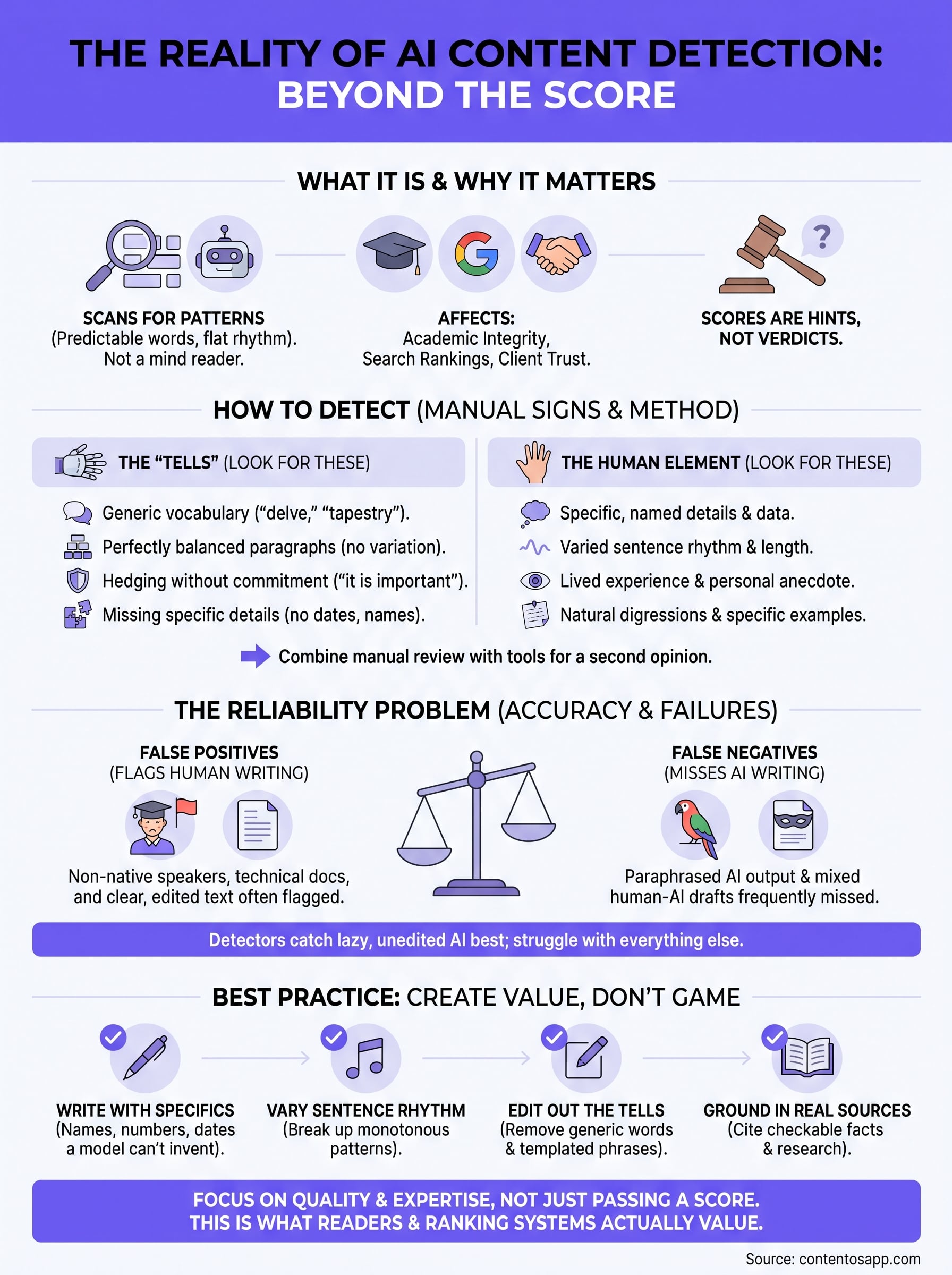
No checker can tell you with certainty who wrote a paragraph, and treating a score as a verdict rather than a hint will burn trust with students, freelancers, and readers alike. AI content detection works best as one signal among several: read for the missing specifics, listen for flat rhythm, then confirm your instinct with a tool rather than the other way around. The bigger lesson from everything above is that chasing a passing score is the wrong goal entirely. Detectors reward writing that sounds like a specific person did the work, and so does Google, and so does anyone actually reading your content.
If you’d rather skip the guessing game altogether, build content that never raises the question in the first place. That’s exactly what Contentosapp Studio does, grounding every article in real cited research and editorial review before a human ever approves it for publishing, and it’s the same research-first system that gets AI content ranking.