

Most people publishing AI content aren’t failing because of the AI. They’re failing because they’re skipping the edit. If you’ve ever stared at a draft and felt something was off — but couldn’t name what to fix — that’s not an intuition problem. That’s a missing framework problem. Knowing how to edit AI content systematically is the skill that separates blogs that rank from blogs that produce polished-looking slop nobody reads twice.
This isn’t a guide about prompts or tools. It’s a sentence-level editing walkthrough: what to cut on sight, how to rewrite the one paragraph that matters most, and what to inject so Google’s quality systems recognize actual human experience in your content. If you’ve already checked whether AI authorship itself is the ranking issue and ruled that out, then the problem is squarely in your editing pass — or the absence of one. That’s what this fixes.
- Delete before you add: The highest-ROI editing move is removing the three sections where AI adds zero value — the scene-setting opener, the filler transitions, and the restatement conclusion. Only then do you add original content.
- Run a slop-pattern scan first: Phrases like “delve into,” “it’s worth noting,” and “in today’s fast-paced world” are sentence-level signals that a draft is unedited. Find them before you touch anything else.
- Rewrite the first three sentences cold: Don’t edit the AI opener — replace it entirely. This single move has more impact on perceived authority and E-E-A-T than any other edit you’ll make.
- Inject real experience, not humanizer output: Google’s quality signals reward original information, sourced claims, and evidence of genuine expertise. AI detector scores are irrelevant to rankings — experience signals are not.
- Use a five-pass sequence: Slop scan, intro replacement, specificity check, experience injection, and a final read-aloud rhythm pass. Run them in order, every time, on every draft.
- Counter-takes matter: One sentence where you genuinely disagree with the consensus — or qualify a popular claim — signals more editorial authority than five paragraphs of well-phrased agreement.
The AI Patterns That Need to Go First
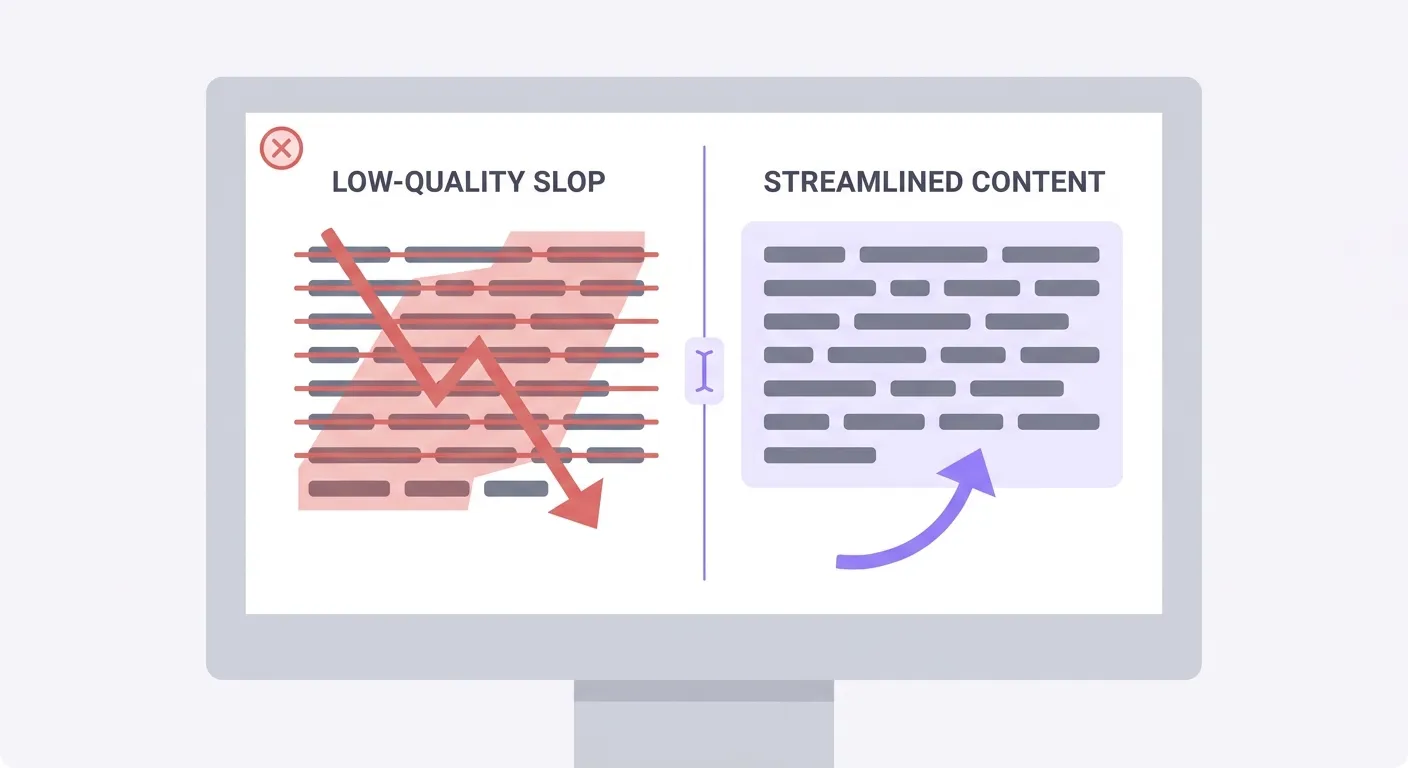
Before you rewrite a single sentence, run a slop-pattern scan. This is a targeted read — not an edit — where your only job is to flag sentences that could have been written about any topic, by any AI, in any context. Those sentences have one thing in common: zero specific information. They exist to fill structural space between real claims, and Google’s own helpful content documentation explicitly flags sloppy or hastily produced content as a quality risk that affects how pages are assessed. That’s not a vague warning. It maps directly onto the hollow filler an AI inserts by default every time it transitions between sections or sets up a topic.
Here are the exact patterns to cut on sight:
| AI Slop Phrase | Why It’s a Problem | Cut or Rewrite? |
|---|---|---|
| “Delve into” | Overused AI marker; signals templated writing | Rewrite: “break down,” “walk through,” “examine” |
| “It’s worth noting that” | Filler with zero informational value | Cut entirely; state the point directly |
| “In today’s fast-paced world” | Generic scene-setter with no specifics | Cut; open with the reader’s actual problem |
| “Certainly” / “Absolutely” | Sycophantic tone leaking from chat sessions | Cut; no replacement needed |
| “Comprehensive guide” | Vague superlative that says nothing | Rewrite with what the content specifically covers |
| “As an AI language model” | Still surfaces in some outputs; destroys credibility | Cut the entire sentence; rewrite from scratch |
This isn’t about style preferences. Google’s spam policies draw a clear line around content generated primarily to manipulate rankings, and even content that doesn’t cross that threshold gets quietly deprioritized when it reads as mass-produced. These phrases are the fingerprint of mass production. Cutting them is the first move — not an optional polish step.
How to Rewrite the Opening So It Doesn’t Lose the Reader in Three Seconds
Here’s a claim most editing guides won’t make this directly: rewriting just the first three sentences of an AI draft is the single highest-ROI editing move available to you. Not restructuring the H2s. Not adding more sources. Three sentences. AI drafts almost universally open with a framing generality — something like “Content marketing has evolved dramatically in recent years, and AI tools are changing how writers approach their work.” That sentence signals low authority to a reader in two seconds flat. It also carries essentially no E-E-A-T weight, because a person with real experience in a topic doesn’t open by narrating how the field has shifted. They open with the problem they’ve already solved, or the specific thing they noticed that others haven’t said.
The move here is not to edit the AI opener — it’s to delete it and write new first sentences cold. Give yourself ten minutes and don’t look at the original. Write your opening as a direct answer to a skeptical reader’s first question. Start with a concrete number you can verify: “I ran this editing pass on 18 AI drafts last quarter. Every single one had the same three dead paragraphs.” That example contains a claim, a scope, and a specific observation. None of those three things appear in a default AI opener — which is exactly why a rewritten intro outperforms it on every quality dimension that matters. Bounce behavior changes. Perceived authority changes. And the quality signals that Google’s systems extract from early-page content shift in your favor before the reader has scrolled an inch.
What to Add Back After You Cut the Slop
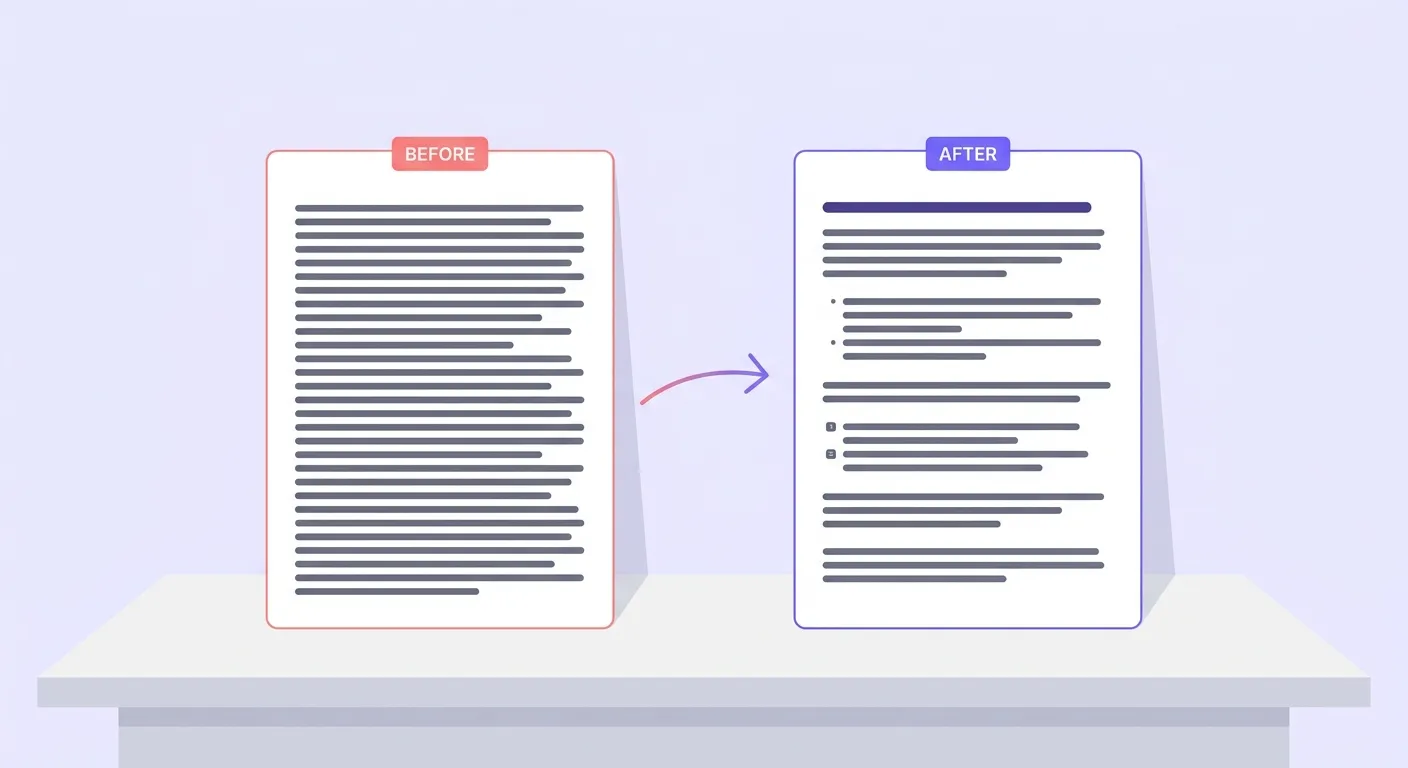
Cutting slop creates blank space. Most editors try to fill it with rewritten AI text — call it lipstick-on-robot syndrome: you run the draft through three humanizer tools, it still reads hollow, and the real problem was never the phrasing. Nothing on the page came from actually doing the thing. The fix isn’t a rewrite — it’s an addition: paragraphs built from real observations, actual usage numbers, and one or two things you noticed that contradicted the AI’s confident summary. Google’s helpful content guidance asks directly: “Does the content provide original information, reporting, research, or analysis?” and “Does the content present information in a way that makes you want to trust it?” Humanizer tools answer neither question. They optimize surface texture, not substance.
There are three categories of additions that actually move the needle. First: first-person specifics with scope — not “this can improve your content” but “I tested this format on 12 posts and all but two saw lower bounce rates within three weeks.” Second: named sources and verifiable numbers — one dateable statistic from an identified source signals more real expertise than five paragraphs of well-phrased generality. Third: a genuine counter-take the AI would never generate — one sentence where you qualify a popular claim, acknowledge a known limitation, or disagree with the consensus position. Google’s ranking systems are explicitly designed to reward content that demonstrates expertise, experience, authoritativeness, and trustworthiness, and AI authorship is not the disqualifying factor. The absence of those signals is. Stop optimizing for detector scores. Start injecting the markers that Google’s systems are actually reading for.
Your Repeatable Editing Pass: A Workflow You Can Run on Every Draft
The three sections above aren’t independent tips — they’re a sequence. Run them out of order and you’re building on an unstable base. Injecting experience before cutting slop means you’re polishing a structurally weak draft. Rewriting the intro before you’ve verified the facts means you might nail the opening of a piece that still contains unverifiable claims. The order is part of the system.
Here’s the full five-pass workflow:
- Slop pattern scan. Read the draft once with the pattern table open. Flag every match. Don’t rewrite yet — just identify.
- Intro replacement. Delete the opening paragraph entirely. Write three new sentences from scratch. Give it ten minutes, then move on.
- Paragraph specificity check. For every paragraph: does it contain at least one specific claim, named example, verifiable number, or personal observation? If not, inject one or cut the paragraph.
- Experience signal injection. Add first-person observations at roughly one per 400 words. They don’t need to be long. One sentence with a named result or a qualifying disagreement is enough.
- Read-aloud rhythm pass. Flat, identical sentence lengths are audible before they’re visible. Read the full draft out loud. Break up the monotony. Vary short sentences with longer ones. This catches everything the eye skims past.
Run this sequence twice and it becomes habit. Run it twenty times and you’ll start catching slop patterns before the AI finishes generating them. If you want to build this editing workflow into a complete content production system — not just a fix for individual drafts — How to Make AI Content Rank: The Exact System That Works in 2026 maps the full operational framework that this pass fits inside.
Frequently Asked Questions
What’s the fastest way to tell if an AI draft needs a full edit or just light cleanup?
Read the first paragraph and the conclusion. If either one is generic, framing-based, or could have been written about a completely different topic with one word swapped, the draft needs a full editing pass — not a cleanup. Full edits are triggered by structural slop: weak intro, filler transitions, restatement conclusion. Light cleanups apply to drafts that already have specific content and solid structure but rough sentence rhythm or a handful of dead phrases. Most AI drafts fall into the first category, not the second.
Do I need to rewrite everything, or are there specific sections where AI output is weakest?
You don’t need to rewrite everything. AI output is consistently weakest in three predictable places: the opening paragraph (almost always a framing generality), transition sentences between sections (almost always filler), and conclusions (almost always a restatement of the intro). Cut those first. The instructional middle sections — where the actual how-to content lives — are often serviceable with targeted edits: one specificity injection per paragraph, one fact check per claim, and a sentence-length variation pass. Start at the edges, not the center.
Will editing AI content make it pass AI detectors — and does that actually matter for rankings?
It might, but it doesn’t matter for rankings. Google’s official guidance is explicit that their focus is on the quality of content, not how content is produced. There is no documented mechanism by which AI detector scores feed into Google’s ranking systems. Spending editing time optimizing for detector outputs is solving the wrong problem. Spend that same time injecting the E-E-A-T signals that Google’s quality systems actually evaluate: original analysis, sourced claims, and evidence of real experience. A piece that reads like it was written by someone who has actually done the thing will consistently outrank a detector-clean piece that says nothing new.
How do I add first-hand experience to content about a topic I haven’t personally tested?
You have more experience than you think. Document the research process itself — what sources conflicted, what surprised you, what the common consensus gets quietly wrong. Even 20 minutes of hands-on testing with a tool or process gives you a genuine “I tried this and found…” sentence that no AI will generate. If you genuinely can’t test the topic, interview someone who has and attribute their specific observation. Or cite a named case study with verifiable outcomes. One honest, specific observation from a limited test outperforms three paragraphs of AI-synthesized generality every single time — because it answers the question Google is asking about your content: does a real person with real experience stand behind this?
The edit is where AI content either becomes something worth reading or stays exactly what it started as — a competent draft that says nothing a hundred other pages don’t say better. The framework here is built to run on every draft you publish, not just the ones that feel obviously broken. Delete first. Rewrite the opening cold. Inject experience where the AI left a vacuum. Run the five passes in order. Do that consistently, and the difference between your AI-assisted content and the AI slop filling the rest of the SERP becomes structural, not accidental — and that’s a gap you can build a real content operation on.
References
External sources
- Creating Helpful, Reliable, People-First Content | Google Search Central | Documentation | Google for Developers — https://developers.google.com/search/docs/fundamentals/creating-helpful-content
- Spam Policies for Google Web Search | Google Search Central | Documentation | Google for Developers — https://developers.google.com/search/docs/essentials/spam-policies
- Google Search’s guidance about AI-generated content | Google Search Central Blog | Google for Developers — https://developers.google.com/search/blog/2023/02/google-search-and-ai-content