

You publish every month, keep the cadence, take care of on-page SEO — and the clicks still drop. Not because your articles got worse. It’s because Google now answers questions before it shows links. That is the reality for WordPress publishers in 2026, and it demands a technical response, not a lament. That response has a name: generative engine optimization.
GEO is not a reinvention of SEO. It is an additional layer that determines whether your content gets cited as a source inside AI-generated answers — in Google’s AI Overviews, in Perplexity, in ChatGPT Search — or sits in the organic rankings below the answer that absorbed the click that used to be yours. The difference between those two positions is measurable. An Ahrefs study of 300,000 keywords found a 34.5% drop in the average CTR of position #1 on queries where an AI Overview is present, comparing March 2024 with March 2025. The pie shrank. GEO is the strategy for being inside the pie that’s left.
This guide delivers the complete playbook: the precise definition of GEO, the real difference between GEO, AEO, and traditional SEO, the content attributes backed by data, the technical setup most publishers still haven’t implemented, and an operational workflow that fits the routine of someone working solo. No agency pitch. No guaranteed-placement promises. Only what you can apply next week.
- What GEO is: the practice of structuring content to be selected and cited by generative models (ChatGPT, Perplexity, Google AI Overviews) when they compose answers — not just ranked in traditional SERPs.
- The critical difference: SEO optimizes for ranking position; AEO optimizes for featured snippets and voice; GEO optimizes for being cited as a source inside AI-generated answers. They are distinct mechanics — confusing them is today’s most expensive mistake.
- The number that matters: AI Overviews correlate with 34.5% less CTR for the #1 organic result. Being inside the Overview is the new being on top.
- The four attributes that increase citability: verifiable sources embedded in the text, clear H2/H3 structure, proprietary or first-hand data, and factual language without excessive hedging.
- Priority technical signal: the
/llms.txtfile lets you flag LLM-friendly content — few publishers have implemented it; it’s the technical edge available right now. - The GEO window is real and finite: the criteria are still accessible, the tools are still forming, and structuring verifiable content today builds citation authority before the market saturates.
What Generative Engine Optimization Is — and Why It Emerged Now
GEO is the practice of optimizing content to appear cited inside answers generated by AI-powered search engines — ChatGPT, Perplexity, Gemini, Google AI Overviews. It is not “SEO for AI” in the generic sense. It is a specific discipline, formalized academically by Princeton researchers in the seminal paper that coined the term and mapped the content attributes that increase the citation rate in generative systems. The fact that academia documented the discipline before the market standardized it is a relevant signal: this is not agency buzzword material.
The context that created the urgency is straightforward. 99.2% of the queries that trigger AI Overviews are informational — the exact niche where editorial and affiliate publishers concentrate most of their organic traffic. When an AI Overview is displayed, it compresses the visual space of the organic links and absorbs the user’s answer intent before the first click. The result: a 34.5% drop in the average CTR of the #1 result on keywords with an AI Overview versus informational keywords without one, comparing March 2024 with March 2025. That number is not a projection — it is aggregated GSC data across 300,000 keywords.
The timeline is short, but the pattern is familiar. Featured snippets appeared in 2014, and it took publishers years to realize that optimizing for them was different from optimizing for position. AI Overviews rolled out in the US in May 2024 — after a 2023 beta as SGE — and are already at global scale. Anyone who learned the snippet lesson knows how this curve works: the first to adapt their content structure harvest disproportionate authority. Everyone else waits and claws back ground later, with far more effort.
GEO, AEO, and SEO: What Each One Actually Optimizes
The confusion between the three terms is not semantic — it has a real operational cost. A publisher applying AEO techniques while thinking they’re doing GEO is spending time on featured-snippet formatting when they should be building verifiable-source density per paragraph. They are different optimizations because the systems evaluating them are different.
| Dimension | Traditional SEO | AEO | GEO |
|---|---|---|---|
| Goal | Position in SERPs | Featured snippets and voice answers | Being cited in AI-generated answers |
| Dominant signal | Backlinks + domain authority | Direct-answer structure (lists, tables) | Source credibility + E-E-A-T + verifiable sources |
| Ideal format | Keyword in title, meta, H1, body | Definition paragraph + list below the H2 | Factual language, embedded sources, self-contained paragraphs |
| Success metric | CTR, average position, impressions | Position Zero appearances | Citations in AI Overviews, Perplexity, ChatGPT |
| Key technique | robots.txt, sitemaps, schema markup | FAQ/HowTo schema, 40–50 word anchor answer | /llms.txt, clean markdown, semantic schema |
| Who decides | Google’s algorithm (PageRank + signals) | Google’s algorithm (featured snippet extraction) | Language model + retrieval system |
The most common mistake: using AEO when the goal is GEO. AEO prioritizes the extraction of a short, formatted answer block — the famous definition paragraph Google captures for Position Zero. GEO demands something different: paragraphs that work as self-sufficient units of verifiable knowledge, each with an identifiable source, extractable by the model without losing context. An article can be excellent for AEO and invisible for GEO if it lacks the credentialing density generative models look for.
The practical distinction: if you’re writing for featured snippets, you concentrate the effort on the answer within the first 100 words after the H2. If you’re writing for GEO, you distribute verifiable sources throughout the entire article, structure each section to be understandable without the rest of the text, and document first-hand experience wherever possible. The two goals aren’t mutually exclusive, but the execution priorities differ.
How Generative Engines Select the Content They Cite
Understanding the selection mechanics changes what you prioritize. Google, Perplexity, and ChatGPT use distinct systems, but they converge on a few fundamentals. Google’s official documentation for AI features is explicit: to appear as a supporting link in AI Overviews or AI Mode, a page needs to meet Google Search’s technical requirements, follow the search policies, and focus on helpful, people-first content best practices — the same fundamentals as traditional SEO, with an additional citability layer.
Beyond that, both AI Overviews and AI Mode can use the “query fan-out” technique: when formulating an answer, the system fires multiple related searches across subtopics and data sources to build the response. This has direct implications for publishers. Articles that cover a topic deeply enough to answer related sub-queries have a better chance of appearing in multiple fan-outs of the same query — not just the main one.
There are two distinct filters that many people collapse into one: being crawled and being cited. An article can be indexed, crawled frequently, and still never appear as a source in an AI Overview. Crawling is the prerequisite; citation is the destination. What determines the passage from one to the other is the combination of precise semantic relevance, source authority as assessed by the model, structural clarity that allows unambiguous extraction, and the presence of verifiable data that increases the model’s confidence in the content’s factuality.
The Content Attributes That Increase Your Citation Rate
The data points to a clear pattern. Content that gets cited in AI Overviews shares the same DNA as content that wins featured snippets — but the decisive difference lies in the density of verifiable sources per paragraph, not just the format. A well-structured article with no traceable external citation is invisible to generative models the same way it was invisible to experienced editors before E-E-A-T. Structure opens the door; sources close the deal.
Four attributes are backed by the data and the technical documentation:
- High-authority source citations embedded in the text. Not in a references section at the end — in the paragraph, where the model can associate the claim with the source while processing the content. Every important factual claim should have an identifiable credibility anchor in the same paragraph.
- Semantic structure with clear H2/H3s and self-contained paragraphs. Each section must make sense in isolation from the rest of the article. Models process limited context windows — a paragraph that depends on context from three sections back to be understood is rarely cited.
- Proprietary or first-hand data. Results from your own tests, original analyses, data collected by the author. This is what no generative model can produce autonomously — which is why models prioritize it as a source.
- Factual language without excessive hedging. “It may be that”, “some experts believe”, “it’s possible that” — phrases like these reduce the model’s confidence in the content’s factuality. State precisely and attribute with a source. If you’re not sure, don’t state it.

The point about proprietary data deserves emphasis. Solo publishers have a structural advantage here that at-scale content agencies can’t easily replicate: documented niche experience, real tests with real results, and analyses based on direct access to the platform the article discusses. Your own data point, even at a smaller scale, carries more weight in an AI Overview than a paraphrase of another article paraphrasing a third.
This guide runs its own advice. Attribute #1 above — sources embedded inside the paragraph — is exactly how this page is written: the 34.5% CTR figure, the Google fan-out detail, and the /llms.txt spec each link to their live source in the same sentence, not a footnote at the bottom. And the whole thing was produced by our 7-agent pipeline, then edited by a human. We’re not describing a method we read about — it’s the one we ship on ourselves.
Technical Signals AI Engines Read Before Citing You
Most GEO guides stop at “cite sources and use clear headers”. That is necessary but incomplete. There is a technical layer the vast majority of solo publishers still haven’t implemented — and it is already functional today.
The /llms.txt file is the most concrete signal in that layer. The proposal, documented at llms-txt.org, was born from a real limitation of language models: context windows are too small to process most websites in full, and converting complex HTML — with navigation, ads, and JavaScript — into LLM-readable text is difficult and imprecise. The proposed solution is direct: a Markdown file at the root domain (yoursite.com/llms.txt) that provides concise, expert-level information in a single place. Complementarily, the proposal suggests that pages with LLM-useful content offer a clean Markdown version at the same URL with .md appended.
The /llms.txt file is not yet a confirmed ranking factor for any generative engine — but it is exactly the kind of preemptive signal that separates publishers who anticipate changes from those who react after the market has commoditized. You can create this file today in 30 minutes, and none of the traditional SEO tools audit or validate it yet. That means whoever implements it now is technically ahead of the audit curve.
Beyond /llms.txt, three other technical signals affect citability: Article, FAQPage, and HowTo schema markup applied correctly (they help the model identify the content type and extract specific sections); clean, conflict-free canonical tags (URL ambiguity reduces the model’s confidence in the canonical source); and server response time — models crawling for indexing are latency-sensitive, especially Perplexity’s and ChatGPT’s crawlers, which operate on shorter time windows than Googlebot.
The Role of E-E-A-T in GEO: First-Hand Experience Is Irreplaceable
E-E-A-T is not an SEO checklist — it is the criterion by which generative models decide whether they trust your content enough to place it in an answer that goes out to millions of users. And the first “E” — Experience — is what differentiates a solo publisher from an at-scale content generator.
Generative models favor content that demonstrates real experience, not just encyclopedic knowledge. An article describing a process the author actually executed, with specific results, documented mistakes, and particular lessons, carries signals that generated or rewritten-from-other-sources content cannot replicate. For a technical deep dive into how these signals work in practice, the guide on E-E-A-T for AI content covers the exact signals Google uses to assess authority in AI-assisted content.
The good news for the solo publisher: adding experience signals to existing posts doesn’t require a full rewrite. In an already-published section, you can insert: the specific result you got with that technique, the exact tool you used at a given step, the mistake you made on the first attempt, or the data from your own Search Console that confirms (or contradicts) what external sources claim. These first-hand paragraphs are the hardest for competing AI to replicate — and the most valued by systems that need to trust the factuality of the content they cite.
How to Adapt Your Content Workflow for GEO
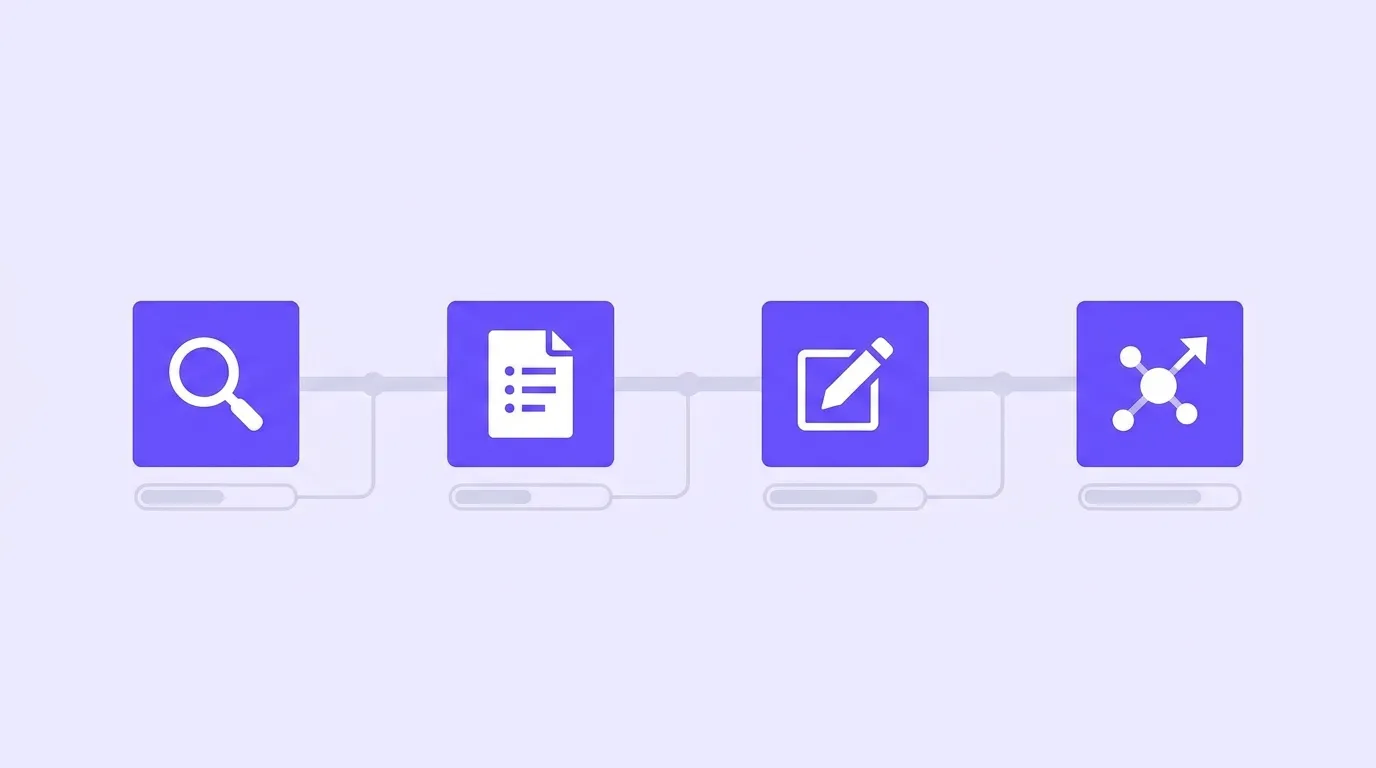
Applying GEO doesn’t require abandoning the workflow you already have. It requires adding three layers to the existing process — one in research, one in structuring, one in post-publication review.
In research: before writing, test the target query in ChatGPT, Perplexity, and Google AI Mode. See which articles are being cited as sources. Analyze what they have in common: structure, source density, use of specific data. This is not for copying — it’s for understanding that query’s citability pattern before you write. If the query already has an AI Overview with fixed sources, your article needs to offer something the current sources don’t have: fresher data, a first-hand perspective, or coverage of an ignored subtopic.
In structuring: write every H2 section as a self-sufficient block. The test question: if someone read only that H2 and its paragraphs, would they understand the point without the rest of the article? If not, the paragraph is still too anchored in prior context. Add the verifiable source in the same sentence as the claim, not at the end of the section. For the complete workflow of producing SEO articles with AI — including intent research and structuring — the guide How to Write SEO Articles With AI covers the process end to end.
In post-publication review: one week after publishing, query Perplexity and ChatGPT with the article’s main query. See whether you appear as a source. If you don’t, check: is the article indexed? Is the schema correct? Are there verifiable external sources embedded in the main paragraphs? This manual review is what substitutes, for now, the GEO tracking tools that are still taking shape.
GEO and AI-Generated Content: What the Data Actually Says
The most common objection from publishers arriving at GEO is blunt: “if I use AI to create content, Google will punish me and I’ll never get cited.” That objection mixes two separate questions that need to be handled separately.
Google doesn’t penalize content for having been generated with AI. It penalizes content that isn’t helpful, lacks E-E-A-T, has no verifiable sources, and was produced to manipulate rankings instead of informing users. That is the distinction that matters — and it is documented. For a detailed, data-backed analysis of what Google actually penalizes, the guide Does Google Penalize AI Content? dismantles the myth with concrete evidence.
The real problem with AI slop in a GEO context isn’t the tool used — it’s the result: content with no identifiable sources, no first-hand experience, no structure that allows reliable semantic extraction. Generative engines that need to cite sources for users have a systemic incentive to avoid content they can’t verify. An AI-generated article with embedded sources, clear structure, verifiable data, and human review that adds real experience passes every filter. A human-written article with none of those characteristics does not.
What to Measure to Know Whether Your GEO Strategy Is Working
GEO tracking is still an immature market. Enterprise tools are emerging, but most are in beta or priced out of reach for solo publishers. What you can do today, at no additional cost:
Manual citation monitoring: once a week, run your five main queries through Perplexity and ChatGPT Search. Note whether your domain appears as a source. It takes 15 minutes and is more reliable than any tool that hasn’t stabilized its methodology yet.
We ran the exact check described above. We asked Perplexity “what is generative engine optimization and how do you get cited by AI?” — and contentosapp.com came back among the cited sources. The method in this guide, working on our own site.
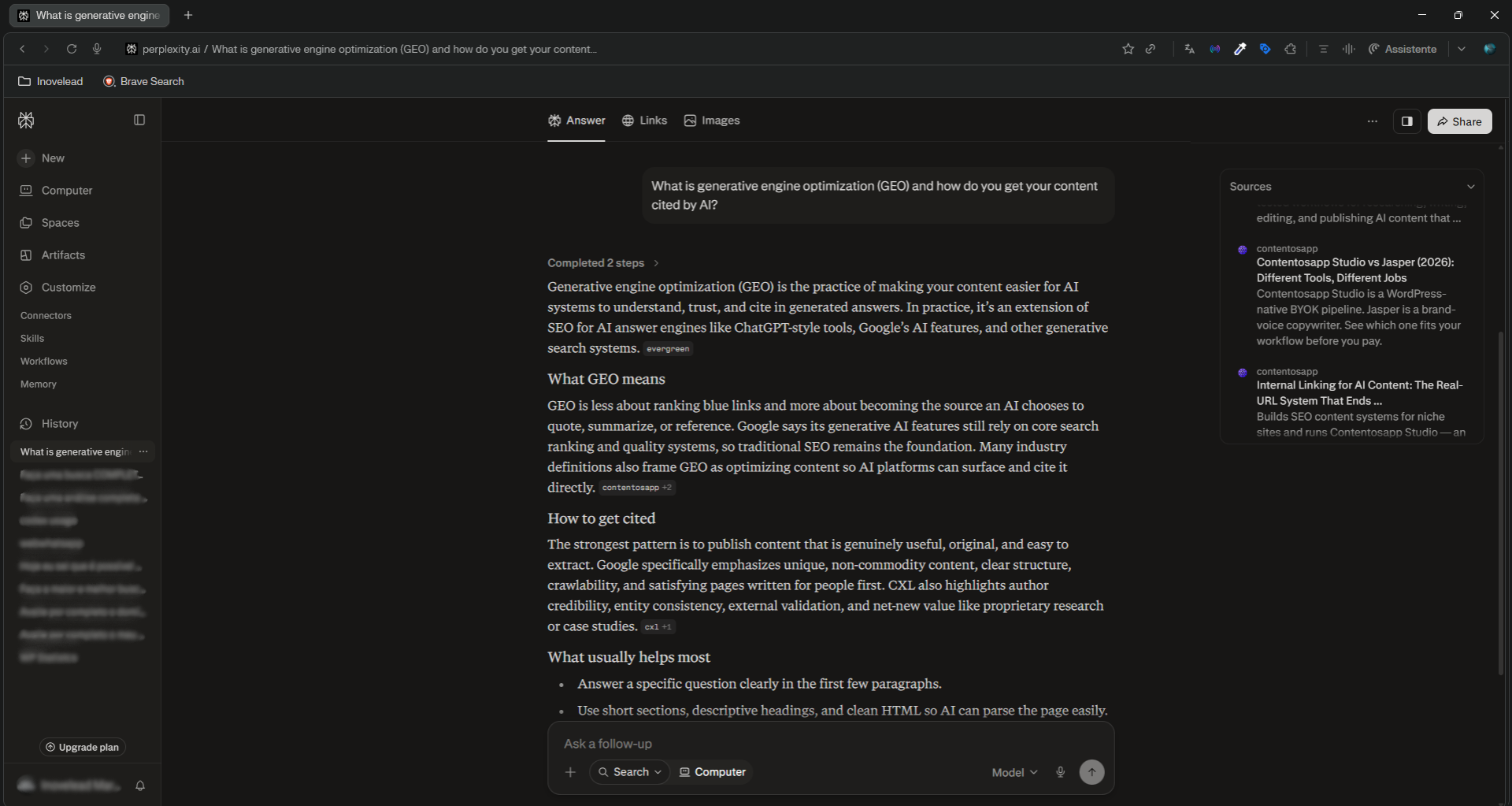 Perplexity’s Sources panel citing contentosapp.com — July 2026.
Search Console as an AI Overviews proxy: when an AI Overview absorbs the click, what you see in Search Console is impressions without clicks — the keyword shows high impressions and very low CTR. A CTR below 0.02 on top informational queries is a sign an AI Overview is present. Use this metric as a priority diagnostic: queries with this pattern are the most urgent candidates for GEO optimization.
Google Alerts for brand mentions: set up alerts for your site’s name and for specific phrases from key articles. When an AI cites your content in a published answer, the chance of someone linking or mentioning it goes up. Alerts capture the indirect trail.
The recommended cadence: manual citation review monthly for priority queries; Search Console analysis weekly to identify queries with the AI Overview pattern; and a quarterly GEO content review for the articles that lost the most clicks in the last 90 days.
Frequently Asked Questions
Is Generative Engine Optimization the same as Answer Engine Optimization?
No — and this confusion costs time and effort for anyone applying the wrong technique. AEO (Answer Engine Optimization) is the practice of formatting content to appear in featured snippets and voice assistant answers: short definition paragraphs, structured lists, FAQ schema. GEO is specifically about being cited as a source inside answers generated by language models — ChatGPT, Perplexity, AI Overviews. An article can be excellent for AEO (appearing in Position Zero) and invisible for GEO (no citations in generated answers) if it lacks embedded verifiable-source density. The mechanics converge on some points — clear structure helps both — but the selection criteria are different.
Can AI-generated content be cited by AI Overviews?
Yes, as long as it meets the quality criteria. What determines citation isn’t the creation tool — it’s the result: verifiable sources embedded in the text, clear semantic structure, first-hand or verifiable data, and factual language. An AI-generated article with those attributes, plus human review that adds real experience, has the same chances as a 100% human-written article of the same quality. What generative engines avoid is AI slop: content without sources, structure, or verifiability — regardless of who or what wrote it.
Do I need to rewrite my old articles to apply GEO?
A full rewrite is rarely necessary. What usually works: adding high-authority source citations to the main claims (directly in the paragraph, not in a references list at the end), inserting one or two first-hand experience paragraphs per section, revising H2s so each section is self-sufficient without external context, and implementing correct schema markup. Start with the three informational articles that lost the most impressions or clicks in the last 6 months in Search Console — they are the candidates with the highest potential return from a GEO revision.
Is the llms.txt file already an official ranking factor?
No — no generative engine has officially confirmed /llms.txt as a ranking or selection factor. It is a technical proposal with growing adoption, documented at llms-txt.org, that solves a real limitation: LLM context windows are insufficient to process entire sites with HTML, navigation, and JavaScript. The file works as an LLM-friendly access guide to your content. Implementing it now is a preemptive bet — the kind of move that generates structural advantage before standardization, not after.
How do I know if my content is being cited by ChatGPT or Perplexity?
The most reliable method is still manual: run your target queries directly on those platforms and check whether your domain appears as a source. Complement that with Google Alerts for your domain name and key phrases from your most important articles. Dedicated GEO tracking tools are emerging, but the market is still immature — most are in beta with unstable methodology. For now, 15 minutes of weekly manual checking on priority queries beats any dashboard that is still being calibrated.
Does GEO work for affiliate niches or only editorial content?
It works for both, with nuances. Informational editorial content is the primary candidate because 99.2% of the queries that trigger AI Overviews are informational — comparisons, guides, definitions. Affiliate articles with a strong informational angle (“best X for Y type of user”, “how to choose X”, “does X work for Z situation”) benefit directly. Purely transactional pages — price, buy button, little context — have less GEO relevance because they aren’t the kind of content generative models cite when answering informational questions.
What’s the difference between optimizing for AI Overviews and for SGE?
SGE (Search Generative Experience) was the name of Google’s pilot project that evolved into what is now called AI Overviews and AI Mode. In practical optimization terms, what you find today are two distinct surfaces: AI Overviews, which appear at the top of the standard SERP on informational queries, and AI Mode, described in Google’s documentation as better suited to complex queries that need exploration, reasoning, or detailed comparisons. Google’s documentation indicates both can use query fan-out and display supporting links — the eligibility criteria are the same, but the models and techniques may vary between the two surfaces.
Conclusion
GEO doesn’t ask you to throw away the SEO that already works. It asks you to add a layer of rigor that traditional SEO never explicitly demanded: verifiable sources inside the text, structure that works as self-sufficient units of knowledge, and documented experience that no model can fabricate. For a solo publisher, that set is feasible and executable — it isn’t an agency budget, it’s editorial discipline. The window is real: the criteria are still accessible, the tools are still forming, and the publisher who structures verifiable content now will harvest citation authority before the market treats it as table stakes. Start with the diagnosis: open Search Console, identify the three informational articles that lost the most clicks in the last six months, and apply what this guide describes. That is GEO with source-backed proof — not theory.
References
External sources
- AI Overviews Reduce Clicks by 34.5% — https://ahrefs.com/blog/ai-overviews-reduce-clicks/
- AI Features and Your Website | Google Search Central — https://developers.google.com/search/docs/appearance/ai-features
- The /llms.txt file — llms-txt — https://llmstxt.org/