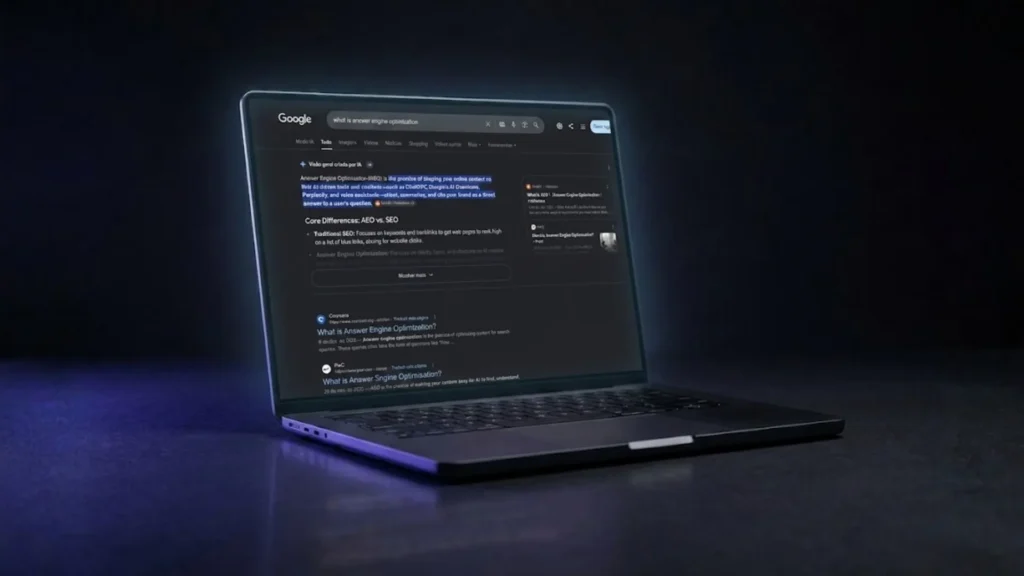
Here’s the reality most SEOs haven’t fully internalized yet: your content can rank #1 on Google and still be completely invisible to the user who asked a question directly above your result. That user got their answer from an AI Overview. They never scrolled down. They never clicked. Answer engine optimization — AEO — is the discipline that determines whether your content gets cited inside that answer, or whether a competitor’s does. Getting that distinction wrong is increasingly expensive.
This isn’t a conceptual primer on why AI search matters. You already know it matters. According to the 2026 Conductor Benchmarks Report, AI has created a “parallel surface of visibility” that determines which brands appear inside AI answers before a user ever clicks — meaning brand discovery now precedes the website visit entirely. If your content isn’t structured to be extracted, cited, and surfaced by answer engines, you’re absent from that layer regardless of your organic rankings. This playbook gives you the complete implementation framework to change that — from content architecture to measurement — in a sequence you can execute this week.
- What AEO is: The practice of structuring content so AI-powered answer engines — Google AI Overviews, Perplexity, ChatGPT, Gemini — extract and cite it when forming responses to user queries.
- Why it’s urgent: AI has created a parallel visibility surface where brand discovery happens before any click occurs. If you’re not cited, you’re absent from the modern customer journey.
- AEO vs. GEO vs. SEO: These are distinct but complementary disciplines — SEO earns rankings, AEO wins answer-layer citations, GEO targets pure LLM outputs. Each requires a different content format.
- The biggest structural mistake: Publishing schema on content with vague claim boundaries. Schema on a poorly scoped passage doesn’t help — the extraction algorithm can’t isolate a clean answer.
- Measurement without rankings: Zero-click impression share in GSC, manual citation testing in Perplexity, and brand mention monitoring are your primary AEO performance proxies.
- Traffic from ChatGPT-style AI experiences converts at rates [up to 9× higher](https://www.forbes.com/sites/lutzfinger/2025/06/19/answer-engine-optimization-aeo–what-brands-need-to-know/) than traditional search — making AEO a revenue argument, not just a visibility one.
What Answer Engine Optimization Actually Is (and Isn’t)
Answer engine optimization is the practice of structuring content so that AI-powered systems — Google AI Overviews, Perplexity, ChatGPT with web browsing, Gemini — can extract, reproduce, and cite it when answering a user query. That’s the core definition. But the second half of that definition matters just as much: AEO is not a replacement for SEO. A page that can’t be indexed can’t be cited. Crawlability and authority are prerequisites, not alternatives.
The distinction that separates AEO from traditional SEO is the success metric. Traditional SEO optimizes for a ranking position and the click that follows. AEO optimizes for citation — for the AI to pull your sentence, your statistic, your explanation into the answer it constructs. These are related objectives, but the content decisions they produce are different. A high-ranking page can be dense, long, and navigational. A citable passage must be bounded, direct, and self-contained. Those formats don’t always coexist naturally.
What AEO is not: a magic schema layer you add to existing content, a replacement for E-E-A-T signals, or a tactic limited to definition-type queries. Any content format — guides, case studies, how-tos, comparison pages — can be AEO-ready if it’s structured correctly at the passage level. The practice scales across content types. What it doesn’t do is substitute for the foundational SEO work that puts your pages in a position to be considered in the first place.
How Answer Engines Decide What Gets Cited
The selection logic isn’t arbitrary. Google’s AI features use what Google Search Central officially documents as a “query fan-out” technique — both AI Overviews and AI Mode may issue multiple related searches across subtopics and data sources when constructing a response. This has a structural implication most AEO guides completely miss: a single article optimized only at its primary keyword may be invisible to the AI even if it ranks well, because the AI is simultaneously running 5 to 12 sub-searches. Content must provide complete, self-contained answers to every logical sub-question a human could ask — within the document or a tightly linked cluster.
Three filtering layers determine whether your content gets surfaced, and most practitioners treat them in the wrong order. First, technical eligibility: the page must meet Google’s indexability and policy requirements — the same foundational requirements as classic Search, no separate AEO-specific opt-in exists. Second, passage-level legibility: does this specific block of text answer a bounded question without ambiguity? A paragraph that hedges every claim or buries the answer in qualifications fails this test even if the page overall is excellent. Third, domain authority: does the surrounding site carry enough trust that an AI system can reference it without a human editor in the loop?
AI Overviews are also selectively triggered. According to Google’s own documentation, AI Overviews only appear “when systems determine it is additive to classic Search” — they often don’t trigger at all. This means AEO effort is best concentrated on queries where AI answers are consistently shown: complex questions, comparison queries, multi-step how-tos, and definition-anchored informational searches. Chasing AEO for transactional queries where AI Overviews rarely appear is a low-return use of optimization time.
AEO, GEO, and SEO: How to Know Which One You Actually Need
These three disciplines are not synonyms. Conflating them leads to wasted effort — specifically, applying GEO tactics where AEO tactics belong, or trying to run both without a clear decision rule. Here’s how the split actually works.
Traditional SEO captures demand that exists in the SERP — users who click a result. AEO captures demand that resolves in the answer layer — users who get their answer inline and may not click at all. GEO targets AI systems that generate longer-form, synthesized responses in environments like ChatGPT, Claude, and Gemini, where the user never entered a traditional search engine. The case study evidence from 2026 confirms this: AEO focuses on answer engines like Google AI Overviews and Perplexity; GEO focuses on generative AI outputs from pure LLM environments. Complementary frameworks, not interchangeable ones. For a full breakdown of the GEO side, the complete guide to generative engine optimization goes deeper on LLM-specific strategies.
The decision matrix looks like this. Choose AEO as your primary track when your content targets definition queries, how-to questions, or comparison searches where AI Overviews consistently appear. Choose GEO when your goal is brand presence inside ChatGPT or Claude responses — environments where users are asking conversational, research-oriented questions without a classic search entry point. Choose SEO as your foundation always — it feeds both. The original claim this article is making, and it’s one you won’t find in most AEO roundups: running AEO and GEO as parallel tracks with shared authority signals but distinct content formatting consistently outperforms treating them as a single discipline. AEO-formatted content (bounded Q&A passages, FAQPage schema) performs poorly in pure LLM environments that reward narrative authority and entity depth. Format for the surface you’re targeting.
| Dimension | Traditional SEO | AEO | GEO |
|---|---|---|---|
| Primary target | Google SERP rankings | AI Overviews, Perplexity, featured snippets | ChatGPT, Claude, Gemini, Copilot, Grok |
| Success metric | Rankings, organic clicks | Citation frequency in AI answers | Brand mentions in LLM-generated outputs |
| Content format | Keyword-matched pages | Structured Q&A, schema-rich, concise answers | Authoritative, entity-rich, source-cited content |
| Click intent | User clicks to explore | Often zero-click (answer delivered inline) | Zero-click by default |
| Attribution tooling | Google Search Console | GA4 AI search tracking (partial) | No native publisher dashboard (2026) |
| Maturity | Decades of documentation | Emerged 2024–2025 | Frameworks forming now |
The Content Architecture That Makes Answer Engines Pick You
Schema is necessary. It is not sufficient. This is the mistake that wastes the most time in AEO implementations. Practitioners add FAQPage markup to existing content and wonder why citations don’t improve. The problem isn’t the schema — it’s the underlying passage structure the schema is wrapping. An extraction algorithm can’t isolate a clean answer from a vague one, no matter how well-marked-up the surrounding HTML is.
A citable passage has three components, in this order. First: a direct answer to a bounded question, in the opening sentence, with no lead-in padding (“Great question — this is complex, but…”). Second: a support layer — a fact, a data point, a concrete example — within two sentences of the claim. Third: a boundary condition. The passage signals where its answer stops, either by naming a caveat, a condition, or a scope qualifier. Without that third component, the AI extraction engine can’t determine where your answer ends and the next topic begins. The result: your passage gets skipped in favor of one that is more clearly scoped. This is the structural failure point most AEO guides don’t name — the biggest obstacle to citation is not missing schema, it is vague claim boundaries. A passage that says “it depends” without a conditional frame is functionally invisible to extraction.
This architecture is documented in more detail in the passage-level method for optimizing content for AI Overviews — a worthwhile read for implementing this at scale. The short version for implementation: write each H3-level block as if it were a standalone answer to a question a user might type directly into Perplexity. If you removed every other part of the article, would that block answer its question completely? If yes, it’s extraction-ready. If not, it isn’t.
Schema Markup for AEO: What Moves the Needle and What Doesn’t
Not all schema has equal AEO impact in 2026. The market has overcorrected on FAQPage and QAPage schema — both are overused to the point of diminishing returns and Google has reduced their visible footprint in standard SERPs. That doesn’t mean they’re worthless; it means they’re no longer the primary lever.
The underused schema types with actual AEO lift are Article, HowTo, and Speakable. Article schema with proper dateModified and named author entity signals freshness and authorship credibility — two machine-legible proxies that answer engines read directly. HowTo schema structures sequential content in a format that maps cleanly to how AI Overviews surface step-by-step answers. SpeakableSpecification — implemented via the speakable property inside Article schema — explicitly signals which passages are answer-ready. It’s underimplemented on most platforms, which means it currently carries a differentiation signal. The llms.txt implementation guide for WordPress covers the technical setup side where schema intersects with AI crawler accessibility — useful if you’re managing WordPress sites without developer resources.
For sites without developer access, the minimum viable AEO schema stack is this: Article schema on all pillar and satellite content, with author linking to an indexed author page, datePublished and dateModified populated, and FAQPage added to any content that includes an explicit Q&A block. More schema isn’t better when the underlying content isn’t extraction-ready — redundant or conflicting schema creates parsing ambiguity. Fix the passages first, then layer the markup.
Building E-E-A-T Signals That Answer Engines Trust
Answer engines don’t evaluate E-E-A-T the way a human quality rater does. They read machine-legible proxies. Named authorship connected to an indexed author page with biographical content and external citations is read differently than a byline with no linked entity. A page cited by authoritative external domains carries a trust signal that schema alone can’t replicate. These aren’t new SEO concepts, but their weight in the AEO context is different — they’re not just ranking signals, they’re citation eligibility signals.
The distinction worth drawing clearly: some E-E-A-T signals help SEO and therefore indirectly help AEO (domain authority from backlinks, topical depth across a cluster). Others are read directly by AI extraction systems: author structured data with a linked entity, publisher organization schema with a verified logo, publication and update timestamps in structured metadata. The full breakdown of E-E-A-T signals for AI content goes deep on which signals map to which evaluation layer — that guide is worth reading in parallel with this one.
The 2026 Conductor Benchmarks Report frames the stakes plainly: brands that are not cited, mentioned, or referenced inside AI answers are “effectively absent from the modern customer journey” even when they rank in organic search. That’s the brand-awareness dimension of AEO that pure SEO thinking misses. E-E-A-T signals — particularly external citations and entity associations — are the mechanism that gets your brand into AI answers at the brand mention level, not just the page citation level. Build them accordingly.
How to Measure AEO When There Are No Rankings to Track
There is no AEO position 1. There is no canonical measurement dashboard. As documented in the 2026 case study analysis, AI platforms don’t provide publisher dashboards equivalent to Google Search Console, and connecting AI citations to revenue requires more sophisticated tracking than traditional SEO. That’s the honest state of AEO measurement — and it’s also the biggest gap in existing AEO guides. Most stop at “track your brand mentions.” That’s not a measurement system; it’s a starting point.
Here’s a working measurement stack deployable without enterprise tooling. First layer: Google Search Console zero-click impression share. Rising impressions with flat or declining clicks on informational queries is a strong proxy signal that the AI answer layer is capturing intent above your result. This is currently the most underused AEO performance proxy available to practitioners — it requires no new tools, just a filter on existing GSC data. Calculate it monthly: impressions ÷ clicks for your top informational queries. A widening ratio signals answer layer capture. Second layer: manual citation testing. Build a list of 10 to 15 target queries — questions your content is designed to answer — and test them weekly in both Google AI Overviews and Perplexity. Log whether your domain is cited, what passage is used, and which competitor appears when you don’t. This takes 30 minutes a week and produces the most actionable signal you have. Third layer: brand mention monitoring via tools like Brand24 or Mention, configured to catch references in AI-generated content and syndicated summaries.
The measurement stack doesn’t need to be expensive to be useful. A shared Google Sheet, a weekly 30-minute citation audit, and a GSC filter set up correctly will tell you more about your AEO performance than most teams currently track. The gap between what’s measurable and what’s being measured is genuinely wide in 2026 — which means systematic practitioners have a real information advantage right now.
AEO Implementation: A Step-by-Step Workflow
Everything above is only useful if it translates into a repeatable process. This section is that process — not a summary of principles, but a sequenced protocol you can run on new or existing content.
The AEO Protocol — Run in Order
On timeline: the 2026 AEO case study documentation is candid that AEO is a newer discipline with less established benchmarks than SEO — realistic citation lift typically appears 6 to 12 weeks after structured implementation, depending on domain authority and crawl frequency. Don’t optimize for a single pass. AEO is a content maintenance protocol, not a one-time rewrite.
Common AEO Mistakes That Kill Your Citation Rate
The workflow above is designed to avoid all of these by default. But knowing what the failure modes look like helps you diagnose existing content that isn’t performing.
Publishing AEO content on low-authority domains. Answer engines rely on authority signals as a trust proxy. A perfectly structured passage on a domain with minimal backlinks and no established entity recognition will lose to a mediocre passage on an authoritative domain. AEO amplifies authority; it doesn’t replace it. If your domain authority is low, link acquisition and entity building have to run in parallel with content optimization — not after.
Using schema without fixing the underlying passage structure. This is the most common mistake. FAQPage markup on a block of content that doesn’t actually answer a bounded question signals nothing useful to the extraction algorithm. The AI reads the passage, not just the schema wrapper. Fix the content architecture first. Always.
Treating AEO as a one-time rewrite. Freshness signals matter. A dateModified timestamp with actual content changes signals that the information is current — AI systems factor this into citation selection for time-sensitive queries. Set a quarterly review cadence for your highest-priority AEO content. And remember: the 2026 Benchmarks Report establishes that AI visibility is now a “critical new currency” for digital success — that currency depreciates if you stop maintaining the content backing it.
Ignoring internal linking as an AEO amplifier. Answer engines use internal link structure to assess topical authority. A single well-optimized page linked from no other content on your site signals weak topical coverage. Build cluster depth — supporting pages that interlink with the pillar — and you give the AI system more signal that your domain owns the topic, not just the single URL.
Frequently Asked Questions
What is answer engine optimization?
Answer engine optimization (AEO) is the practice of structuring content so that AI-powered answer engines — including Google AI Overviews, Perplexity, ChatGPT with web browsing, and Gemini — extract, cite, and reproduce it when answering user queries. The goal is not a ranking position but a citation: having your content be the source the AI pulls from when constructing its response. It builds on traditional SEO as a prerequisite but targets a different success metric.
How is AEO different from traditional SEO?
Traditional SEO optimizes for ranking positions and the click that follows. AEO optimizes for citation within AI-generated answers, many of which deliver a complete response without requiring the user to click at all. The content formats that perform well differ: SEO rewards comprehensive, navigational pages; AEO rewards bounded, extraction-ready passages. Both disciplines share the same technical foundation — crawlability, authority, indexability — but the content decisions they drive are distinct.
Is answer engine optimization the same as GEO?
No. AEO targets answer engines that operate alongside traditional search — Google AI Overviews, Perplexity, featured snippets. GEO (Generative Engine Optimization) targets pure LLM environments like ChatGPT, Claude, Copilot, and Grok, where users never enter a classic search engine. The 2026 case study data confirms these are complementary but non-interchangeable frameworks. AEO-formatted content (structured Q&A, FAQPage schema) often underperforms in pure LLM environments that reward narrative authority and entity density — which is why running them as parallel tracks with distinct formatting is more effective than treating them as one strategy.
What types of content get cited most often by AI answer engines?
Content that answers a bounded, specific question in the first sentence of a passage — supported by evidence within two sentences and scoped with a clear boundary condition — gets cited most reliably. Structurally: Q&A blocks, step-by-step how-tos with numbered structure, definition passages, and comparison tables. Queries where AI Overviews consistently trigger are complex informational questions, multi-step processes, and terminology definitions. Transactional or navigational queries rarely produce AEO citation opportunities.
How long does it take to see results from AEO?
Based on documented AEO case studies from 2026, measurable citation lift typically appears 6 to 12 weeks after structured implementation. This assumes the domain already meets a baseline authority threshold and that the content rewrite addresses passage structure, not just schema. AEO is not a one-time intervention — it’s a content maintenance protocol. Sites that treat it as a single rewrite project see slower and less durable results than those that build it into a quarterly content review cycle.
Do small or new websites have a realistic chance of winning AI citations?
Yes, with caveats. Authority is a prerequisite — AI systems use domain credibility as a trust proxy, so very low-authority sites face a structural disadvantage regardless of content quality. But authority is not the only variable. A smaller, highly topically focused site with clean passage architecture, external citations from relevant domains, and consistent named authorship can outperform a large generalist domain on specific bounded queries. The gap between large and small sites is narrower in AEO than in traditional SEO for niche informational queries — which is the opportunity for focused practitioners.
What schema markup is most important for AEO in 2026?
The minimum viable AEO schema stack is Article schema — with named author entity, datePublished, dateModified, and publisher organization data — combined with FAQPage on explicit Q&A blocks. HowTo schema adds meaningful lift on step-by-step content. SpeakableSpecification inside Article schema is underimplemented across most platforms and currently carries a differentiation signal. FAQPage and QAPage schema alone have declining marginal impact from overuse. Schema layered on top of extraction-ready content accelerates citation; schema layered on vague passages does nothing.
Conclusion
AEO is not a trend to monitor — it’s a structural shift in how brand visibility works. The 2026 Conductor data puts it plainly: AI isn’t replacing search, it’s replacing your website as the first place customers engage with your brand. Rank #1 and get cited by nobody, and you’re functionally invisible to the users who resolved their intent in the answer layer above your result. The framework in this article — passage architecture, selective schema, parallel AEO and GEO tracks, and a systematic measurement stack built around zero-click impression share — gives you a concrete starting point. But the most important shift is in how you think about content success. Citation rate is the leading indicator. Organic rank is no longer the whole story. So: which of your top-performing pages is currently getting extracted by AI Overviews, and which ones are being passed over — and do you know why?
References
External sources
- The 2026 AEO / GEO Benchmarks Report — https://www.conductor.com/academy/aeo-geo-benchmarks-report/
- Answer Engine Optimization — What Brands Need To Know — https://www.forbes.com/sites/lutzfinger/2025/06/19/answer-engine-optimization-aeo–what-brands-need-to-know/
- AI Features and Your Website | Google Search Central | Documentation | Google for Developers — https://developers.google.com/search/docs/appearance/ai-features
- AEO & GEO Case Studies: Real Answer Engine Optimization Results, ROI & Proven Strategies (2026) — https://www.stackmatix.com/blog/aeo-case-studies
Related content
- Generative Engine Optimization (GEO): The Complete Guide to Getting Cited by AI in 2026 — Contentosapp
- How to Optimize Content for AI Overviews: The Passage-Level Method — Contentosapp
- llms.txt for WordPress: What It Is, What It Can’t Do, and How to Add It in 10 Minutes — Contentosapp
- E-E-A-T for AI Content: The Exact Signals That Make Google Take You Seriously — Contentosapp