
An AI SEO agent is software that plans and runs a multi-step SEO task with tools and live data, choosing its own next step, while a human approves what matters. A chatbot answering one prompt doesn’t qualify. Neither does a scheduled report with an “AI” badge on it. This guide also includes first-party cost and time data from a seven-agent content pipeline, logged across 24 real productions.
You’ve probably noticed the problem already. Vendors label chatbots, fixed automations and dashboards as “agents,” so you can’t compare tools on equal terms. A feature that rewrites a title tag after you click a button sits in the same category as software that scans a whole site, decides what’s broken and ships fixes to production. Those are very different risk profiles.
One enterprise-wide forecast shows why the label is spreading. Gartner predicted in August 2025 that 40 percent of enterprise applications will include task-specific AI agents by the end of 2026, up from less than 5 percent in 2025. That is a forecast for enterprise software in general, not for SEO tools, but it explains why every vendor wants the word on the homepage.
So here is what the guide answers. What can an agent do alone? What does it cost per task? Where does a human approve? Does Google penalize agent-produced content? And should you build or buy? Every number is dated as of October 2026, and every vendor claim is labeled as a vendor claim.
What an AI SEO agent is, and what it isn’t
An AI SEO agent runs a multi-step SEO job, uses tools and live data, and decides its own next step. A chatbot answering one prompt, or a fixed automation that always runs the same sequence, is not that.
The cleanest definition comes from Anthropic’s engineering team. In its guide to building agents, workflows are “systems where LLMs and tools are orchestrated through predefined code paths”, while agents are “systems where LLMs dynamically direct their own processes and tool usage, maintaining control over how they accomplish tasks.” Anthropic calls both “agentic systems,” and draws the architectural line between them. That line is the most useful one you have when a vendor says “agent.”
Apply a three-question test to any product:
- Does it use tools or live data (Search Console, a crawler, an SEO data API), or only the text you typed?
- Does it choose its next step, or follow a fixed script?
- Does a human approve what matters before it takes effect?
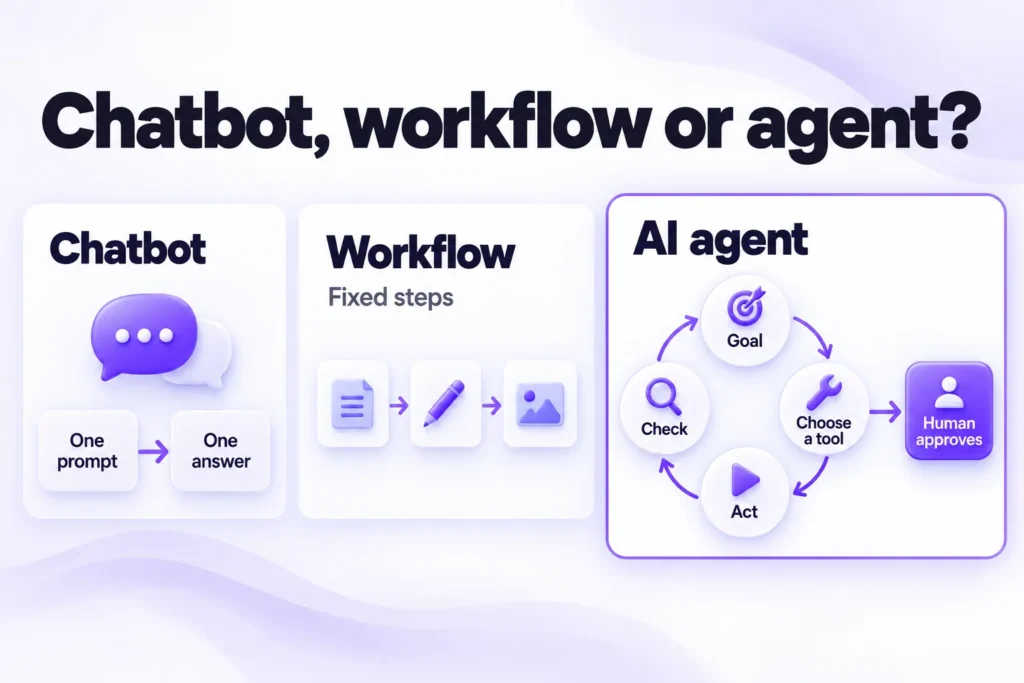
Most products sold as agents fail the second question. By Anthropic’s definition they’re workflows, and that’s often fine. Predictable steps are what you want for a lot of SEO work. The same guide warns that agentic systems often trade latency and cost for better task performance, and recommends finding the simplest solution possible and adding complexity only when needed. It also points to compounding errors as a risk of autonomy, which is why it advises testing in sandboxed environments with guardrails.
One caveat on that source. The Anthropic page was published December 19, 2024, and it notes that much of the tooling it describes has changed since. Treat it as a source for concepts, not for current products. If you want the distinction between agents that operate a site and pipelines that create articles, agentic AI for WordPress covers it in detail.
The jobs AI SEO agents do today
AI agents for SEO cluster into four jobs: technical fixes on a live site, research and data, content, and build-your-own. What differs most between them is what each can change without your approval. This is an editorial map, not a ranking.
The approval column below is my own analysis of how each category works, not a vendor statement. The example facts come from vendor pages and a public repository, all checked October 6, 2026.
| Job | Example | What it can change | Where approval sits |
|---|---|---|---|
| Technical and on-page fixes | OTTO SEO (Search Atlas), vendor claims | Titles, schema, canonicals, links, headings, meta tags, alt text on the live site | Per-change review if approval mode is on. Check the default. |
| Research and data | SE Ranking Claude SEO Skills | Nothing on the site. Produces briefs, audits, analyses | You decide what to act on |
| Content | Seven-agent pipelines (category) | Creates or updates articles | At Draft stage, before publish |
| Build-your-own | n8n | Whatever you wire up | You design the gate |
Start with the deployers. According to the OTTO SEO product page, the tool scans a site and deploys fixes for titles, schema, canonical URLs, broken and redirect links, headings, meta tags, alt text and internal links. The vendor says changes go live through a Cloudflare Worker or are written into a CMS, and that changed URLs are submitted for indexing through Google Search Console.
Here’s the detail that matters for you: the page describes the tool as running on autopilot, and approval mode is a toggle you switch on to review each change. No pricing appears on the page, and I have no independent test of it. The page’s “99% reduction in manual SEO tasks” and “30K+ websites optimized” are the vendor’s own figures.
Research and data agents sit at the other end of the risk scale. SE Ranking’s open-source repository describes production-ready Claude Agent Skills powered by the SE Ranking MCP server. Each skill turns API data into a deliverable such as a content brief, an AI search share-of-voice report, structured data or a competitive analysis. The pattern is reusable skills plus an MCP data source, and nothing gets pushed to your site. For a step-by-step audit and a security check for third-party skills, see our Claude SEO guide. If you want to see how Claude skills and MCP connect to WordPress, Claude for WordPress walks through the options.
Content agents brief, research, draft and review articles. The next two sections work through one in detail. The fourth category is the DIY route. n8n’s AI agents page claims 500+ integrations, support for code, human-in-the-loop guardrails and the ability to add predefined logic. You assemble the agent yourself. For tool-by-job coverage beyond these examples, see best AI SEO tools.
One agent or a pipeline of specialists
Narrow agents with explicit handoffs are easier to test, fix and price than one long prompt. A reviewer step catches errors before a human sees them. That is my operating view, and the evidence for it in this article is our own pipeline, not a controlled comparison.
Anthropic describes two patterns that map onto content work. Prompt chaining splits a task into a sequence of steps, each feeding the next. Evaluator-optimizer is the review loop: one LLM call generates a response while another provides evaluation and feedback in a loop. A drafting agent plus a reviewing agent is exactly that.
Here is the angle I’d push on. A single long prompt hides where your cost and your errors come from. When one prompt researches, plans, writes and checks, a bad result could be a research failure, a planning failure or a writing failure, and you can’t tell which. A pipeline puts a line on every step, which is what makes the cost table in the next section possible. You can’t price an agent you can’t separate.
There’s an honest caveat. A fixed sequence of specialists is, by Anthropic’s own definition, closer to a workflow than a free-roaming agent. For content work I think that’s a feature, because predictable steps beat open-ended autonomy when the output goes under your name. Still, the claim that a pipeline beats one prompt in quality is something I’m stating from experience, and our log doesn’t prove it. For a side-by-side look at the trade-off, see ChatGPT vs an AI content pipeline for SEO.
Inside a seven-agent content pipeline: what each agent does, costs and takes
The seven-agent Contentosapp Studio pipeline averaged about $0.49 in model cost and about 15.4 minutes of model time per article across 24 logged productions on Claude Sonnet 5.5. The Writer is the largest line.
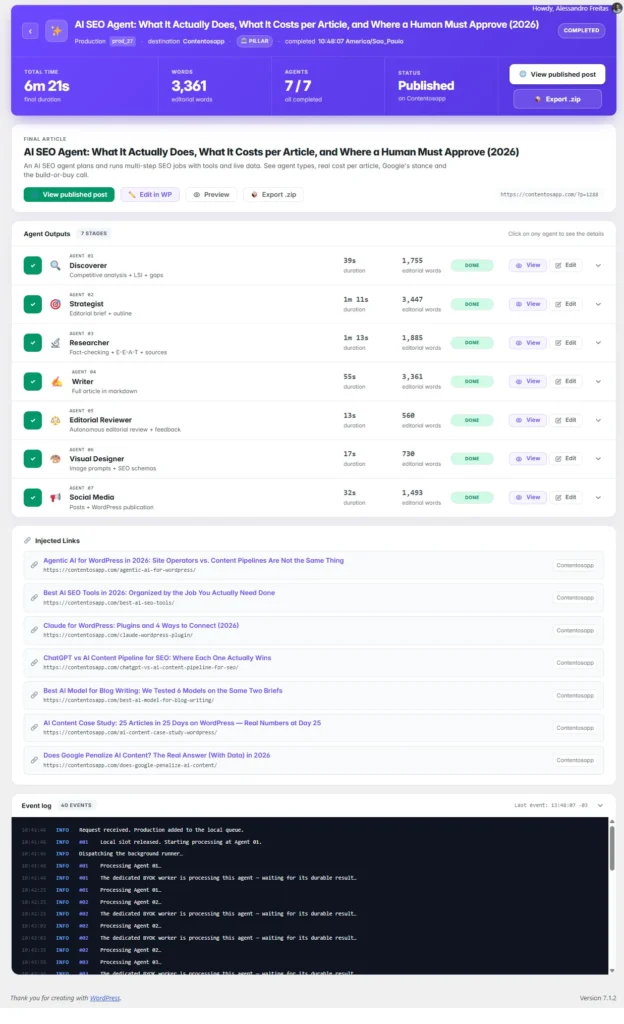
First, what each agent hands to the next. The roles below follow the WordPress.org listing for Contentosapp Studio, which is our own product:
- Discoverer: related queries, entities, intent, information gaps and questions.
- Strategist: the editorial brief, with structure and keyword map.
- Researcher: sources, statistics and facts to ground the draft.
- Writer: the draft, in the configured language and brand voice.
- Editorial Reviewer: checks the draft for quality, structure and factual consistency.
- Visual Designer: image prompts and Schema.org markup.
- Social Media: social copy for distribution.
Here are the averages per article. Source: Contentosapp Studio usage log on contentosapp.com, pulled October 6, 2026. 24 productions (23 for Social Media).
| Agent | Input tokens | Output tokens | Cost (list price) | Model time |
|---|---|---|---|---|
| Discoverer | 722 | 3,327 | $0.035 | 76 s |
| Strategist | 3,118 | 5,332 | $0.060 | 117 s |
| Researcher | 4,428 | 5,360 | $0.062 | 125 s |
| Writer | 23,343 | 11,901 | $0.166 | 287 s |
| Editorial Reviewer | 10,428 | 4,889 | $0.070 | 138 s |
| Visual Designer | 2,823 | 4,497 | $0.051 | 84 s |
| Social Media | 1,390 | 4,004 | $0.043 | 96 s |
| Total (sum of averages) | about 46,250 | about 39,300 | about $0.49 | about 15.4 min |
Read the methodology before you quote any of this. Contentosapp Studio is made by the publisher of this site, and the data comes from our own usage log. Token counts are what the AI provider reported to the plugin for the models selected in those productions. All 24 productions ran on Claude Sonnet 5.5, and the cost column applies Anthropic’s list price for that model, $2 per million input tokens and $10 per million output tokens (checked October 6, 2026), to those tokens. It’s a list-price calculation, not an invoice, and prompt caching or batch discounts would lower it.
Time is model processing time, not human editing, and output tokens include reasoning tokens when a model uses them. The limits are real: one publisher, our own models and settings, no outside replication and no quality scoring. This isn’t a “best” claim. Your real cost depends mainly on the model you choose and the article length, and our six-model test shows model-by-model costs.
Where the cost goes, per article
Average of 24 productions (23 for Social Media) on Claude Sonnet 5.5 at list price, Contentosapp Studio usage log, pulled October 6, 2026.
Three readings stand out. The Writer is about 34% of cost and about 31% of model time. The Editorial Reviewer receives the draft (about 10,400 input tokens) and adds about 14% of the cost. And Strategist plus Researcher together cost $0.122, less than the Writer alone at $0.166.
That last reading is my main takeaway. The steps people call “agentic,” meaning discovering, planning and researching, are the cheap ones. The money sits in generation and review, so your cost per task tracks the model you choose and the length you ask for. A review step has a measurable price, about 14% of the total here, and you can decide whether that’s worth it for your site.
What agents can’t do alone
An agent can’t take responsibility for judgment calls, for checking its own facts against sources, or for brand and legal risk. The human approval gate belongs before anything is published or changed on a live site.
Take the three limits in turn. Judgment is deciding which angle fits your audience, and no pipeline knows your reader the way you do. Verification means checking claims against the cited sources, and a reviewer agent can flag inconsistencies but it’s still a model reading a model’s work. Risk covers brand voice, regulated claims and legal exposure, none of which an agent can own.
Where the gate sits depends on the type. For deployers, it belongs before each change goes live, using approval mode where the vendor offers it. For content pipelines, it belongs at Draft stage, before Scheduled or Published. Contentosapp Studio’s publish modes are Draft (the default), Scheduled or Published. It creates and updates articles, and it doesn’t change site settings, themes or sitewide technical SEO.
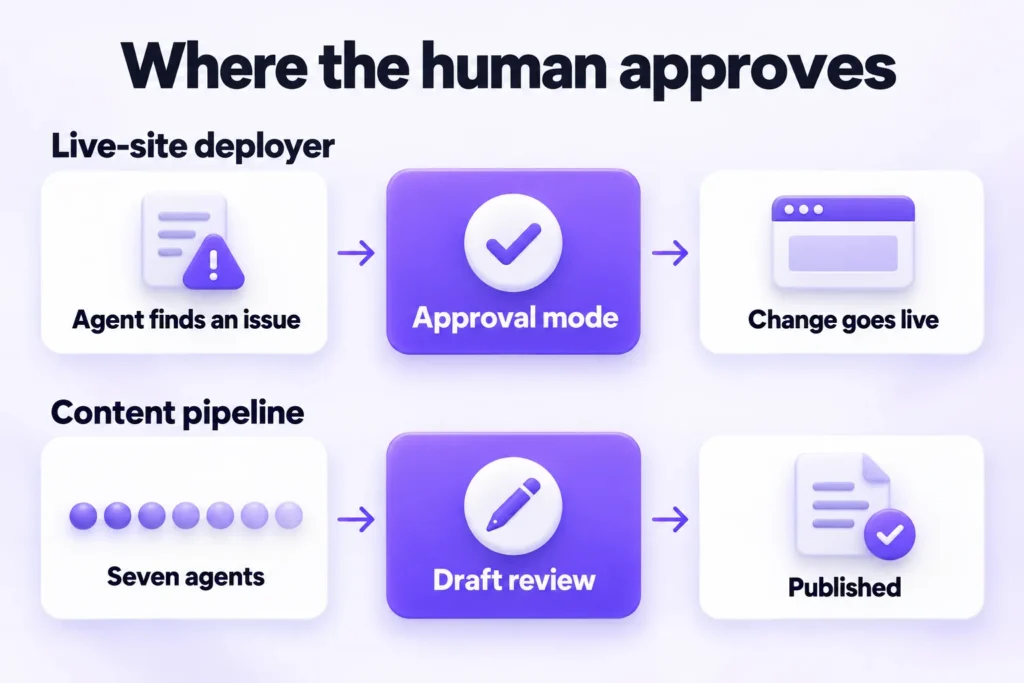
Model time and human time are separate budgets. In our AI content case study, human editing averaged about 20 minutes per article. That’s on top of the roughly 15.4 minutes of model time in the table, and it’s why I keep the gate even when the Reviewer agent has already run.
Google’s position on AI-agent content
Google doesn’t penalize content for being AI-generated, and it does act on scaled content abuse however the pages are created. The test is whether the content helps users.
The foundation is Google’s February 8, 2023 post on AI content. Google says its ranking systems aim to reward original, high-quality content that demonstrates E-E-A-T (expertise, experience, authoritativeness and trustworthiness), and it rewards quality “however it is produced”. It also says that “appropriate use of AI or automation is not against our guidelines,” while using automation, including AI, “to generate content with the primary purpose of manipulating ranking in search results is a violation of our spam policies.”
The current spam policies are the enforcement side. Scaled content abuse is “when many pages are generated for the primary purpose of manipulating search rankings and not helping users,” and it applies “no matter how it’s created.” One listed example is using generative AI tools to generate many pages without adding value for users. The same page says spam includes attempting to manipulate generative AI responses in Google Search, that detection combines automated systems with human review, and that violating sites may rank lower or not appear at all.
The practical read is straightforward. The risk isn’t the agent, it’s publishing many pages that add nothing. That’s why the human gate and research-backed, rank-ready drafting matter more than which tool made the first version. Nothing here promises a ranking, and Google doesn’t either. For the longer treatment with data, see does Google penalize AI content.
How to evaluate an AI SEO agent
Judge an agent by what it can change without your approval and how you can undo it. Cost transparency and data grounding come next.
Use this checklist on any vendor, including ours:
- What can it change without approval? Good looks like an approval mode you can see, and a default that matches your risk tolerance. On a live-site deployer, check whether approval is on or opt-in.
- What data sources ground it? Good looks like named sources, such as Search Console, a crawler or an SEO data API, that you can inspect.
- Are there logs and rollback? Good looks like a record of every change and a way to revert it.
- What is the cost per task? Good looks like a number per article or per job, not “unlimited” with no basis.
- Who pays the model bill? Good looks like a clear answer: your own provider key, or credits bundled into a plan.
- BYOK or credits? Both can be fair. BYOK gives you control and visibility. Credits give you simplicity.
As one example of that split, Contentosapp Studio supports BYOK with your own Gemini, OpenAI or Claude key, with no plugin fee and no per-article cap, so your provider’s limits and pricing apply. Managed ContentOS Auto plans include AI usage and need no API key. There are 3 free articles, then Starter (5 articles a month), Pro (30) and Studio (100), and annual billing gives two months free. Current prices are at contentosapp.com, and I’m not quoting plan or third-party prices here.
Tie the checklist back to the job map. A research agent needs the data-grounding question most, while a deployer needs the approval question most. And take Anthropic’s advice: test with guardrails before you give anything write access.
Build or buy: n8n or Claude skills vs a ready tool
Build when you need custom logic and can maintain it. Buy when you want a working pipeline now and can accept someone else’s design. Either way, you own the approval gate.
If you want to build your own AI agent for SEO, the route has two common shapes. With n8n, you get 500+ integrations, support for code and human-in-the-loop guardrails, as the vendor describes it (checked October 6, 2026). With Claude skills plus MCP, you follow the SE Ranking pattern: reusable skills on top of a data source. What you carry is setup time, prompt maintenance, evaluation and the model bill. Anthropic’s own advice to start simple applies here too, because a custom agent is a system you now have to test.
The buy route trades control for speed. You get a defined pipeline from day one, and you accept someone else’s design decisions about steps, prompts and review. Contentosapp Studio is one option. According to its WordPress.org listing, it runs a seven-agent pipeline with BYOK, supports English, Spanish and Brazilian Portuguese, and sends each article as a draft or a published post. We make it, so weigh that accordingly.
A simple decision rule by reader type. A solo blogger with limited time usually gains more from a ready pipeline and an editing habit than from months of wiring. An agency with unusual client workflows may need custom logic, so building has a real payoff. An in-house SEO team with a developer can reasonably build the research layer and buy the content layer. If you’re weighing Claude specifically, Claude for WordPress covers the connection options.
Frequently Asked Questions
What is an AI SEO agent?
It’s software that plans and runs a multi-step SEO task using tools and live data, and chooses its own next step. A human approves what matters. A chatbot answering one prompt is not an agent.
How does an AI SEO agent work?
It connects a language model to tools such as a crawler, Search Console or an SEO data API, then loops through steps: gather data, decide, act, check. In a content pipeline, specialist agents hand work to each other, from discovery and strategy to research, drafting and review.
Do AI SEO agents work?
For defined tasks with output you can check, yes: scanning a site, turning SEO data into briefs, or drafting and reviewing articles. They don’t replace judgment, fact checking or brand and legal decisions, so a human still approves what goes live. Our own log measures cost and model time, not ranking results, so it can’t show that an agent lifts traffic.
Can an AI agent do SEO on its own?
It can run defined tasks on its own, such as scanning a site or drafting an article. It can’t own judgment, fact verification or brand and legal risk. Keep a human approval step before anything goes live.
What is the difference between an AI SEO agent and an AI SEO tool?
A tool does what you tell it, once. An agent runs several steps and decides what to do next. Under Anthropic’s definition, a fixed sequence of steps is a workflow, which many products sold as agents really are.
Is content from AI agents safe for Google?
Google says it rewards quality content “however it is produced,” and that appropriate use of AI isn’t against its guidelines. It does act on scaled content abuse, meaning many pages generated to manipulate rankings without helping users. Nobody can promise rankings.
How much does an AI SEO agent cost?
It varies by tool, and I’m not quoting third-party prices. In our own log, one seven-agent content pipeline averaged about $0.49 in model cost on Claude Sonnet 5.5 at list price and about 15.4 minutes of model time per article as of October 2026, with no human editing included. See the six-model test for model-by-model costs.
Can I build my own SEO AI agent with n8n or Claude?
Yes. n8n offers 500+ integrations and human-in-the-loop guardrails per its own page, and Claude skills plus an MCP data source is another pattern. You’ll carry setup, prompt maintenance, evaluation and the model bill.
Conclusion
The word “agent” tells you nothing until you ask what the software can change without you. Run the three-question test, find the approval boundary, and then look at the price per task. In our log, the cheap steps were discovery, planning and research, and the expensive ones were generation and review.
Your next step is small. Pick one tool you already use or are considering, answer the six checklist questions about it in writing, and don’t give it write access to a live site until you can name how you’d undo its changes. If it can’t pass that, what exactly are you buying?
References
External sources
- Building Effective AI Agents \ Anthropic — https://www.anthropic.com/engineering/building-effective-agents
- GitHub – seranking/seo-skills: Claude SEO Skills — production Claude Agent Skills for the SE Ranking MCP server. Content briefs, AI Searc… — https://github.com/seranking/seo-skills
- Contentosapp Studio – AI Content Writer & SEO (BYOK) – WordPress plugin | WordPress.org — https://wordpress.org/plugins/contentosapp-studio/
- Google Search’s guidance about AI-generated content | Google Search Central Blog | Google for Developers — https://developers.google.com/search/blog/2023/02/google-search-and-ai-content
- Spam Policies for Google Web Search | Google Search Central | Documentation | Google for Developers — https://developers.google.com/search/docs/essentials/spam-policies
- Build Custom AI Agents With Logic & Control | n8n Automation Platform — https://n8n.io/ai-agents/
- Gartner predicts task-specific AI agent growth — https://www.processexcellencenetwork.com/ai/news/gartner-40-percent-of-enterprise-apps-will-feature-task-specific-ai-agents-by-2026
- OTTO SEO: Automated & Auto SEO Software | Search Atlas — https://searchatlas.com/otto-seo/
Related content
- Agentic AI for WordPress in 2026: Site Operators vs. Content Pipelines Are Not the Same Thing — Contentosapp
- Best AI SEO Tools in 2026: Organized by the Job You Actually Need Done — Contentosapp
- Claude for WordPress: Plugins and 4 Ways to Connect (2026) — Contentosapp
- ChatGPT vs AI Content Pipeline for SEO: Where Each One Actually Wins — Contentosapp
- Best AI Model for Blog Writing: We Tested 6 Models on the Same Two Briefs — Contentosapp
- AI Content Case Study: 25 Articles in 25 Days on WordPress — Real Numbers at Day 25 — Contentosapp
- Does Google Penalize AI Content? The Real Answer (With Data) in 2026 — Contentosapp