You’ve seen the phrase “AEO tool” used to describe a visibility dashboard, a content writer, an on-page optimizer, and a publishing pipeline — sometimes in the same week. That’s not a branding accident. It’s a symptom of a market where the category name is growing faster than the category itself is maturing, and where every established SEO platform is racing to plant a flag in AI search before the territory solidifies.
This article covers five specific aeo tools — Semrush, Writesonic, Ahrefs, Surfer, and Contentosapp Studio — evaluated against what their official sources actually document, not what category logic might suggest they do. Every capability claim in this guide traces to a primary source. Every gap in that documentation is labeled as a gap, not glossed over with editorial inference.
The comparison is organized around four functional jobs: Measure (track AI visibility after publishing), Research (discover which sources and queries matter), Optimize (improve content before it goes live), and Produce (generate and publish sourced content at scale). Most tools serve one or two of these jobs well. None of them serve all four equally. Buying the wrong category costs more than buying the wrong feature set — you can’t configure your way out of a category mismatch.
If you’re already clear on what AEO is and just need the tool breakdown, the summary below is your fastest path to the right shortlist. If you need the foundational concept explained first, the complete AEO playbook covers the mechanics before you start evaluating tools.
At a Glance
- The core problem: "AEO tool" describes four structurally different products — a tracker, a researcher, an optimizer, and a publisher. This guide maps each tool to the job it actually performs.
- Semrush: Measure + Optimize — prompt-level AI visibility tracking and a 28B-keyword research foundation, per its official site.
- Writesonic: Measure + Research — citation gap analysis and an agent fleet designed to close the gaps it finds.
- Ahrefs: Research + Measure — Brand Radar for AI chatbot citation tracking, backed by a 41.9B-keyword index.
- Surfer: Optimize — a content editor and brief tool; its "AI Visibility Platform" header is not supported by documented tracking features in official sources.
- Contentosapp Studio: Produce + Publish — a seven-stage pipeline that outputs sourced, human-reviewed articles directly to WordPress.
- No tool among the five is publicly documented as supporting llms.txt generation or AI-agent crawl readiness. That gap is real and this guide names it.
What “AEO Tool” Actually Means in 2026
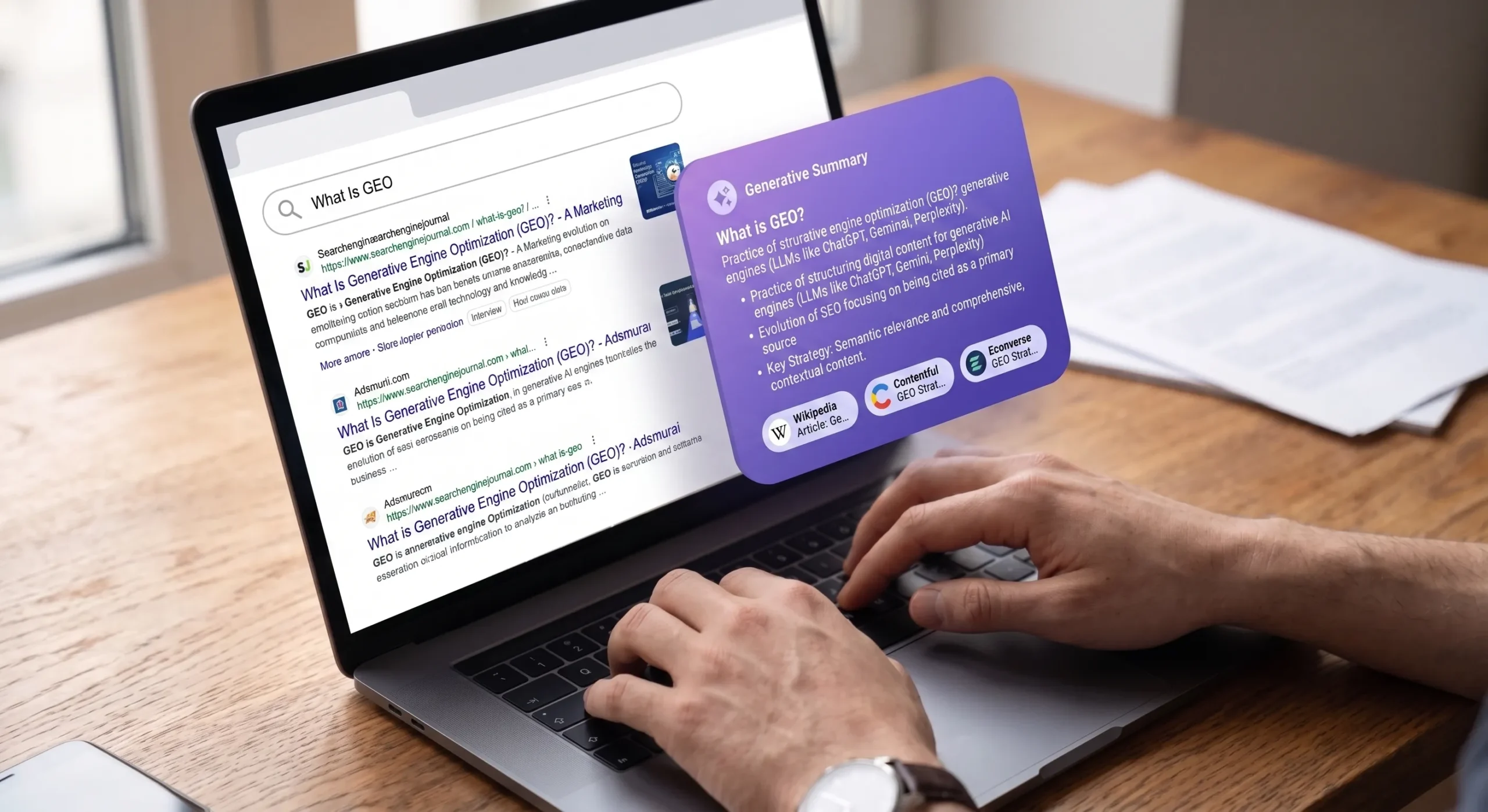
Answer engine optimization and generative engine optimization are related but not identical. AEO focuses on getting your content cited in AI-generated answers — across platforms like ChatGPT, Perplexity, and Google’s AI Overviews. GEO is a broader framing that includes the structural and distributional signals that influence how AI models interpret and represent your brand. If you’re conflating the two, the GEO guide makes the distinction concrete before you start spending money on either.
The reason “AEO tool” covers such wildly different products in 2026 is that it describes an outcome, not a method. Tracking whether your content appears in a Perplexity answer is a measurement problem. Figuring out which sources Perplexity is reading instead of yours is a research problem. Improving your article’s structure to increase citation probability is an optimization problem. Writing and publishing the article with embedded source references is a production problem. These are four different technical operations, and the tools built to solve them are, in most cases, built differently from the ground up.
Four Jobs, Five Tools: How to Read This Comparison
Before you look at any feature matrix, you need to know which of these four jobs you’re hiring a tool to do. This isn’t about finding the most capable tool. It’s about finding the right category.
| Job | What it means | Primary tools (from official sources) |
|---|---|---|
| Measure | Track prompt-level AI visibility; monitor citation share across LLMs post-publish | Semrush (AI Visibility module), Writesonic (visibility dashboard), Ahrefs (Brand Radar) |
| Research | Discover which sources LLMs cite; identify query patterns that drive AI answers | Writesonic (citation gap analysis), Ahrefs (Firehose + keyword index), Semrush (AI PR) |
| Optimize | Score and improve content before publishing for AI-answer readiness | Surfer (Content Editor), Semrush (Content module), Ahrefs (AI Content Grader) |
| Produce & Publish | Build sourced, human-reviewed content and push it directly to a CMS | Contentosapp Studio (seven-stage pipeline → WordPress) |
Buying a production tool when you need a measurement tool is not a feature gap — it’s a category mismatch. No amount of prompting Writesonic or Contentosapp Studio will tell you whether your published content appears in Perplexity’s answers. Conversely, Semrush’s AI visibility tracking won’t write and publish a sourced article for you. These tools solve adjacent problems, not the same problem.
Some tools straddle two jobs. Semrush spans Measure and Optimize. Writesonic spans Measure and Produce (via its agent fleet). Ahrefs spans Measure and Research. Contentosapp Studio sits exclusively in Produce and Publish. Surfer’s documentation places it firmly in Optimize — despite its current brand positioning, which the next section addresses directly.
Measure
- Semrush
- Writesonic
- Ahrefs
Research
- Ahrefs
Optimize
- Semrush
- Surfer
Produce
- Writesonic
- Contentosapp Studio
Decision Matrix
This matrix maps documented features only. Cells marked “not publicly verified” reflect the absence of verifiable public information as of 2026-09-02 — not an editorial judgment about the tool’s quality.
| Tool | Primary Job | AI Visibility Tracking | Citation / Source Analysis | Query Discovery | Source-Backed Content Production | WordPress Publishing | llms.txt / AI-Agent Readiness | Pricing |
|---|---|---|---|---|---|---|---|---|
| Semrush | Measure + Optimize | Prompt-level tracking; AI market share vs. competitors (per official site) | AI PR module — finds LLM-trusted media for outreach (per official site) | 28B keyword database (per official site) | Content scoring/optimization pre-publish; not a publishing pipeline (per official site) | Not publicly verified | Not publicly verified | Not publicly verified — check semrush.com |
| Writesonic | Measure + Research + Produce | Prompt-level; citation gap dashboard (per official site) | Source-level citation tracking vs. competitors (per official site) | Not publicly verified | Agent fleet for content + outreach (per official site) | Not publicly verified | Not publicly verified | Not publicly verified — check writesonic.com |
| Ahrefs | Research + Measure | Brand Radar — AI chatbot mentions, citations, sentiment (per official site) | Firehose — real-time brand and competitor mentions (per official site) | 41.9B keyword index (per official site) | AI Content Helper + Grader; not a publishing pipeline (per official site) | Not publicly verified | Not publicly verified | Not publicly verified — check ahrefs.com |
| Surfer | Optimize | Not publicly verified — “AI Visibility Platform” header not supported by documented tracking features (per official site) | Not publicly verified | Partial — integrated within brief and content editor (per official site) | Content Editor with keyword guidance; not a publishing pipeline (per official site) | Not publicly verified | Not publicly verified | Not publicly verified — check surferseo.com |
| Contentosapp Studio | Produce + Publish | Not publicly verified | Partial — source selection with rationale embedded in pipeline output (per official site) | Not publicly verified | Seven-stage pipeline; sourced + human-reviewed (per official site) | Primary positioning: AI content pipeline for WordPress (per official site) | Partial — llms.txt cited as a reference in pipeline output (per official site) | Not publicly verified — check contentosapp.com |
Individual Tool Analyses
Semrush
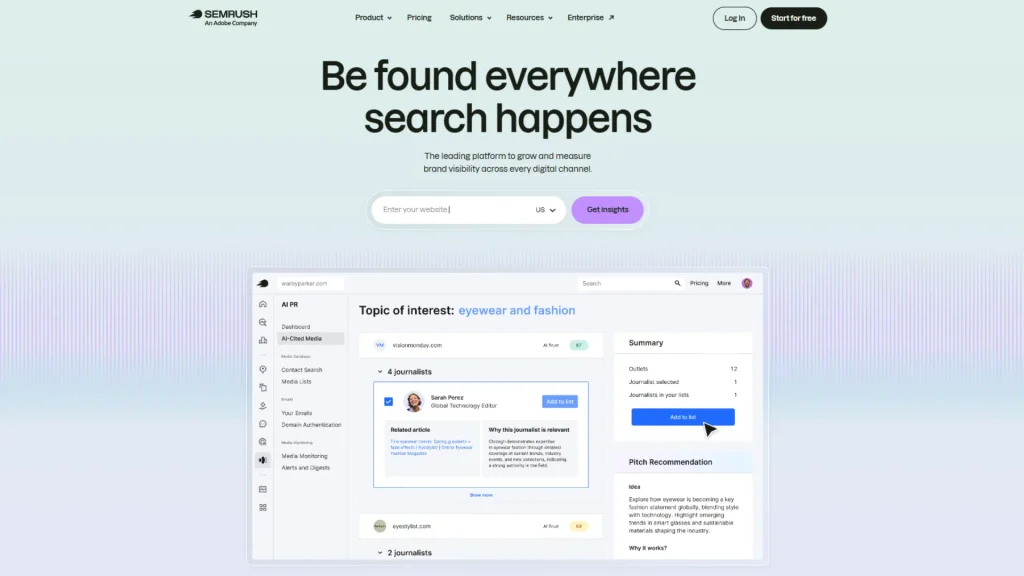
Semrush is the most horizontally positioned tool in this comparison. Its official site describes it as “the leading platform to grow and measure brand visibility across every digital channel,” and the documented product backs that claim up across multiple modules. The AI Visibility module — which tracks prompt-level brand visibility and AI market share against competitors — is the clearest AEO-specific feature in its product lineup. If your primary job is understanding whether your brand is being surfaced in AI answers, this is the most explicitly documented tracking capability among the five tools.
Beyond visibility tracking, Semrush documents a 28B-keyword research database, a content scoring and optimization module for pre-publish AEO readiness, and an AI PR module designed to identify media sources trusted by LLMs and generate press outreach. That last feature is genuinely distinct — it’s not just about ranking, it’s about earning citation credibility with the sources that LLMs already trust.
Verified limitations and evidence gaps: Whether the AI visibility tracking covers all major LLMs — ChatGPT, Perplexity, Gemini, Claude — as separate signals or as a blended metric is not clarified in available official documentation (not publicly verified as of 2026-09-02). A direct WordPress publishing pipeline is not mentioned. Structured data generation and llms.txt support are not mentioned. Pricing tiers are not visible in extracted content — check semrush.com for current plans.
Writesonic
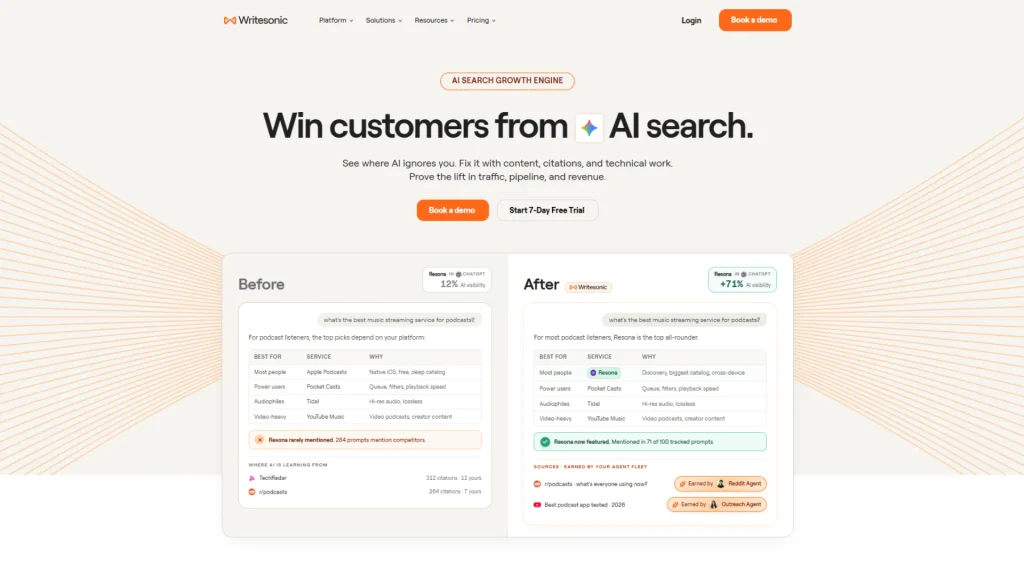
Using a fictitious brand called Resona for illustration purposes only, Writesonic’s official site demos a before/after visibility scenario where the brand rises from 12% AI visibility in ChatGPT to 71 of 100 tracked prompts after content and outreach interventions. Those numbers are demonstrative, not independently verified — but the product architecture the demo describes is documented as the core workflow: measuring citation gaps, identifying which external sources LLMs prefer over yours, then deploying a content agent and an outreach agent to close those gaps.
This places Writesonic in an interesting position: it spans Measure, Research, and a form of Produce, but the production layer is agentic rather than editorial. The “agent fleet” that earns citations appears to work by generating content and conducting outreach on behalf of the user, though the technical specifics of how those agents operate, what they produce, and what human oversight looks like are not detailed in available official documentation.
Verified limitations and evidence gaps: Which specific AI platforms are tracked (ChatGPT alone, or also Perplexity, Gemini, Claude) is not specified — not publicly verified as of 2026-09-02. Native WordPress publishing is not mentioned. Structured data generation is not mentioned. The “10,000+ leading marketing teams” figure and the “4.8” rating are vendor-displayed claims — methodology not specified in available documentation. Check writesonic.com for current pricing and platform coverage.
Ahrefs
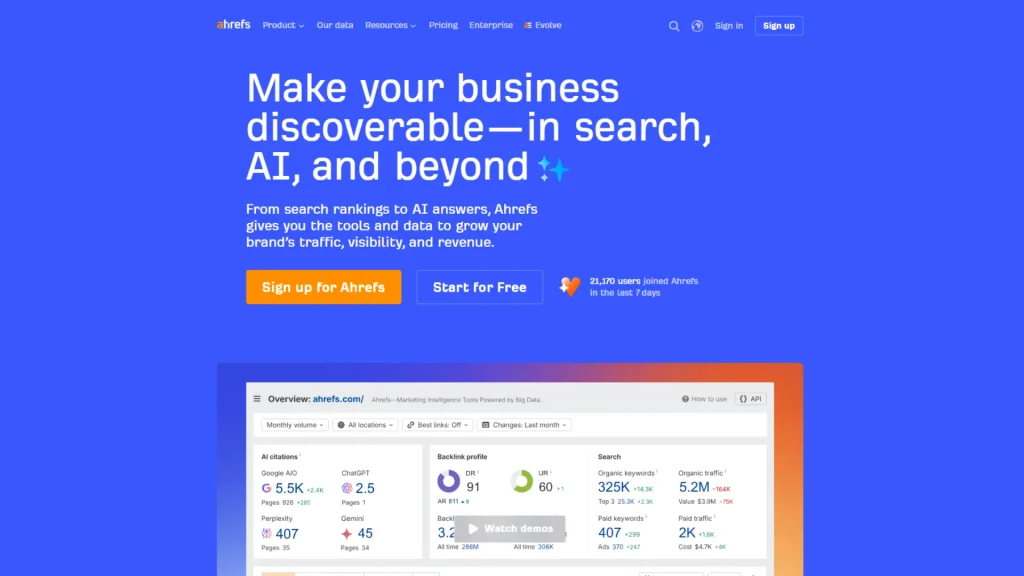
Ahrefs describes itself as “the only AI marketing platform built on Ahrefs’ proprietary index of the web” — and the scale of that index is the clearest differentiator documented on its official site. The platform tracks 400 million monthly AI prompts, 41.9 billion keywords, and 170 trillion pages. Those are vendor-stated figures, but they establish the data foundation that makes Ahrefs’ AI-related modules credible.
The AEO-relevant feature is Brand Radar: documented as tracking brand mentions, citations, and sentiment “across AI chatbots.” Firehose, available as a free tier per the official site, adds real-time brand and competitor mention monitoring. On the content side, AI Content Helper and AI Content Grader are listed under Content Marketing — positioned as tools for creating content that “matches search intent” and fills content gaps. A newer product, Letaido, is mentioned for marketing reports and automations, but its capabilities and scope are not elaborated in available documentation (not publicly verified as of 2026-09-02). For context on what it looks like to build a citation strategy informed by tools like this, ranking in ChatGPT and Perplexity requires a different approach than traditional keyword targeting.
Verified limitations and evidence gaps: Whether Brand Radar covers all major AI platforms simultaneously as separate signals is not specified — not publicly verified as of 2026-09-02. A WordPress publishing pipeline is not mentioned. llms.txt or WebMCP generation is not mentioned. The “44% of Fortune 500” figure is a vendor marketing claim and should be attributed as such. Check ahrefs.com for current pricing and Brand Radar platform coverage.
Surfer
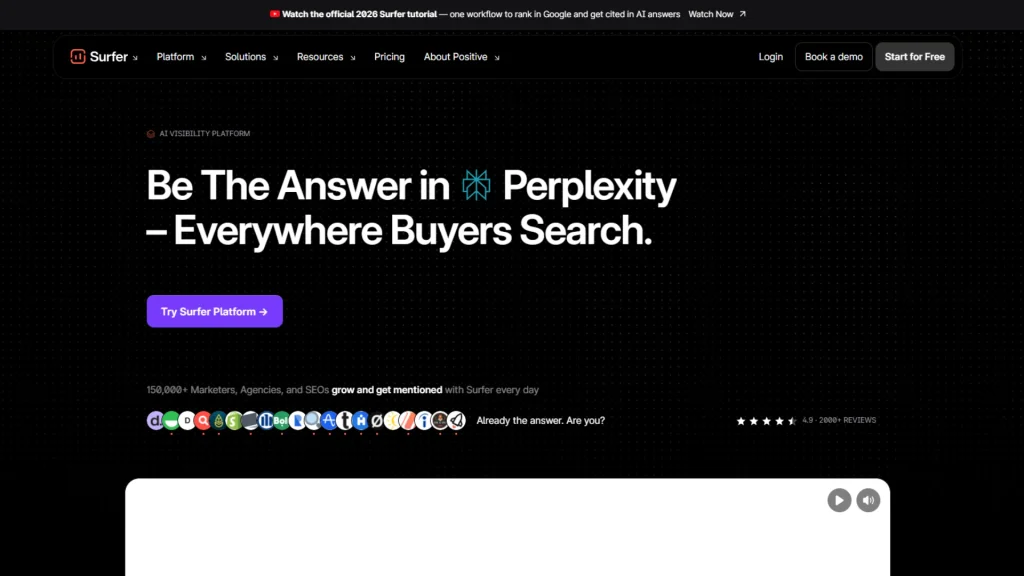
Here’s the thing about Surfer’s current branding: the homepage header reads “AI Visibility Platform — Be The Answer in Google — Everywhere Buyers Search.” That positioning language would suggest a tool in the Measure category. But the documented product — what testimonials describe, what users reference, what every feature mention points to — is a Content Editor. Brief generation. On-page optimization recommendations. Keyword-guided writing. A tool that told one user to delete 22,000 words, and after he did, he moved to the number one position. That’s content optimization, not AI visibility tracking.
This matters because the gap between Surfer’s header claim and its documented product is exactly the kind of mismatch that leads to wrong purchasing decisions. If you’re evaluating Surfer because you saw “AI Visibility” in its positioning, pause. The feature that would justify that label — prompt-level tracking across AI platforms — is not described anywhere in available official documentation as of 2026-09-02.
Verified limitations and evidence gaps: Prompt-level AI visibility tracking is not documented on the official site despite the header claim — not publicly verified as of 2026-09-02. Citation or source-gap analysis is not mentioned. WordPress publishing is not mentioned. llms.txt or schema generation is not mentioned. All testimonial results (740% organic visibility growth in 90 days, 200% impressions increase, 1 million clicks per week) are vendor-curated and should not be treated as independently verified performance data. Check surferseo.com for current pricing.
Contentosapp Studio
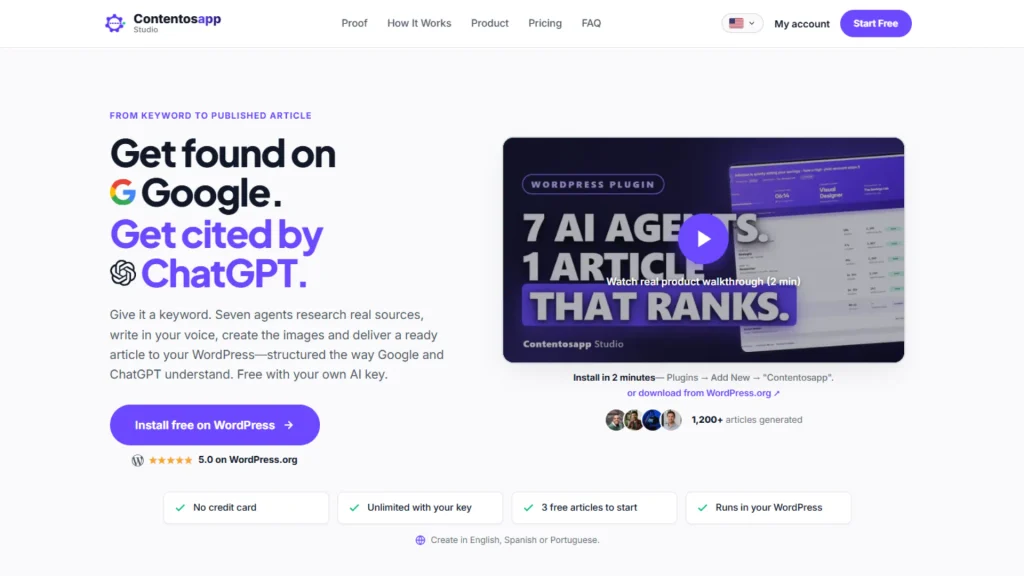
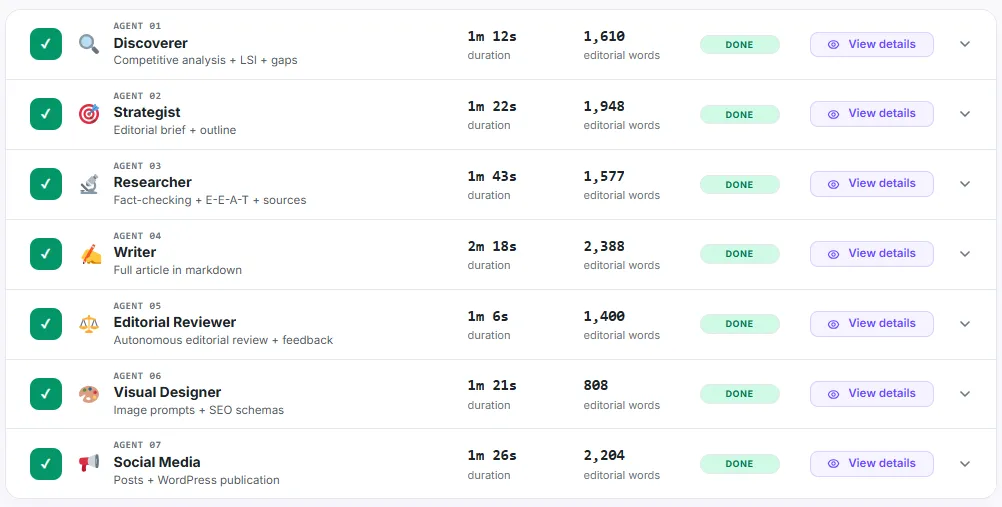
Contentosapp Studio is the only tool in this comparison whose primary documented job is Produce and Publish. The official site positions it as an “AI Content Pipeline for WordPress” and describes a seven-stage workflow that outputs articles tagged as published, sourced, and human-reviewed. That last attribute matters: the human editorial review stage is documented as part of the pipeline, not an optional add-on.
The source-attribution model is what makes this tool structurally distinct. A published article example on the official site shows four references embedded alongside the content — each tagged with its domain, a rationale for why it was used, and an open link to the source. One of those references is llmstxt.org, documenting the llms.txt proposal. That reference selection signals alignment with AI-agent crawl readiness as an editorial standard, even if llms.txt generation as a named product feature is not publicly documented. For teams that need managed AEO execution rather than a self-serve tool, AEO services built on this pipeline are also available.
Verified limitations and evidence gaps: Prompt-level AI visibility tracking is not described — not publicly verified as of 2026-09-02. Citation gap analysis (which LLMs are citing vs. not) is not described. A keyword research database is not mentioned. Whether the pipeline supports content types beyond long-form articles is not stated. The names and functions of the seven pipeline stages are not detailed beyond the count — not publicly verified as of 2026-09-02. Check contentosapp.com for current pricing.
Category Gaps: What No Listed Tool Clearly Solves
AI-agent crawl readiness (llms.txt / WebMCP). WebMCP — short for Web Model Context Protocol, a standard for exposing structured site context to AI agents — and llms.txt, a proposed file format for helping language models navigate a site’s content, represent a distinct layer of AEO infrastructure. None of the five tools in this comparison explicitly document support for generating either standard as a named product feature. The only indirect signal is Contentosapp Studio’s pipeline referencing llmstxt.org as a cited source in a published article example — which signals editorial awareness, not a generation tool. Free utilities like AEO Vision and FixAEO are documented as offering dedicated generators for these standards; both are referenced here as editorial context based on their availability as category-level tools, not as items within the core comparison scope. Verify their current feature set and availability directly at their respective sites. This is a real capability gap among paid platforms as of 2026-09-02, and it’s worth knowing before you assume any of these tools handle it.
Real-time citation monitoring across multiple AI engines simultaneously. Knowing your content appeared in a Perplexity answer yesterday is a different technical problem from knowing it appeared in ChatGPT’s context window. Semrush, Writesonic, and Ahrefs all document some form of AI visibility tracking — but none of the official sources specify whether their tracking covers multiple LLMs independently and in real time, or whether coverage is limited to certain platforms or blended into an aggregate signal. That ambiguity matters when your visibility gaps differ by platform.
Query discovery tuned for conversational AI prompts. A traditional keyword research tool measures search volume, difficulty, and CPC. None of those metrics map cleanly to the compound, conversational queries that AI engines answer. Whether any of the five tools has adapted its query research layer to the syntax and intent patterns of AI-prompted search — rather than repurposing keyword data from traditional search — is not clearly documented in available public sources as of 2026-09-02.
Recommendations by Use Case
These recommendations are based on documented capabilities only. Verify current feature scope and pricing on each tool’s official site before purchasing — this category is moving fast.
- If your primary need is tracking whether your brand appears in AI-generated answers: Semrush’s AI Visibility module and Ahrefs’ Brand Radar are the most explicitly documented options for this job. Writesonic also offers a prompt-level visibility dashboard. Verify which AI platforms each tool covers before committing, as that specificity is not publicly confirmed for any of the three.
- If your primary need is identifying which sources LLMs prefer over yours: Writesonic’s citation gap analysis and Ahrefs’ Firehose monitoring are the most relevant documented features. Semrush’s AI PR module addresses the outreach side of the same problem.
- If your primary need is creating content structured for AI citation with source attribution embedded: Contentosapp Studio is the only tool in this comparison with a documented end-to-end pipeline for sourced, human-reviewed content published directly to WordPress. Writesonic’s agent fleet also produces content and conducts outreach, though the production specifics are less detailed in official documentation.
- If your primary need is pre-publish content scoring and on-page optimization: Surfer’s Content Editor is the most consistently documented tool for this job among the five. Semrush’s content module and Ahrefs’ AI Content Grader also serve this function, though they sit within broader platforms.
- If your primary need is keyword and backlink research informing an AEO content strategy: Ahrefs’ 41.9B keyword index and Semrush’s 28B keyword database are the documented standards. Whether either tool has adapted its query research specifically for conversational AI prompts is not publicly verified.
- If you need llms.txt generation or AI-agent crawl readiness: None of the five listed tools are publicly documented as providing this. Free utilities like AEO Vision and FixAEO exist specifically for this job — verify their current capabilities directly.
Most teams working in this space will combine a visibility tracker with a content production tool. The market hasn’t converged yet. Two tools is the accurate answer for now, not a sales pitch.
Final Verdict: Strengths and Limitations by Tool
Semrush — Its AI Visibility module is the most explicitly documented prompt-level tracking feature in this comparison, backed by a 28B-keyword research foundation. The primary limitation is breadth without depth in specific areas: llms.txt support, WordPress publishing, and which specific AI platforms the visibility tracking covers are all not publicly verified. Best for teams who need a single platform spanning traditional SEO and AI visibility measurement.
Writesonic — The citation gap analysis and agent fleet architecture are genuinely distinctive: you can see which domains LLMs prefer over yours and deploy agents to close the gap. The limitation is documentation transparency — the agent fleet’s technical operation, human-in-the-loop controls, and exact platform coverage are not detailed in official sources. Best for teams focused on the Research-to-Produce loop specifically around AI citation share.
Ahrefs — The sharpest research foundation in the comparison: 41.9B keywords, 170T indexed pages, and real-time brand monitoring via Firehose. Brand Radar adds AI chatbot citation tracking. The limitation is that Ahrefs remains primarily a research and analysis tool — it does not offer a publishing pipeline, and the AI content tools are graders and helpers rather than autonomous generators. Best for teams building an evidence base for AEO content strategy rather than deploying content at scale.
Surfer — A proven content optimization tool with strong documented testimonials in the agency and creator space. Its Content Editor is clearly valued for brief generation and keyword-guided writing. The limitation is the mismatch between current brand positioning (“AI Visibility Platform”) and documented product capabilities (content optimization). Do not buy Surfer expecting prompt-level AI tracking — that feature is not evidenced in official documentation. Best for teams optimizing existing content workflows for traditional and AI-adjacent search.
Contentosapp Studio — The only tool in this comparison with a documented end-to-end pipeline from research to WordPress publication, with human review and source attribution embedded in the output. The limitation is scope: it does not track visibility, monitor competitors, or provide a keyword database. It is a production tool, not a measurement tool. Best for teams whose primary gap is publishing sourced, AI-citation-ready content consistently — not for teams who first need to know whether their existing content is being cited.
Frequently Asked Questions
What is the difference between an AEO tool and an SEO tool?
An SEO tool is primarily built to improve how content ranks in traditional search engine results pages — through keyword research, backlink analysis, technical audits, and on-page optimization. An AEO tool is built to improve how content surfaces in AI-generated answers across platforms like ChatGPT, Perplexity, and Google AI Overviews. In practice, the line blurs: most established SEO platforms are adding AI visibility modules, while newer AEO-specific tools are building citation tracking and content production features. The safest approach is to identify which specific job you need to solve — tracking AI visibility, discovering citation sources, optimizing content pre-publish, or producing and publishing sourced content — and then match the tool category to that job.
Which of these tools tracks whether my content appears in ChatGPT or Perplexity answers?
Semrush’s AI Visibility module explicitly documents prompt-level visibility tracking and AI market share analysis. Ahrefs’ Brand Radar is documented as tracking brand mentions, citations, and sentiment across AI chatbots. Writesonic’s dashboard shows citation-level tracking with a before/after visibility metric. All three list this as a primary feature in their official documentation. However, which specific AI platforms each tool covers — whether separately or as a blended signal — is not publicly specified for any of them as of 2026-09-02. Verify current platform coverage directly before purchasing.
Does Semrush have an AI visibility or AEO feature, and what does it actually cover?
Yes. Semrush’s official site documents a dedicated AI Visibility module described as: “Take control of how you show up in AI answers. Track prompt-level visibility and analyze AI market share against your competition.” It also documents an AI PR module for identifying LLM-trusted media sources and generating press outreach. What isn’t publicly specified is whether the tracking distinguishes between individual AI platforms (ChatGPT, Perplexity, Gemini, Claude) or aggregates them into a single visibility signal — that detail is not confirmed in available official documentation as of 2026-09-02.
Can Surfer SEO or Ahrefs optimize content specifically for AI search engines?
Surfer’s Content Editor is documented as an on-page optimization tool for keyword-guided writing and content scoring — it is not documented as having prompt-level AI citation tracking despite the “AI Visibility Platform” header on its homepage. Whether its optimization recommendations translate to improved AI citation likelihood is not claimed or evidenced in official documentation. Ahrefs offers an AI Content Grader and AI Content Helper positioned as tools for creating high-quality content that matches search intent. Neither tool is publicly documented as having a specific AI-citation correlation mechanism — meaning the connection between their optimization scores and AI answer inclusion is not officially stated.
What is the difference between AEO and GEO, and does it change which tool I need?
AEO (answer engine optimization) focuses on getting content cited in AI-generated answers — it’s about showing up when users ask questions through ChatGPT, Perplexity, or AI Overviews. GEO (generative engine optimization) is a broader discipline covering how AI models interpret, represent, and distribute your brand across generated content. The distinction matters for tool selection: AEO tools focus on citation tracking and content structure, while GEO work often involves broader distribution and entity signals. The GEO guide covers this in detail. In practical terms, if you’re evaluating visibility trackers, you’re primarily in AEO territory. If you’re building a full AI-discovery strategy, both frameworks apply.
Are there free AEO tools that cover llms.txt generation and AI-agent readiness?
None of the five tools in this comparison — Semrush, Writesonic, Ahrefs, Surfer, or Contentosapp Studio — are publicly documented as offering llms.txt generation or WebMCP/AI-agent crawl readiness auditing as named features. Free utilities like AEO Vision and FixAEO are documented as offering dedicated generators for these standards; they are referenced here as category context, outside the five-tool comparison scope. If AI-agent crawl readiness is a priority for your site, verify their current capabilities directly at their respective sites — the current answer is to handle this job through a dedicated tool outside your primary AEO stack.
The Real Decision Before You Buy Any Tool
Pick the job first. Not the tool. Every category error in AEO tool purchasing traces back to the same mistake: choosing a platform based on its name or its header positioning rather than its documented functionality. Surfer calls itself an AI visibility platform. That framing will mislead you if you read it before reading what the product actually does. Map your primary gap to one of the four jobs — Measure, Research, Optimize, Produce — and then use the matrix and individual analyses in this guide to shortlist. Most teams discover they need two tools: one tracker and one production tool. The market hasn’t converged yet. Two tools is the accurate answer for now, not a sales pitch. Check each tool’s official site before purchasing, because this category is updating faster than any comparison guide can keep pace with.
References
External sources
- Semrush: Your Unfair Advantage for Growing Brand Visibility — https://www.semrush.com/
- Writesonic | The AI Search Growth Engine. Win Customers. — https://writesonic.com/
- Ahrefs—AI Marketing Platform Powered by Big Data — https://ahrefs.com/
- Positive Surfer – AI Visibility Platform for maximum organic growth — https://surferseo.com/
- AI Content Pipeline for WordPress | Contentosapp Studio — https://contentosapp.com/
Related content
- Answer Engine Optimization: The Complete 2026 Playbook for Winning AI Answers — Contentosapp
- Generative Engine Optimization (GEO): The Complete Guide to Getting Cited by AI in 2026 — Contentosapp
- How to Rank in ChatGPT and Perplexity: Get Cited, Not Just Ranked — Contentosapp
- 7 Best Answer Engine Optimization Services in 2026 — Contentosapp