
ChatGPT, Perplexity, and Google’s AI Overviews now answer questions that used to send clicks to your site. If your brand never shows up in those answers, you lose traffic before a reader ever sees a blue link. That’s why so many site owners are hunting for answer engine optimization services that actually understand how AI models pick sources, not just traditional SEO shops slapping a new label on old tactics.
This guide answers the question directly: which companies and tools genuinely help you get cited by AI search engines in 2026. We looked at research grounding, structured data, and publishing workflows, not just marketing claims, to separate the best answer engine optimization services from agencies coasting on buzzwords.
Below you’ll find seven options, ranging from full-service AEO agencies to AI-native platforms built for content marketers and niche site owners. If you run WordPress and want fact-checked, schema-ready articles published without a fragmented tool stack, we’ve included where a done-for-you AI pipeline fits alongside human-led services, so you can pick the option that matches your budget, team size, and how much control you want over the final content.
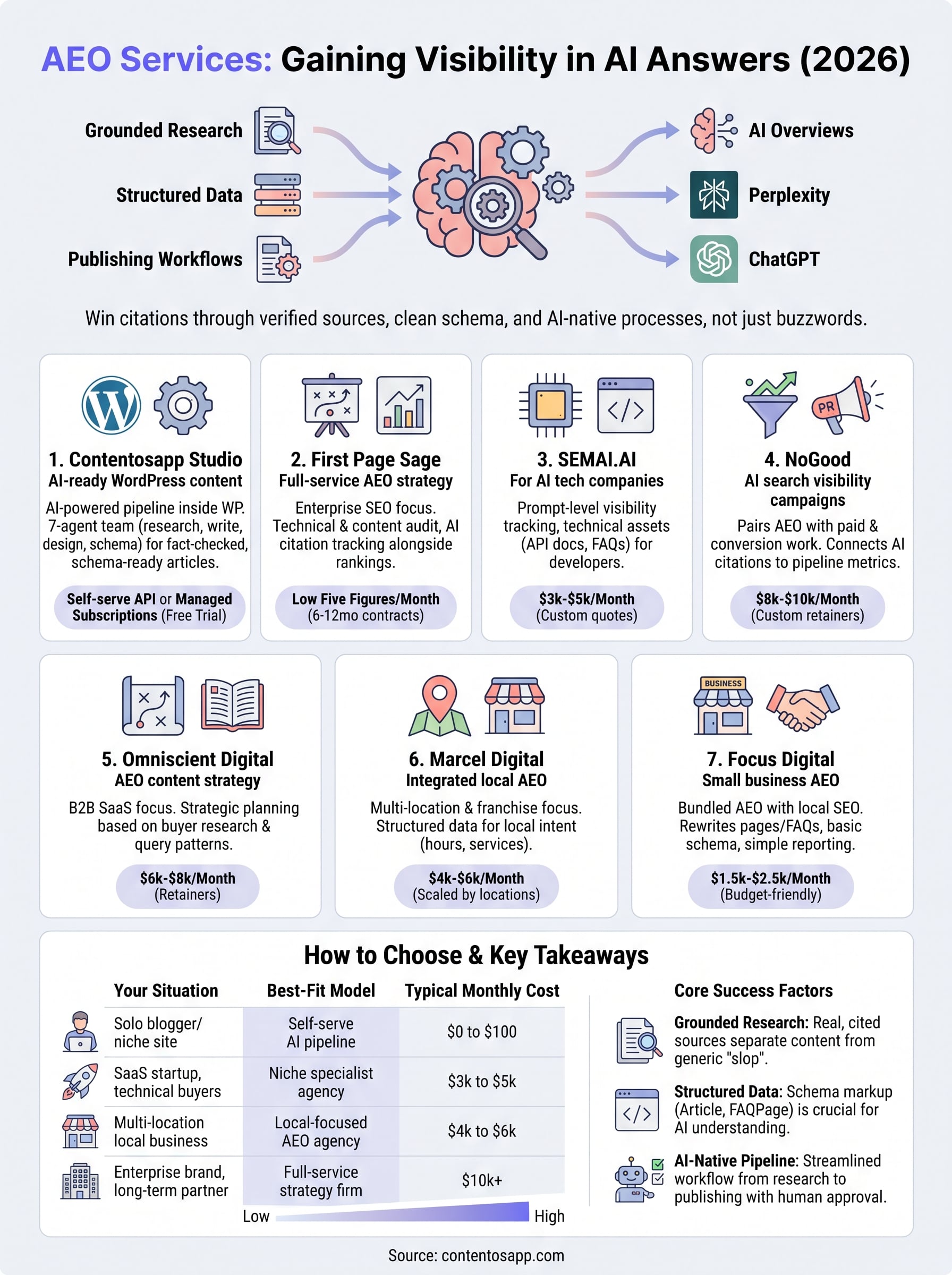
1. Contentosapp Studio for AEO-ready WordPress content
Contentosapp Studio takes a different approach than most agencies on this list: instead of billing hours for strategy decks, it runs an AI-powered content pipeline directly inside your WordPress dashboard. You feed it one keyword, and seven specialized agents research, write, fact-check, design, and publish a complete article, structured from the start around the 2026 AEO framework for winning AI citations in AI Overviews, Perplexity, and ChatGPT answers.
How it works
The plugin runs a 7-agent editorial pipeline: a Discoverer maps competitive and keyword gaps, a Strategist builds the brief and outline, a Researcher pulls facts from live sources like the BLS or Federal Reserve with real citations, a Writer drafts the article in your brand voice, an Editorial Reviewer issues a pass/fail quality verdict, a Visual Designer generates original images and JSON-LD schema, and a Social Media agent writes distribution copy before publishing the draft natively into WordPress.
The 7-agent editorial pipeline
Discoverer
Maps competitive and keyword gaps
Strategist
Builds the brief and outline
Researcher
Pulls facts from live sources with citations
Writer
Drafts the article in your brand voice
Editorial Reviewer
Issues a pass/fail quality verdict
Visual Designer
Generates original images and JSON-LD schema
Social Media
Writes distribution copy, then publishes
Grounded research with cited sources is what separates content AI engines actually cite from generic AI slop.
Who it’s for
This fits WordPress site owners, niche bloggers, and SEO freelancers who want consistent, fact-checked publishing without juggling a separate research tool, writer, and image generator. It also suits agencies managing content for multiple clients who need repeatable quality without hiring a full editorial team, and anyone who’s tried generic AI writers and gotten flat, unsourced output back.
Key strengths
Contentosapp Studio stands out among answer engine optimization services for keeping humans in the loop: nothing publishes without your approval, and every article ships with schema markup (Article, FAQPage) already built in. Your content and data live in your own WordPress database, not a vendor’s server, and the plugin supports English, Spanish, and Portuguese for teams publishing across markets.
Pricing
You choose between two modes: connect your own AI API key in WordPress (Google Gemini, OpenAI, Anthropic, or Stability AI) for unlimited, free usage, or ContentOS Auto, a fully managed subscription with monthly article quotas if you’d rather skip API setup entirely. Every paid plan comes with a free trial of three done-for-you articles and a 30-day money-back guarantee, so you can test the output on your own site before committing. Check the full Contentosapp Studio pricing page for current plan details.
2. First Page Sage for full-service AEO strategy
First Page Sage has run enterprise SEO campaigns for over a decade, and it pivoted early to treat AI search visibility as a core deliverable rather than an add-on. This is a full-service agency model, so you’re hiring strategists and analysts, not buying software, which changes both the price tag and the level of hands-on guidance you get.
How it works
Teams start with a technical and content audit, then build a roadmap targeting citations across Google AI Overviews, Perplexity, and ChatGPT. Writers and strategists produce the content, and account managers report on AI citation tracking alongside traditional rankings each month.
Full-service agencies trade speed and cost for hands-on strategy you don’t have to manage yourself.
Who it’s for
This suits mid-market and enterprise brands with dedicated marketing budgets who want a long-term partner handling strategy, not just execution. It’s a poor fit if you need fast turnaround on individual articles or you’re managing a single niche site.
Key strengths
First Page Sage brings genuine enterprise SEO experience to AEO work, with documented case studies and a research-backed approach to ranking factors published on their site. Their reporting tends to be thorough, covering both traditional organic traffic and AI answer citations in the same dashboard.
Pricing
Engagements typically start in the low five figures monthly, with contracts running six to twelve months. Expect a formal proposal process rather than self-serve signup.
3. SEMAI.AI for AI tech companies
SEMAI.AI builds its entire pitch around one niche: helping AI and software companies get cited in the answers generated by the very models they compete against. If you sell to developers, data scientists, or technical buyers, this specialization matters more than a generic agency’s broad playbook, especially when you’re comparing best answer engine optimization solutions for ai tech companies specifically.
How it works
SEMAI.AI runs prompt-testing audits across ChatGPT, Perplexity, and Gemini to see how your product currently surfaces (or doesn’t) against competitors, the same signals that decide whether you get cited by ChatGPT and Perplexity at all. From there, the team builds technical content assets, comparison pages, documentation-style articles, and structured FAQs designed to match the exact phrasing AI models use when answering buyer questions.
Niche expertise in how AI models describe technical products beats generic content advice every time.
Who it’s for
This service fits SaaS founders and AI startups competing in crowded technical categories where buyers research heavily through chat interfaces before ever visiting a website. It’s less useful for local businesses or ecommerce brands without a technical audience.
Key strengths
SEMAI.AI’s biggest asset is prompt-level visibility tracking, showing you exactly which queries mention your brand versus competitors across multiple AI engines. Their team also understands developer-focused content formats, like API docs and integration guides, that generic SEO writers typically get wrong.
Pricing
Pricing runs on custom quotes based on scope, typically starting around $3,000 to $5,000 monthly for ongoing content and tracking work. Smaller startups can request scoped audits as a lower-cost entry point before committing to retainer work.
4. NoGood for AI search visibility campaigns
NoGood built its name running full-funnel growth marketing for venture-backed startups, and it now folds AI search visibility into that same performance mindset. Instead of treating AEO as a standalone service, NoGood pairs it with paid acquisition and conversion work, so citations in AI answers become one input feeding a larger growth dashboard rather than an isolated metric.
How it works
Campaigns start with a growth audit that maps how prospects currently discover your brand across search, social, and AI assistants. From there, NoGood’s team builds content and digital PR pushes designed to earn mentions in AI Overviews and chatbot answers, then tracks how those mentions influence signups or demo requests downstream.
Treating AI citations as one growth metric among many keeps AEO tied to revenue, not vanity visibility.
Who it’s for
This fits venture-backed startups and scaling SaaS companies already running growth marketing programs who want AEO folded into existing reporting rather than managed separately. It’s a weaker match if you just need standalone content production or you’re a solo site owner without a broader growth budget.
Key strengths
NoGood’s strength is connecting AI search citations to pipeline metrics, something most content-focused AEO shops skip entirely. Their team also moves quickly across channels, testing content, PR, and paid experiments in parallel rather than sequencing them one at a time.
Pricing
Engagements run as custom retainers, generally starting around $8,000 to $10,000 monthly depending on scope. NoGood requires a discovery call before quoting, so there’s no published rate card.
5. Omniscient Digital for AEO content strategy
Omniscient Digital made its reputation writing organic content programs for B2B SaaS companies long before AEO became a buzzword, and that background shows in how methodically it approaches AI search visibility. Rather than bolting AEO onto existing SEO retainers, the team treats answer engine optimization as a content strategy discipline built on the same research rigor that made their organic traffic case studies notable in the first place.
How it works
Omniscient starts with keyword and topic research mapped specifically to how buyers phrase questions inside AI chat interfaces, then builds a content calendar targeting those query patterns. Writers produce long-form guides and comparison content, and strategists revisit performance quarterly, checking which pieces earn citations in AI Overviews or ChatGPT responses versus which ones only rank traditionally.
A content strategy built around how buyers actually phrase questions in AI tools outperforms one built around keyword volume alone.
Who it’s for
This fits B2B SaaS marketing teams that already invest in content marketing and want a partner who treats AEO as an extension of that program, not a separate initiative. It’s a weaker fit for ecommerce brands or anyone needing fast, transactional content rather than a long-term editorial strategy.
Key strengths
Omniscient’s core strength is strategic content planning grounded in real buyer research, not templated blog calendars. Their case studies show sustained organic growth over years, suggesting the team plays a long game rather than chasing quick wins.
Pricing
Retainers typically start around $6,000 to $8,000 monthly, with scope and pricing set after an initial strategy call.
6. Marcel Digital for integrated local AEO
Marcel Digital has spent years running SEO and paid media for multi-location retailers and franchises, and it now extends that local-search playbook into answer engine optimization. The agency’s angle is practical: local businesses lose real foot traffic when AI assistants answer “best plumber near me” or “hours for [store]” without ever surfacing the actual business, so Marcel treats AEO as an extension of local SEO rather than a separate discipline.
How it works
Marcel audits your existing local listings, structured data, and review profiles, then rebuilds location pages and FAQ content to match how voice assistants and AI Overviews answer local intent queries. The team layers in schema markup for business hours, services, and reviews, then monitors citation appearances across Google’s AI features and local pack results alongside traditional rankings.
Local visibility in AI answers depends on the same structured data that used to just power map listings.
Who it’s for
This suits multi-location retailers, franchises, and regional service businesses that already run local SEO campaigns and want AEO folded into that same operational structure. It’s a poor match for purely digital or national brands without physical locations to anchor local intent.
Key strengths
Marcel’s strength is structured data expertise for local entities, ensuring business information stays consistent everywhere AI models pull from. Their team also integrates AEO reporting into existing local SEO dashboards clients already use.
Pricing
Retainers generally start around $4,000 to $6,000 monthly, scaled by location count and scope.
7. Focus Digital for small business AEO
Focus Digital rounds out this list as the budget-friendly option, built for owners who can’t justify a five-figure retainer but still need to show up when customers ask AI tools for recommendations. The agency keeps its service menu simple: small business AEO packages bundled with the local SEO work most clients already need, rather than a separate line item that requires its own budget approval.
How it works
Focus Digital starts with a lightweight audit of your Google Business Profile, website structure, and existing reviews, then rewrites service pages and FAQs to match how customers phrase questions to voice assistants and chatbots. The team adds basic schema markup and checks monthly whether your business shows up in AI-generated local recommendations.
Small businesses don’t need enterprise strategy decks, they need consistent, affordable execution that actually gets checked every month.
Who it’s for
This fits independent local businesses and single-location shops with limited marketing staff who want AEO handled without hiring an in-house specialist. It’s not built for multi-location brands or technical B2B companies needing deeper content strategy.
Key strengths
Focus Digital’s advantage is affordable, bundled service, combining AEO with local SEO so you’re not paying for two separate programs. Their reporting stays simple and jargon-free, which suits owners without a marketing background.
Pricing
Packages generally start around $1,500 to $2,500 monthly, making this one of the cheapest full-service options on this list.
8. How to choose the right AEO service for your brand
Matching your budget to the right model matters more than picking the “best” name on this list. A solo blogger paying five figures a month for enterprise strategy wastes money on reporting they’ll never read, and a venture-backed startup running AEO through a $1,500 bundled package will outgrow it in a quarter, so it pays to know what you actually spend per published article. Start by asking whether you need strategy or execution: agencies like First Page Sage and NoGood sell judgment and reporting, while Contentosapp Studio and similar tools sell repeatable output you control directly.
Next, weigh how much hands-on control you want over the final draft. Human-led agencies mean waiting on account managers and revision cycles; an in-dashboard pipeline means you approve or reject content the same day it’s written. Neither approach is wrong, but they demand different amounts of your own time each week.
The right answer engine optimization service fits your budget and team size, not the other way around.
| Your situation | Best-fit model | Typical monthly cost |
|---|---|---|
| Solo blogger or niche site | Self-serve AI pipeline | $0 to $100 |
| SaaS startup, technical buyers | Niche specialist agency | $3,000 to $5,000 |
| Multi-location local business | Local-focused AEO agency | $4,000 to $6,000 |
| Enterprise brand, long-term partner | Full-service strategy firm | $10,000+ |
Finally, check whether the provider shows cited sources and structured data in sample work, and whether the drafts use the passage-level formatting AI Overviews actually cite, not just promises about “AI visibility.” That single detail separates services that actually get quoted by AI engines from those that just add the label to old SEO packages.
Your next step toward AI search visibility
Getting cited by AI Overviews, Perplexity, and ChatGPT isn’t luck. It comes down to grounded research, structured data, and a publishing process that doesn’t cut corners to hit a deadline. Every option on this list, from five-figure agency retainers to bundled small-business packages, wins citations the same way: real sources, clean schema, and content built around how people actually phrase questions to AI tools.
Before you sign a contract or hand over a monthly budget, test whether an AI-native pipeline can already get you most of the way there. Contentosapp Studio runs that entire research-to-publish workflow inside your own WordPress dashboard, with citations, schema, and human approval built in from the first draft. Start with the free trial of three done-for-you articles, and if you want the underlying method first, work through the framework for getting cited by AI engines before you commit to anything bigger.