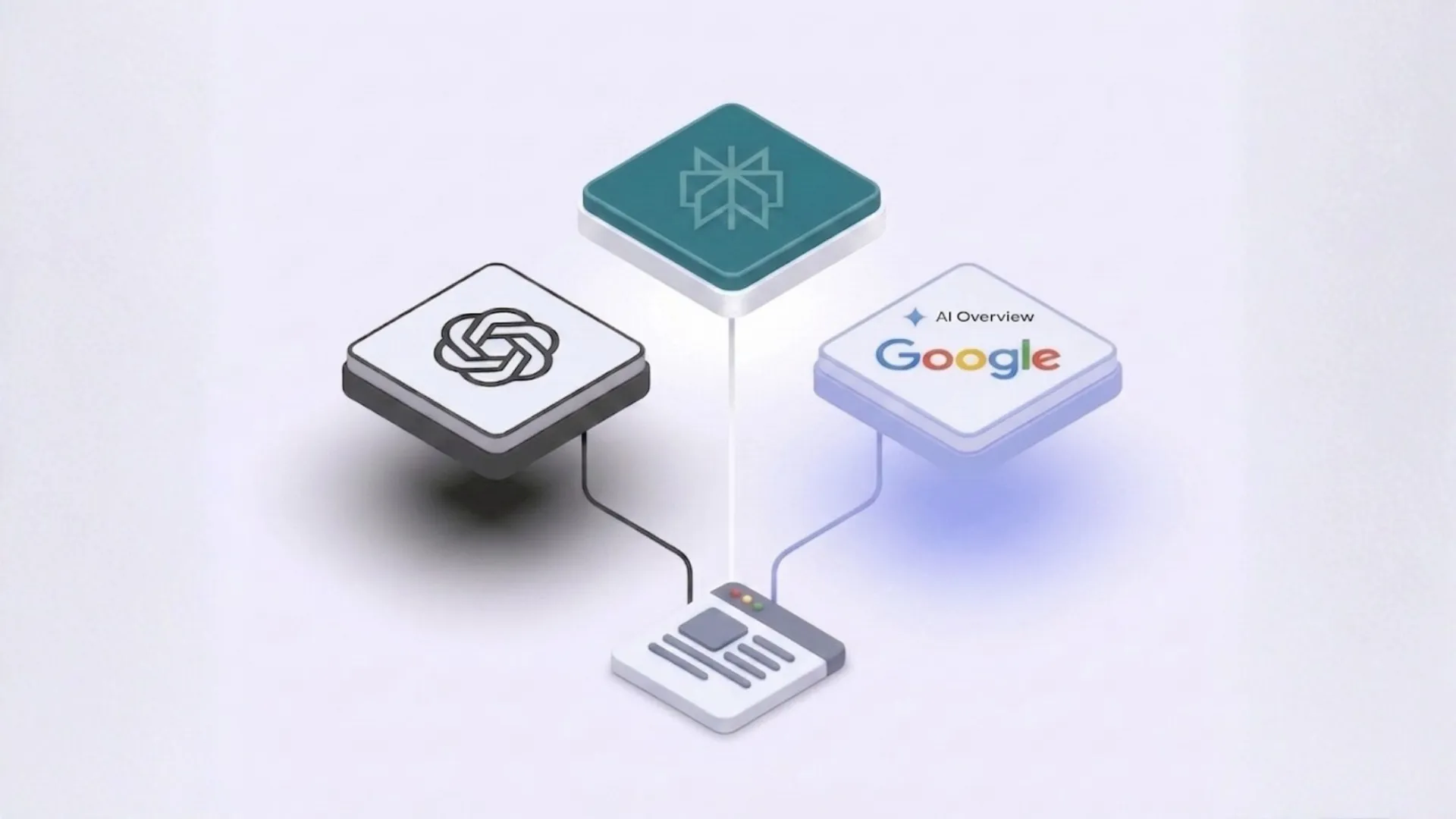
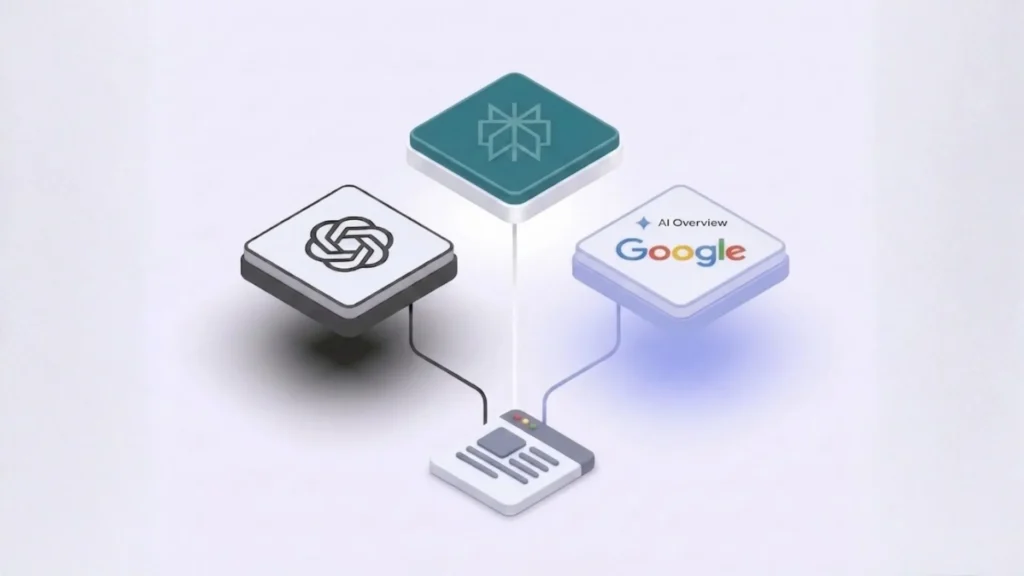
Google still sends traffic. But it’s no longer the only system deciding whether your content surfaces to an actual reader. ChatGPT, Perplexity, and Google AI Overviews now handle millions of queries daily — and they operate on a signal set that’s meaningfully different from PageRank. If you want to optimize your website for ChatGPT, Perplexity, and AI search visibility, replicating your 2022 on-page checklist isn’t enough. A page can hold the #1 position on Google and never appear in a single AI-generated response. That gap is real, and most SEO strategies haven’t closed it.
Here’s what makes this moment worth acting on now: only 16% of brands systematically track their AI search performance today, according to McKinsey. Most teams are still optimizing for a search environment that’s actively eroding. Gartner predicted a 25% drop in traditional search engine volume by 2026 — that prediction materialized. This article covers four concrete changes that move the needle for AI citation visibility: how each platform retrieves content differently, which structured data matters, what llms.txt actually does, and the E-E-A-T signals that LLMs weight most heavily. If you want the full strategic framework behind all of this, the complete guide to Generative Engine Optimization covers the broader picture. This article focuses on execution.
- Platform gap: ChatGPT retrieves via Bing, Perplexity uses a proprietary index with 3.3× fresher weighting than Google — only 11% of cited domains overlap between the two. One optimization strategy won’t cover both.
- Structured data: Schema markup helps LLMs parse entity relationships — author, organization, freshness, topic. Accuracy beats volume. Bloated or mis-applied markup does nothing useful.
- llms.txt: The file tells crawlers what to index — it is not a citation signal. No AI platform has confirmed it improves citation frequency. Treat it as robots.txt for LLM crawl intent.
- E-E-A-T: Thin, anonymous content was never weighted by LLMs in the first place. Author credentials, original data, and answer-first formatting are the highest-ROI signals — and AI citation is earned through source credibility, not keyword density.
How ChatGPT, Perplexity, and Google AI Overviews Retrieve Content Differently
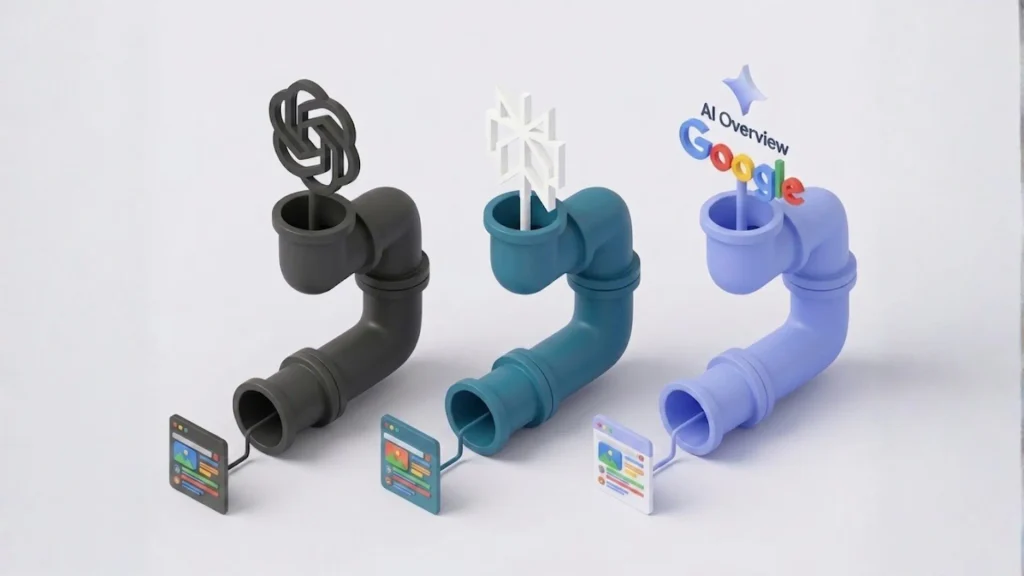
The single most costly mistake in AI search optimization is treating ChatGPT, Perplexity, and Google AI Overviews as one system. They are not. They use architecturally distinct retrieval backends, weight freshness differently, and prefer different content formats. Building a single strategy for all three is the equivalent of serving the same ad creative to a cold social audience and an in-market buyer — technically possible, almost certainly suboptimal. According to data from research into platform-specific citation behavior, only 11% of domains cited by ChatGPT Search and Perplexity overlap — meaning the two platforms are largely pulling from different source pools entirely.
The practical differences are concrete. ChatGPT Search retrieves content via the Bing index, so your Bing crawlability and Bing-indexed authority matter directly. Perplexity runs on its own proprietary index and weights freshness 3.3× more heavily than Google — which means stale content, no matter how comprehensive, is structurally disadvantaged in Perplexity citations. Google AI Overviews work differently still: they use passage-level extraction from the existing Google index, pulling the specific paragraph that best answers the query rather than the page as a whole. You can learn more about how to optimize content for AI Overviews using passage-level targeting — the standard page-level SEO mindset doesn’t transfer cleanly. The table below summarizes the key distinctions:
| Platform | Retrieval Backend | Freshness Signal | Format Preference | Citation Behavior |
|---|---|---|---|---|
| ChatGPT Search | Bing index | Standard (Bing-paced) | Listicle / list format | Cites Bing-crawled pages; favors authoritative domains |
| Perplexity | Proprietary index | 3.3× fresher than Google | Direct-answer passages | Cites recent, structured sources; strong freshness weighting |
| Google AI Overviews | Google index | Standard (Google-paced) | Passage-level answers | Pulls from top-10 results; CTR impact severe (−58%) |
Sources: platform-specific citation behavior research, McKinsey/Gartner AI search data
Structured Data That LLMs Actually Use
Most advice on schema markup for AI search falls into one of two failure modes: either skip it entirely because “LLMs don’t read schema,” or paste in every available type as a checkbox exercise. Both miss the point. Schema markup’s real function in an LLM context is entity disambiguation — it tells the model who wrote this, what organization stands behind it, what it’s specifically about, and when it was last updated. Those are precisely the signals that determine whether a source is treated as authoritative or anonymous. The Ahrefs study of 331,000 pages framed this clearly: Google penalizes bad, thin, and manipulative content — not AI content per se. The same quality logic applies to LLM surfacing; source credibility signals, not content origin, determine outcomes.
The schema types with the highest semantic payoff in AI citation contexts are Article (or TechArticle) with a properly linked author entity, FAQPage, HowTo, and Organization with knowsAbout populated. A minimal, accurate implementation outperforms a bloated one every time. Here’s a lean Article block that covers the critical fields:
One addition worth making explicit: a speakable specification pointing to your TLDR block and key answer passages signals to Google AI Overviews and voice assistants exactly where the direct-answer content lives. And because Perplexity weights freshness 3.3× more than Google, your dateModified field isn’t decorative — it’s an active retrieval signal. Refresh the timestamp every time you update a page with new data, and make sure those updates are substantive. The complete Answer Engine Optimization playbook covers entity markup in more depth if you want to go further on this.
What llms.txt Does (and Doesn’t Do) for AI Crawlers
The llms.txt file has attracted a lot of breathless coverage in the past year, and most of it overstates what the format actually does. The v2 spec at llmstxt.org is clear: the /llms.txt file is a plain-text, markdown-formatted document placed at your site root (or any subfolder path) that tells LLM crawlers which pages you want included when they’re processing your domain. It links to detailed markdown versions of your key content. It does not instruct any LLM on citation behavior. No major AI platform — not OpenAI, not Anthropic, not Google — has published documentation confirming that a well-structured llms.txt file improves how often your site gets cited. Treating it as a citation lever is wishful thinking unsupported by any platform’s public documentation as of mid-2026.
What it does accomplish is narrower but still worth doing. It reduces the chance that a crawler ingests low-quality, outdated, or structurally messy pages from your site — pages that add noise, not signal, to an LLM’s understanding of your domain. Think of it as robots.txt for LLM crawl intent, not as an SEO lever. The v2 spec also confirms that thousands of sites now publish an llms.txt file, documentation platforms auto-generate one, and Chrome’s Lighthouse audits for it as part of agentic browsing checks. OpenAI, Anthropic, and Gemini all publish their own llms.txt for their developer documentation — which means the AI labs themselves use the format they’re expected to read. But here’s the detail most practitioners miss entirely: the spec explicitly recommends that individual pages also expose a clean markdown version at the same URL, with .md appended (e.g., page.html.md) or substituted (page.md). This per-page markdown approach directly reduces the “expensive HTML-to-text conversion” friction that causes AI agents to skip or misparse pages — and it’s a more granular, higher-impact implementation than a root-level llms.txt alone. If you’re on WordPress, the step-by-step implementation guide walks through the whole setup in under ten minutes.
- Place /llms.txt at the site root with markdown-formatted links to your key content pages
- Add per-page .md alternates (page.html.md) for your highest-value articles — this is where most practitioners stop short
- Include rel=”alternate” type=”text/markdown” link headers pointing to the .md version of each page
- Exclude low-quality, outdated, or thin pages — the file should curate, not just mirror your sitemap
- Do NOT expect this to directly improve citation frequency — it signals crawl intent, not citation priority
- Audit with Chrome Lighthouse’s agentic browsing checks to confirm the file is recognized
E-E-A-T Signals That AI Systems Weight Heavily
Here’s the uncomfortable truth about thin content and AI citation: the problem isn’t that LLMs penalize it. The problem is that it was never in the running. LLMs are trained on data that already skews toward authoritative, entity-verified, frequently-cited sources. A page with no named author, no original data, and no credentials wasn’t excluded by an algorithm — it was never weighted to begin with. This is why Google’s Quality Rater Guidelines frame Experience, Expertise, Authoritativeness, and Trustworthiness not as ranking bonuses but as baseline requirements for serious consideration. The same logic applies to closed LLMs drawing from training data: they absorbed the signal distribution of the web, which skews heavily toward sources with those exact properties. The Ahrefs 331,000-page study reinforces this — what the data shows is that quality signals, not the AI origin of content, determine surfacing and demotion patterns. That’s the same mechanism at work in LLM training-data weighting.
The practical implementation follows from that. Named authors with verifiable credentials — LinkedIn profiles, Wikipedia entries, published bylines elsewhere — are an entity signal LLMs can resolve. Original data (a proprietary survey, a before/after test, specific metrics you measured) differentiates your source from the dozens of paraphrased articles covering the same topic. Answer-first paragraph structure matters for Google AI Overviews specifically: a page can be E-E-A-T-strong overall and still lose an AI Overview citation if the specific passage answering the query is vague or buries the answer behind context. Lead with the direct claim, follow with the evidence. And because GEO is 80% strategic and only 20% technical — positioning, ecosystem presence, brand authority — appearing as a cited source across third-party sites, industry publications, and forums compounds over time in a way that on-page changes alone cannot replicate. The detailed breakdown of E-E-A-T signals for AI content covers how to build those off-page authority markers systematically.
Frequently Asked Questions
Does having a fast, crawlable site actually affect whether ChatGPT cites it?
For ChatGPT in web-browsing mode, yes — crawlability matters directly because the model fetches live URLs when Browse is active. A page that’s blocked by robots.txt, slow to load, or JavaScript-heavy enough to impede parsing is functionally invisible. For Perplexity, this is even more pressing: it runs its own live crawl at query time, so real-time crawlability and page load speed affect whether your content makes it into the response at all. For training-data-based responses from closed LLMs, traditional crawlability matters less than historical authority and citation frequency.
Which schema type has the most impact on AI citation visibility?
Article with a properly linked author entity — specifically with a sameAs pointing to a verifiable external profile like LinkedIn or Wikidata — has the highest semantic payoff for AI citation contexts. It tells an LLM exactly who stands behind the content and whether that person is a recognized entity. FAQPage is a close second because it provides pre-structured question-answer pairs that map directly to how AI Overviews extract passage-level answers. Skip schema types you can’t populate accurately — mis-applied or half-completed markup adds no value and may introduce entity incoherence.
Is llms.txt required to appear in Perplexity results?
No. Perplexity has not published any documentation confirming llms.txt as a prerequisite or ranking input for citations. The file is a voluntary crawl-intent declaration, not a citation lever. Perplexity’s documented retrieval priorities are freshness (3.3× more weighted than Google), direct-answer formatting, and structured source authority. Focus on those first. Add llms.txt because it helps AI agents process your site cleanly — not because you expect it to move your citation frequency.
Can a site with no backlinks get cited by AI search platforms if its content quality is high?
It’s harder than the “content is king” framing suggests. ChatGPT Search retrieves via Bing, which means backlink-based authority still influences which pages get indexed and surfaced by the underlying index. Perplexity’s proprietary index weights freshness and structured sourcing heavily — a brand-new, well-formatted answer page has a real shot there even without deep link authority, especially on fresh topics. Google AI Overviews pull from the existing Google top-10, so without ranking signals you won’t appear. Highest-probability path: combine solid on-page quality with at least some third-party mentions to clear the baseline authority threshold each platform sets implicitly.
How do you actually measure whether your site is getting cited by AI platforms?
This is where most teams are still flying blind. Start with manual spot-checks: run your target queries in ChatGPT, Perplexity, and Google AI Mode and record whether your domain appears as a cited source. Do this weekly for your top-10 head terms and track it in a simple spreadsheet. For scale, tools like Profound, Semrush’s AI Toolkit, and dedicated share-of-model trackers are emerging specifically for this use case. The metric to watch is citation frequency by platform — not aggregate “AI traffic,” which conflates very different retrieval behaviors. And because only 16% of brands systematically track AI search performance, even a basic manual audit puts you ahead of most competitors still optimizing for a pre-AI search environment.
AI search isn’t one system you optimize for once. It’s three platforms with distinct retrieval architectures, different freshness tolerances, and separate content preferences — and only 11% of domains cited by ChatGPT and Perplexity overlap. The optimization work that earns you citations on Perplexity (fresh content, direct-answer passages, clean markdown) is different from what earns you an AI Overview slot on Google (passage-level E-E-A-T, structured data, existing index authority). Start by auditing which platforms are actually in your traffic mix right now, then apply platform-specific changes before trying to cover all three at once. That’s how practitioners build AI search presence — not by adding every schema type and hoping for the best, but by matching the right signal to the right retrieval system.
References
External sources
- GEO, AEO, and SEO in 2026: The enterprise guide to AI visibility – WRITER — https://writer.com/blog/geo-aeo-optimization/
- How to Optimize Content for Perplexity and ChatGPT Search (2026 Guide) | Shadow — https://www.shadow.inc/resources/how-to-optimize-content-for-perplexity-and-chatgpt
- Google Doesn’t Punish AI Content; It Punishes Bad Content (331k Pages Studied) — https://ahrefs.com/blog/google-doesnt-punish-ai-content/
- The /llms.txt file, v2 – llms-txt — https://llmstxt.org/
Related content
- Answer Engine Optimization: The Complete 2026 Playbook for Winning AI Answers — Contentosapp
- How to Rank in ChatGPT and Perplexity: Get Cited, Not Just Ranked — Contentosapp
- How to Optimize Content for AI Overviews: The Passage-Level Method — Contentosapp
- AI Overviews Traffic Drop: How to Diagnose Your Exposure and Win Back Clicks — Contentosapp
- llms.txt for WordPress: What It Is, What It Can’t Do, and How to Add It in 10 Minutes — Contentosapp
- E-E-A-T for AI Content: The Exact Signals That Make Google Take You Seriously — Contentosapp