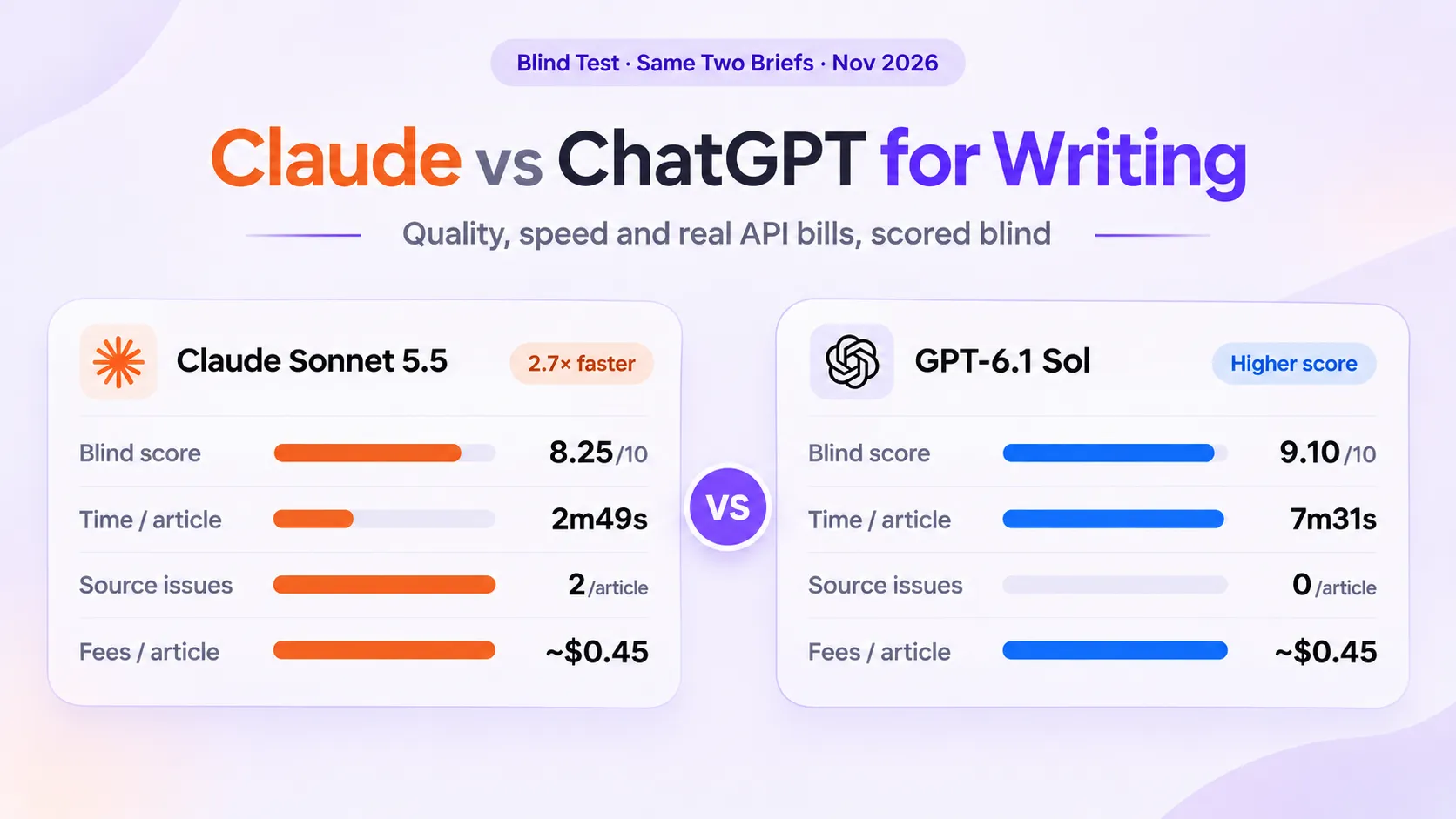
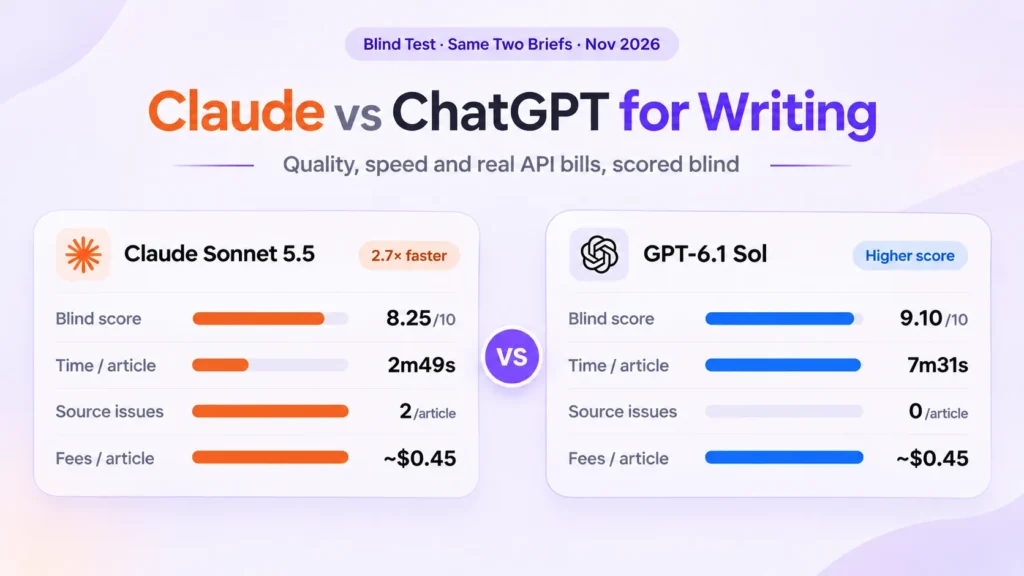
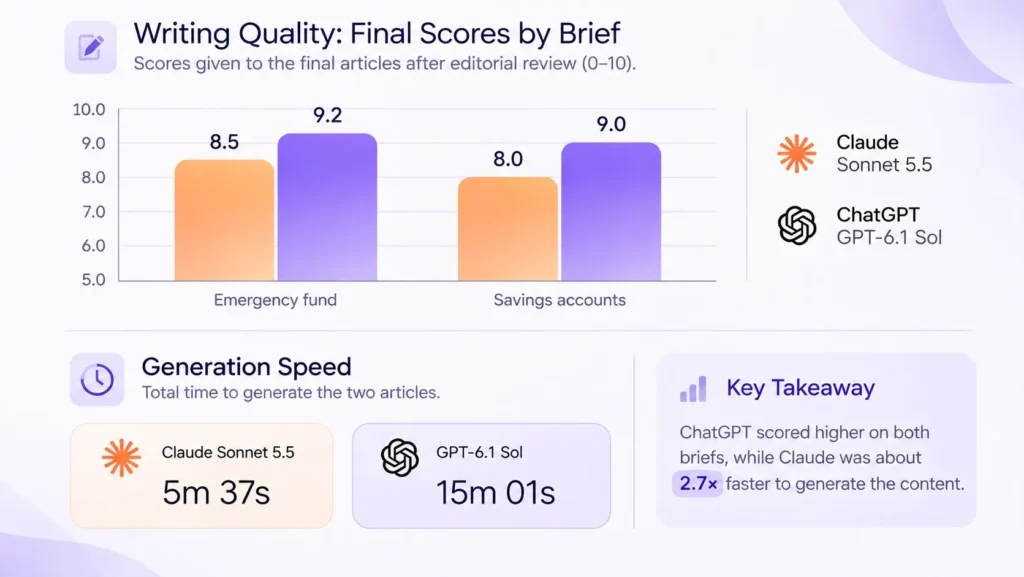
The higher-scoring model needed corrections; the faster model passed internal review immediately. In Contentosapp’s November 17, 2026 test of Claude vs ChatGPT for writing, GPT-6.1 Sol earned higher final-draft scores on both briefs, while Claude Sonnet 5.5 finished about 2.7 times faster. Model fees were effectively tied.
“ChatGPT” is shorthand here: we tested OpenAI and Anthropic API models, not the consumer apps. If you produce informational blog posts, these results show the trade-off between final quality, generation speed, and source repairs—not which brand wins every writing task.
What We Tested and How the Blind Read Worked
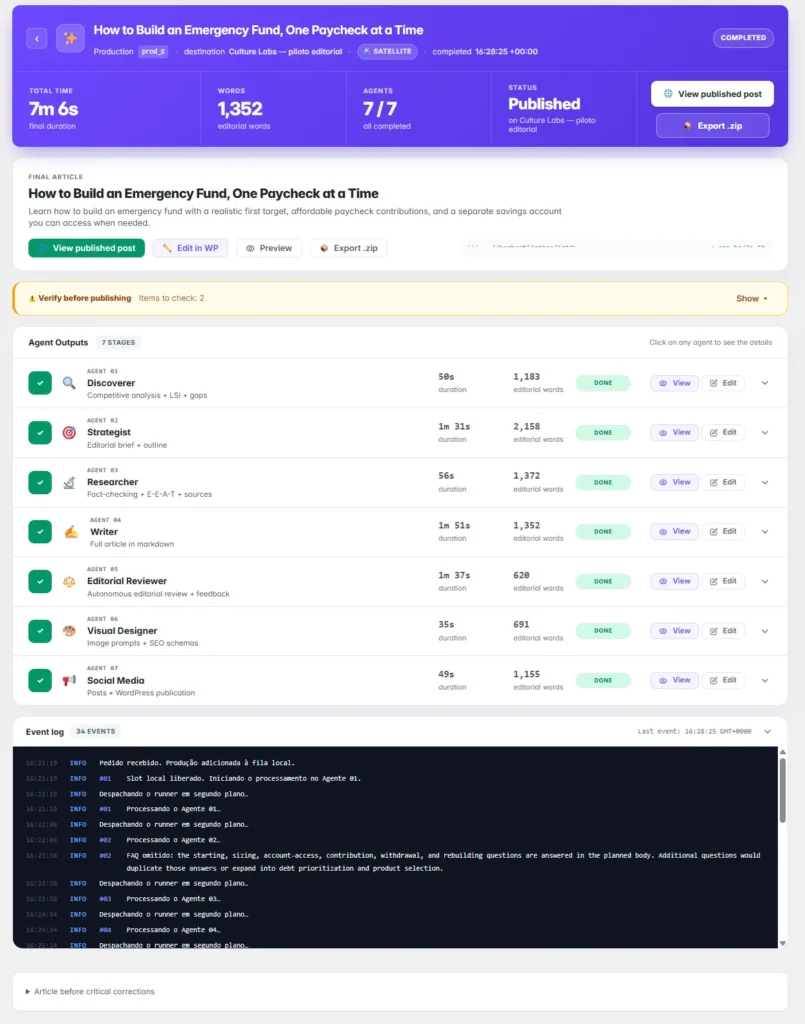
We ran the test on November 17, 2026, on a WordPress test site using Contentosapp Studio’s seven-agent pipeline: Discoverer, Strategist, Researcher, Writer, Editorial Reviewer, Visual Designer, and Social Media. Images were disabled, and the articles were saved as drafts.
How each article moved through the pipeline
Seven agents, one model call each. The Editorial Reviewer can send a draft back once.
- Discoverer · search intent and competitor gaps
- Strategist · editorial brief and outline
- Researcher · sources and fact-checks
- Writer · the full draft
- Editorial Reviewer · checks the draft against the brief
- ↺ Correction pass: when the Reviewer flags a critical issue, the Writer and the Reviewer run again. It happened on both GPT articles and on neither Claude article.
- Visual Designer · image prompts and schema
- Social Media · social posts
Claude Sonnet 5.5: 7 calls per articleGPT-6.1 Sol: 9 calls per article
Both models received identical inputs, brand voice, and settings for the same two US personal finance briefs:
- “How to build an emergency fund”
- “High yield savings account vs money market account”
The models were Claude Sonnet 5.5 (claude-sonnet-5-5) and GPT-6.1 Sol (gpt-6.1-sol). We accessed each provider’s API with our own keys, a bring your own key setup in which model usage is billed through the provider.
This is a newer, narrower comparison than our six-model blog-writing test. That broader test used older model versions and different briefs, so its results aren’t directly comparable with this head-to-head.
A blinded editorial read, not a benchmark
The four drafts were relabeled with random numbers and stripped of their titles. The site’s editor, who had run the productions, scored them without knowing the model-to-draft mapping.
That provides a useful blind read, but not an independent panel or a validated scoring system. The scores reflect one reader’s subjective judgment, and prior involvement in production could have allowed recognition.
We evaluated finished pipeline drafts, including any corrections. This was not a single-prompt writing contest, and it covered informational articles only—not fiction or other writing genres.
Claude vs ChatGPT for Writing: Quality and Speed Results
The trade-off at a glance
Averages of each model’s two articles; fees are the billed total for both. The table below has every article.
Claude Sonnet 5.5GPT-6.1 Sol
Blind score · out of 10, higher is better
Generation time · per article, lower is better
Source or link problems · per article, lower is better
Model fees · both articles, lower is better
Here are the article-level results from Contentosapp’s experiment. Scores apply to the final drafts after pipeline corrections, while generation time measures elapsed workflow time—not human editing time.
| Brief | Model | Blind score / 10 | Generation time | Words | Model calls |
|---|---|---|---|---|---|
| Emergency fund | Claude Sonnet 5.5 | 8.5 | 2m42s | 1,388 | 7 |
| Emergency fund | GPT-6.1 Sol | 9.2 | 7m06s | 1,352 | 9 |
| Savings accounts | Claude Sonnet 5.5 | 8.0 | 2m55s | 1,503 | 7 |
| Savings accounts | GPT-6.1 Sol | 9.0 | 7m55s | 1,244 | 9 |
GPT’s first draft on each brief triggered one critical-correction pass from the Editorial Reviewer, increasing its model calls from seven to nine per article. Both Claude drafts passed internal review the first time.
Yet GPT’s corrected drafts scored higher. First-pass acceptance and final reader preference were different outcomes.
Across both articles, Claude took 337 seconds and GPT took 901 seconds. The calculation is 901 ÷ 337 ≈ 2.67, so Claude finished about 2.7 times faster. We did not measure whether that translated into less human work.
Where the editor preferred GPT
The editor judged GPT’s final drafts more technically consistent and careful in their presentation. In the emergency-fund article, the plan included a cash-flow check before each paycheck. In the savings-account comparison, the editor found the $5,000 interest-after-fees example useful.
Those are observations about how the drafts explained their subjects, not financial recommendations.
GPT still lost points. The editor found its opening less engaging, some passages overly instructive, and its treatment of the three-to-six-month savings goal limited.
Where Claude read better
Claude’s strengths were presentation and accessibility. The editor praised its engaging opening, expense and timeline tables, and progressive goals.
But the drafts also included recommendations the editor considered too rigid, alongside source and link problems. For your workflow, that distinction matters: an inviting draft can still need repairs that an internal approval step misses.
Source Checks Revealed Problems the Scores Alone Miss
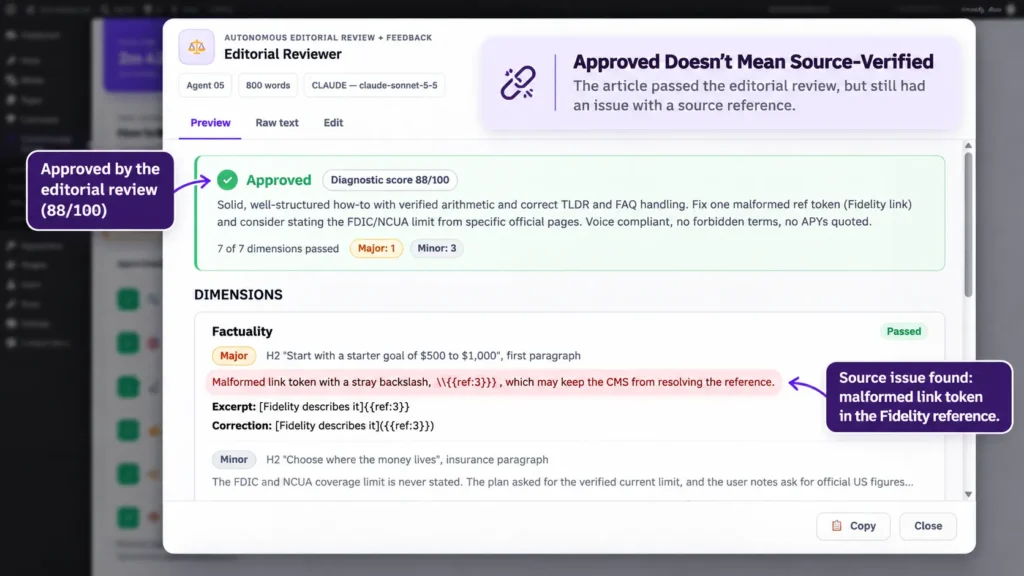
Our test checks identified no factual errors in any of the four drafts, and all calculations checked out. That finding does not mean every draft was ready to publish.
Our fact-check found two attribution or link problems in each Claude article and none in the GPT drafts:
- Emergency fund: one link came out empty because the Writer typed the reference tag for a Fidelity page with an extra backslash. Another sentence credited Vanguard with advice about fixed and variable “essentials,” while the Vanguard page talks about fixed and variable expenses.
- Savings accounts: one sentence credited a Capital One page with saying APY includes compounding, which that page does not say, although the fact itself is correct. Two phrases, “as one bank explains” and “one bank suggests,” lost their source when another bank’s page failed the pipeline’s link check and was dropped from the references.
The savings article had a second layer of trouble. Claude’s Writer linked six official sources, the FDIC, NCUA, Federal Reserve, CFPB, SEC, and IRS, with reference numbers that did not exist in the research list. The pipeline removed all six links, so only commercial sources stayed linked. The editor marked that draft down for leaning on commercial sources, even though its facts were right.
Factual correctness and source integrity are separate checks. A sentence can be correct while its link is empty, points to the wrong evidence, or disappears during processing.
The two GPT drafts had no source problems in our check. That is two drafts, not a guarantee about future citations.
Actual API Costs Were Effectively Tied
Contentosapp’s provider-billed model fees differed by just one cent across the two articles.
| Model | Emergency-fund article | Savings-account article | Billed total |
|---|---|---|---|
| Claude Sonnet 5.5 | $0.44 | $0.47 | $0.91 |
| GPT-6.1 Sol | About $0.44* | About $0.46* | $0.90 |
GPT’s per-article allocation is estimated because the productions used a shared API key. The reported two-article billed total was $0.90.
These costs include prompt-cache writes and workflow calls, including GPT’s correction passes. Rounded for planning, either model cost about $0.45 per article in this test. The one-cent difference is not a meaningful cost advantage.
The tie is less surprising once you see the list prices. At standard context lengths, both models list at $2 per million input tokens and $10 per million output tokens, according to Anthropic’s pricing page and OpenAI’s pricing page. Cache writes cost more than plain input on both: Anthropic charges 1.25 times the base input price for five-minute writes, and OpenAI lists GPT-6.1 Sol’s 30-minute writes at $2.50 per million tokens. List prices explain the rates; the totals above come from each provider’s billing console.
Your model bill also isn’t your publishing cost. These figures exclude subscriptions, Contentosapp charges, hosting, human editing, and any other production expenses.
The missing measurement is human repair time. We did not track it, so this experiment cannot establish which model was cheaper to take from draft to publication.
Frequently Asked Questions
Is Claude better than ChatGPT for creative writing?
This test can’t answer that. We scored informational blog articles, where accuracy, structure, and sourcing carry most of the weight. Fiction rewards voice, imagery, and character, so it needs its own test with its own criteria.
Is Gemini better than Claude for writing?
Not in our earlier six-model test, which used older versions. In September 2026, Claude Sonnet 5 made 1 factual error in 20 checked claims, against 6 for Gemini 3.1 Pro and 5 for Gemini 3.5 Flash, and it scored 9.55 in the blind read against 7.95 and 8.05. Gemini 3.1 Pro was the fastest writer, at about five minutes per draft.
Can you switch between Claude and GPT in Contentosapp Studio?
Yes. Contentosapp Studio’s AI provider setting supports Claude, OpenAI, and Gemini with your own API key, so you can run the same brief through each model, as we did here. For other ways to bring Claude into WordPress, see our guide to Claude for WordPress.
Choose With Your Own Briefs Before Scaling
For accuracy-sensitive informational work, including these personal finance subjects, GPT-6.1 Sol produced the stronger final drafts in this test. If your priority is faster generation and engaging how-to presentation, Claude Sonnet 5.5 is a reasonable starting candidate. Observed model fees don’t separate them.
Keep the limits in view: two briefs, one niche, one reader, one pipeline, and unequal correction histories. We tested API models, not the ChatGPT and Claude apps, whose default models can differ. This does not establish performance across YMYL publishing generally.
Before scaling, run representative briefs through your own workflow and anonymize the outputs. Compare final quality, source integrity, generation time, and actual billing—and add the measurement our test lacked: how long you spend repairing each draft before publication.
This article was drafted with Contentosapp Studio on GPT-6.1 Sol, then fact-checked and edited before publishing.
References
External sources
- Pricing – Claude Platform Docs — https://platform.claude.com/docs/en/about-claude/pricing
- Pricing | OpenAI API — https://developers.openai.com/api/docs/pricing