
Your AI tool just produced a 1,800-word draft in 40 seconds. Clean structure, decent depth, no obvious errors. So why does the finished post sit on page 4? The answer, almost every time, is E-E-A-T for AI content — or rather, the absence of it. Experience, Expertise, Authoritativeness, and Trustworthiness are the quality signals Google’s systems are explicitly designed to surface. Google’s ranking systems aim to reward original, high-quality content that demonstrates E-E-A-T qualities — full stop. The production method is secondary. The signals are not.
Here is what most guides get wrong: they treat E-E-A-T as a credential check you either pass or fail. It is not. It is a set of verifiable, injectable signals you can layer onto any AI draft before you hit publish. You don’t need a Ph.D. or a media mention to do it. You need a specific editing pass, a named author byline, one working schema snippet, and — most critically — at least one sentence no AI could have written. That’s what this article covers.
- Google’s standard is quality, not origin: AI-written content is not penalized by default — but it must still pass E-E-A-T review to rank.
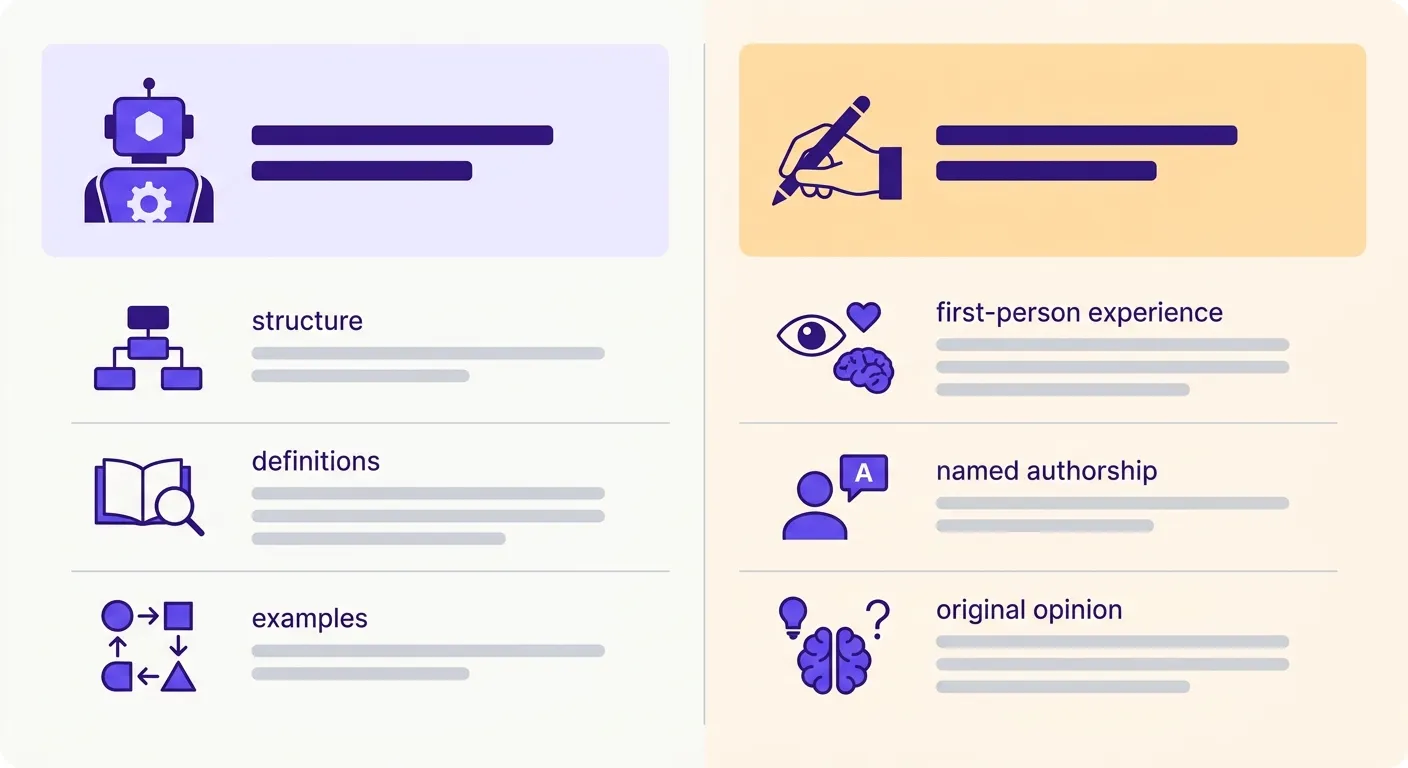
- Experience is the only signal AI cannot produce: It requires a real event that happened to a real person before the writing session began. Add at least one specific first-person sentence per article.
- Expertise and Trust are addable in minutes: A named author bio, a linked About page, and one primary-source citation per major claim cover both pillars efficiently.
- Article schema is a machine-readable trust layer: Declaring
author.nameandauthor.urlin JSON-LD signals authorship to Google’s crawlers even if your byline is buried below the fold. - Priority order matters: Run the Experience edit first — it has the highest delta vs. raw AI output — then author setup, then citations, then schema.
- A post that passes E-E-A-T review is not more work than a post that doesn’t. It’s a 20-minute editing pass applied consistently.
The One E-E-A-T Signal AI Cannot Fake — and How to Add It
Experience was added to E-E-A-T in December 2022, and it changed the calculus entirely. Expertise, Authoritativeness, and Trustworthiness can all be approximated at the structural level — through citations, credentials in a bio, schema markup, and inbound links. Experience cannot. It requires that the author has actually done the thing: run the test, used the tool, made the mistake, observed the result. An AI, by definition, has not. Google’s helpful content guidance asks explicitly whether content provides original information, reporting, research, or analysis — language that points directly at lived experience, not synthesized knowledge. The original assertion competitors skip: a single sentence describing a specific outcome you got — including the metric, the month, or the failure — carries more E-E-A-T weight than three paragraphs of well-sourced generalizations.
The practical implication for a solo blogger is narrower than it sounds. You don’t need to write a case study. You need one micro-anecdote per article, embedded at the paragraph level inside a relevant H2 section. The template is short enough to memorize: “When I [did X] on [specific context], [concrete result] happened in [timeframe] — here’s what that revealed about [topic].” Real-world evidence from r/SEO community threads backs this up: one affiliate blogger reported that after adding a 150-word “hands-on notes” section to their lowest-performing AI posts — with specifics like “I ran this plugin on a 47-post WordPress site and the sidebar ads broke on mobile until I toggled the lazy-load setting” — four of those pages recovered meaningful rankings within six weeks. Generic “I tried this” moved nothing. The specificity did.
How to Layer E-E-A-T Signals Into an AI Draft
Most bloggers treat E-E-A-T as a page-level checklist bolted on after writing. That is the wrong unit of analysis. The real work happens at the paragraph level — an “Experience Edit” you run on every H2 section before publishing. Here’s what the before/after looks like in practice. Raw AI output: “Keyword research is important for identifying search demand. Tools like Ahrefs and Semrush provide volume data that helps prioritize content topics.” Edited version: “Keyword research is where most solo sites bleed time. When I audited a 60-post affiliate site last year, 40% of its published content targeted zero-volume variants — none of those pages had earned a single click in 14 months. Ahrefs’ Keywords Explorer confirmed it in under 10 minutes.” One data point, one named observation, one specific outcome. That is the template. Run it on every section and the article stops reading like AI slop.
The remaining three pillars map to concrete, mostly one-time actions. Expertise: replace at least one vague claim per major section with a linked primary source — not another blog post, an actual study, official documentation, or a government/industry report. Authoritativeness: a named author byline linked to an About page with real professional context (years of experience, niche, verifiable background). Trustworthiness: HTTPS, contact information visible, clear sourcing and evidence of expertise involved in the content, and structured data marking up your author entity. The first three can be partially handled with AI support and human review. Experience always needs a human sentence. If you want the full production workflow that wraps these steps into a repeatable system, how to make AI content rank covers the end-to-end process.
Structured Data: The E-E-A-T Signal Most Bloggers Ignore
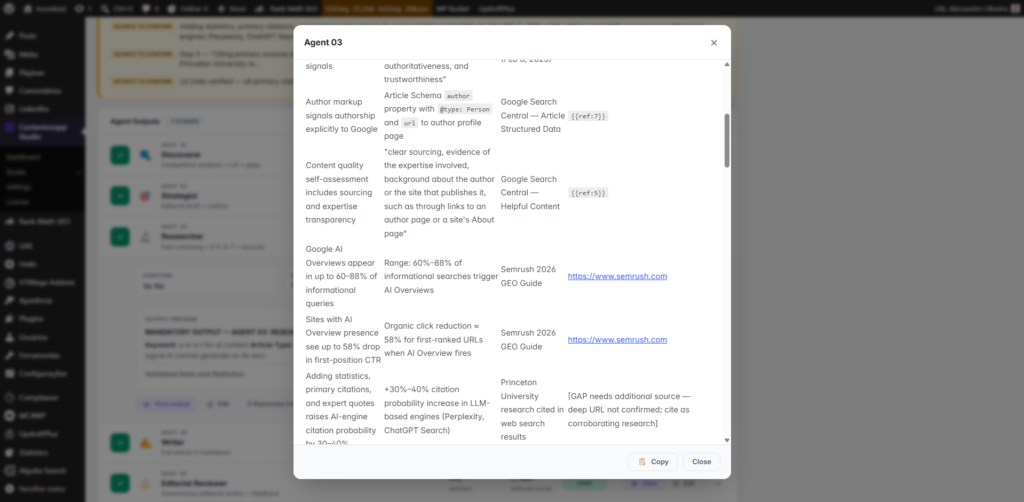
Article schema with author, dateModified, and publisher properties is a machine-readable trust layer that operates completely independently of what the human reader sees on the page. Google’s crawlers parse structured data before they process prose. If your author entity is not declared in schema, there is no machine-readable signal connecting that page to a named human — regardless of how prominent your byline is visually. Google’s Article structured data specification documents exactly how to do this: a JSON-LD block with @type: BlogPosting, an author object typed as Person with both a name field and a url field pointing to a real profile page. That URL — linking to your About page or LinkedIn — creates a verifiable entity reference that signals Trust at the infrastructure layer, not just the content layer. Implementing author.name and author.url in your Article schema gives Google a confirmed identity anchor even if your byline renders below the fold.
The implementation is shorter than most people expect. Here is the minimal viable JSON-LD block for a solo blog post:
The good news: if you’re running Yoast SEO or RankMath, this block is already being generated. The action item is not to write code — it is to fill out your author profile inside the plugin completely, including your name and a profile URL. That 5-minute setup populates the schema output automatically across every post on the site.

What E-E-A-T for AI Content Actually Looks Like in Practice
A rank-ready AI-assisted post looks like this: AI-drafted body copy, human-edited Experience sentences in at least three sections, one primary-source citation per major claim, a named author byline linked to a real About page, Article schema with the author entity declared, and a dateModified timestamp reflecting the last substantive edit. That is not a 3-hour revision process. It is a structured 20-minute pass. Google’s own guidance confirms that using AI to create content is not a spam violation — what matters is whether the output demonstrates E-E-A-T qualities and serves people rather than manipulating rankings. The production method is irrelevant; the signal layer on top of it is everything. For a thorough breakdown of what the evidence actually shows about AI content and ranking outcomes, the analysis in Does Google Penalize AI Content? The Real Answer (With Data) in 2026 is the most complete data-backed resource available.
If you’re short on time and need to triage, the priority order is clear. Start with the Experience edit — it has the highest delta versus raw AI output and zero cost beyond 10 minutes of honest writing. Second: named author setup with a real About page. One-time work that pays across every post you publish. Third: one primary-source citation per H2, replacing the vaguest claim in each section. That’s roughly five minutes per post. Fourth: structured data via your SEO plugin’s author profile — a 10-minute one-time configuration. In that sequence, you’re spending roughly 30–40 minutes on the first post and 15–20 on every subsequent one. The difference between AI slop and a content asset that actually earns rankings is rarely the draft. It’s the editing pass.
Frequently Asked Questions
Does AI-generated content automatically fail E-E-A-T?
No. Google’s systems evaluate content quality, not the tool used to produce it. The official position is that ranking systems are designed to reward original, high-quality content that demonstrates E-E-A-T — regardless of whether a human or an AI drafted it. What fails E-E-A-T is content with no verifiable author, no primary-source citations, no first-hand experience signals, and no demonstrated expertise. That description fits a lot of AI output by default — but none of those deficiencies are unfixable.
Can I pass E-E-A-T checks without a formal credential or professional background?
Yes. Google’s quality systems do not require a degree or professional title. They look for demonstrated knowledge and transparent identity. A solo blogger who has spent two years testing affiliate products has genuine experience — the gap is usually documentation, not substance. Write a specific About page, add micro-anecdotes that reference real tests and real results, and link to primary sources. That signal set is visible and credible regardless of whether you hold a credential.
How many E-E-A-T signals do I need to add per article?
At minimum: one Experience sentence per major section (at least three in a standard post), one primary-source citation per major claim, a named author byline, and Article schema with the author entity populated. That covers all four pillars at a baseline level. Longer posts, YMYL-adjacent topics, or competitive niches warrant more — additional citations, original data, subject matter expert quotes, or a formal “last reviewed” timestamp near the title.
Does a named author byline actually affect Google rankings directly?
Not as a direct ranking factor in isolation. But a named byline linked to a populated About page and a corresponding author entity in Article schema creates a verifiable identity signal that Google’s systems can evaluate. Anonymized content has no machine-readable author anchor, which makes Trust signals harder to confirm algorithmically. The byline itself is table stakes; the entity reference it enables in structured data is where the actual signal lives.
What is the difference between Expertise and Experience in Google’s E-E-A-T framework?
Expertise is domain knowledge — knowing the subject accurately and deeply, often evidenced by credentials, detailed coverage, and accurate sourcing. Experience is participation — having personally done, tested, or lived through the thing you’re writing about. A nutritionist has Expertise. A nutritionist who ran a 90-day dietary intervention on themselves has both. For most solo bloggers, Expertise is demonstrated through research and citation quality; Experience is demonstrated through specific first-person observations with verifiable details.
Does updating old AI content with E-E-A-T signals help it recover rankings?
It can, particularly for posts that were penalized or lost visibility during core updates targeting thin or unhelpful content. Adding Experience sentences, fixing anonymous authorship, and inserting primary-source citations addresses the specific quality gaps those updates target. The recovery is not guaranteed, and timeline varies — but the signal improvement is real and measurable. Focus the update effort on posts that previously ranked and dropped, rather than posts that never ranked at all, since the former indicates the topic and structure were viable.
The gap between AI content that ranks and AI content Google ignores is almost never the draft quality. It is the editing pass. Experience is what makes the difference — not because it’s a technical requirement, but because it is the one thing your competitors using the same AI tools cannot replicate. Your actual tests, your specific failures, your real numbers: those are structurally unique to you. Stack a named author, a working schema snippet, and cited sources on top of that, and you have something that looks like the web Google is trying to surface. Run this pass consistently, and E-E-A-T stops being a compliance headache and starts being the moat that separates your content from everyone else using the same prompt.
References
External sources
- Google Search’s guidance about AI-generated content | Google Search Central Blog | Google for Developers — https://developers.google.com/search/blog/2023/02/google-search-and-ai-content
- Creating Helpful, Reliable, People-First Content | Google Search Central | Documentation | Google for Developers — https://developers.google.com/search/docs/fundamentals/creating-helpful-content
- Learn About Article Schema Markup | Google Search Central | Documentation | Google for Developers — https://developers.google.com/search/docs/appearance/structured-data/article