
SEO for doctors, also called medical SEO or healthcare SEO, is the work of making a medical practice findable and trustworthy in the local map pack, organic search results and Google’s AI Overviews. AI can now draft a patient-education page in minutes, but Google holds health content to a higher standard than almost any other topic. Most advice either ignores that collision or tells you to stay away from AI entirely.
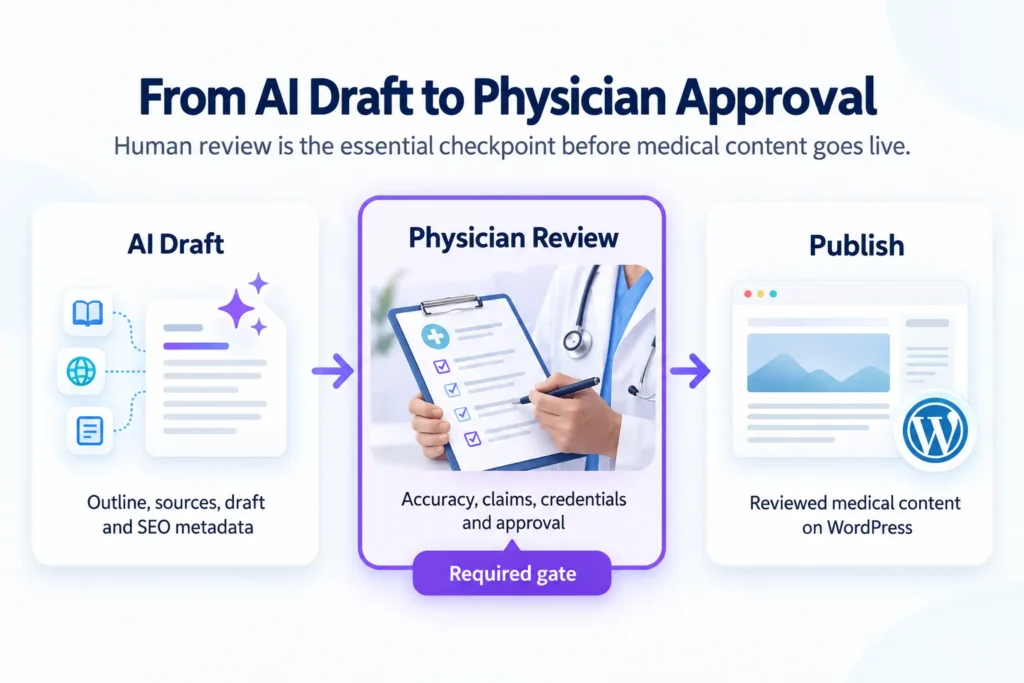
Neither is useful. My position is simple: AI can take over the drafting and the repetitive packaging work, but a named physician has to own every claim, every credential and anything that touches a patient. The physician’s visible sign-off is not a compliance chore bolted on at the end. Google doesn’t list it as a ranking factor, but on health pages it is how a practice delivers what Google does ask for: accurate content, consistent with expert consensus, from a clearly identified source.
This guide splits the work task by task. You’ll see what Google says about health content and AI, which jobs are safe to hand to a model, where the FTC and HIPAA add rules most SEO guides skip, and a workflow you can repeat. It doesn’t cover clinical AI such as diagnosis or scribes, paid ads, or EHR software. Facts are current as of October 21, 2026, and this article is general information, not legal or medical advice.
What SEO for Doctors Means in 2026
In practice, SEO for doctors plays out on three surfaces, each with different rules. The sections below take them in turn, then deal with the myth that AI search needs its own playbook.
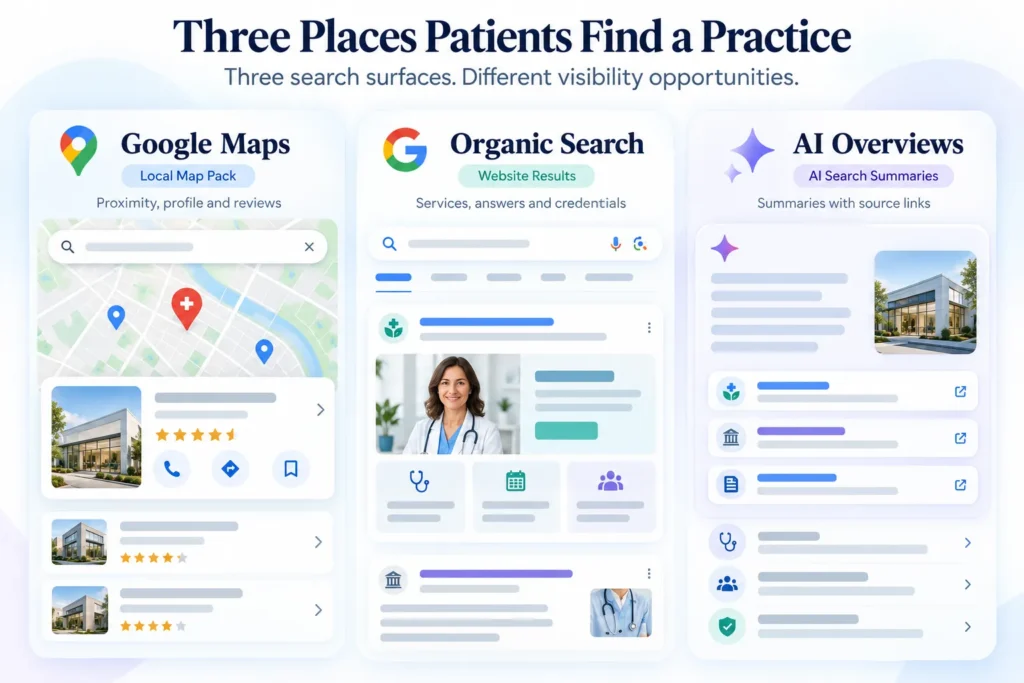
The three places patients find a practice
The local map pack shows nearby practices with ratings, hours and a link to a website. Organic results show pages that answer a query, such as a procedure explainer or a “what to expect” article. AI Overviews summarize a topic and link to supporting pages. Your Google Business Profile feeds the first, your website feeds the second and third, and reviews touch all of them.
How Google ranks local results
Google Business Profile Help states that local results are mainly based on relevance, distance, and popularity. It is blunt about the other half: there is no way to request or pay for a better local ranking. Prominence draws on how many websites link to your business and how many reviews you have, which is exactly why the review rules in section four matter. Verifying the profile, keeping information complete and accurate, and responding to reviews are the controllable parts.
AI Overviews need no special optimization
Google’s documentation on AI features says there are no additional requirements to appear in AI Overviews or AI Mode, “nor other special optimizations necessary.” A page must be indexed and eligible to show in Search with a snippet. The same documentation says there is no special schema.org structured data you need to add, and that AI Overviews often don’t trigger at all.
So when an agency pitches “AI Overview optimization for doctors” as a distinct service, you are buying ordinary SEO under a new label. The foundations are the ones you already know: technical eligibility, policy compliance and helpful, reliable content. Nobody can promise you a citation.
A single-city snapshot from Brazil
One data point shows why a practice’s own website still matters. A Meu Negócioo survey of Google Maps results in Indaiatuba, Brazil, checked on October 12, 2026, looked at 88 businesses across nine business types. Only 30% of the top 10 dentists linked their Google Business Profile to their own website. Across all 88 businesses, 33% linked to their own site, 36% had no website link and 31% pointed to Instagram, WhatsApp or a third-party page.
Treat this as one city in Brazil, not a US statistic. Maps results also vary with the searcher’s location, so the numbers show what a resident saw that day. What it does support is modest: a profile can show a practice, but the website is where services, answers and credentials live.
What AI Can Safely Automate in Medical SEO
AI is a drafting and packaging tool here, never the author of record. Google doesn’t treat AI as the problem. Its guidance says that appropriate use of AI or automation is not against its guidelines, and that using AI doesn’t give content any special gains: “It’s just content.” The limit is intent. Using automation to generate content with the primary purpose of manipulating ranking is a spam-policy violation, however the text was produced.
That is why the split below follows risk, not technology. The danger on a medical site sits in claims and identity, not in sentence structure. A model is good at structure, variants and formatting. It is unreliable at knowing whether a statement matches expert consensus, and it has no standing to vouch for anyone’s credentials. The split itself is my own working framework, built on Google’s wording rather than something Google publishes.
The task split
What AI can draft — and what physicians or practice staff must verify.
| Task | What AI does | Physician or staff responsibility |
|---|---|---|
|
Patient-education article drafts
|
AI · Drafting
Drafts content from real patient questions and sourced material. |
Physician · Clinical approval
Verifies every clinical statement against established expert consensus and signs off with their real name, credentials and review date. |
|
Procedure page outlines
|
AI · Structure
Proposes headings and questions the page should address. |
Physician · Scope & claims
Confirms the scope and services the practice actually offers, removes unsupported treatment outcome claims and checks applicable state advertising rules. |
|
FAQ drafts
|
AI · Questions & answers
Drafts common questions and plain-language answers. |
Physician & staff · Review
A physician approves each clinical answer. Staff removes any patient-specific details before publication. |
|
Meta titles and descriptions
|
AI · Variations
Generates alternative SEO titles and meta descriptions. |
Staff · Accuracy
Checks that metadata accurately describes the page and does not promise results or misrepresent the practice’s services. |
|
Schema markup drafts
|
AI · JSON-LD
Drafts structured data such as Physician, MedicalClinic and FAQPage where appropriate. |
Staff · Validation
Confirms that every marked-up fact is accurate and matches information visible on the page. Checks that the selected schema type is appropriate. |
|
Google Business Profile posts
|
AI · Short-form copy
Drafts short updates and informational posts. |
Staff · Business details
Verifies opening hours, services and offers. Removes unsupported treatment outcome claims before posting. |
|
Review-reply templates
|
AI · Generic templates
Drafts non-identifying response templates without patient information. |
Staff · Privacy review
Reviews each reply before posting. Never confirms that a reviewer is a patient or reveals information about their condition or care. |
|
Internal links
|
AI · Suggestions
Suggests relevant internal link destinations and anchor text. |
Staff · Link verification
Confirms relevance and checks that destination pages exist, work correctly and have been reviewed for accuracy. |
What AI must never do alone
- Clinical claims: only a physician can judge whether a statement matches expert consensus.
- Treatment outcomes: outcome language invites advertising and consumer-protection problems.
- Credentials: a model can’t verify a license, and an invented one is deception.
- Author bios: a bio is a statement of identity and must describe a real person.
- Patient reviews: the FTC rule targets fake and misleading reviews, including AI-generated ones. Changing what a real patient wrote can make a review misleading, so keep AI out of reviews as a practice policy.
- Replies that name a person or condition: see the HIPAA section below.
What a Physician Must Review, and Why Google Cares
Health content falls under what Google calls Your Money or Your Life topics. Its systems give even more weight to content that aligns with strong E-E-A-T for topics that could significantly impact health, financial stability or safety. Google doesn’t say a physician’s signature improves rankings on its own, and this guide doesn’t claim it does. Physician review is the editorial policy that best meets that accuracy bar, and it’s the one input a competitor running unreviewed AI output can’t copy by pressing a button.
YMYL and the accuracy bar
For these topics, Google’s documentation says “the content must be highly accurate and consistent with established expert consensus.” That is a standard for the content, not the tool. If you want the full signal breakdown, Contentosapp’s guide to E-E-A-T for AI content covers how those signals show up on a page. For a practice, the translation is blunt: an AI draft is a hypothesis until a physician has checked it.
Who, How and Why
Google asks three questions about any page. Who created it: is it self-evident who authored it? How was it created: Google says that for automated, AI-generated or AI-assisted content, sharing details of the process can help readers. Why was it created: primarily to help people, not to attract search visits.
Applied to a practice, that means a named physician as author or reviewer, a short note where it helps readers that AI assisted the draft and a physician reviewed it, and a page that exists because patients ask the question.
Never fabricate an author
Google warns that fabricating creator profiles, “such as by using AI-generated headshots, made-up names, or false credentials,” is a form of deception and a low-quality signal. Medical sites are tempted here more than most, because a model will happily write a confident bio for “Dr. Sarah Mitchell, board-certified.” Don’t. Our recommendation, as editorial policy rather than a Google requirement: give each page a real, named physician reviewer, real credentials and a review date.
A credentials model from Brazil
Meu Negócioo, a local SEO agency in Indaiatuba, publishes a guide in Portuguese called SEO para médicos that builds credentials into the content itself. Its authority pillar calls for authorship that shows the physician’s CRM and RQE registration numbers, the Brazilian medical license and specialty registrations, alongside sources and links from real institutions. The content follows the advertising rules of Brazil’s Federal Council of Medicine (CFM): educational content is allowed, results can’t be promised, paid “best doctor” rankings are prohibited, and procedure pages are reviewed against CFM rules and approved by the physician.
The agency also reports that one client, a post-operative care professional in Itu, was the first professional cited in Google’s AI Overview for the local query “pós operatório em Itu” (post-operative care in Itu). That is an agency-reported result from October 2026, not proof of a method and not something to expect.
What this means in the US
The Brazilian rules are CFM rules, and they don’t apply here. In the US, advertising rules for medical practices come from the FTC and your state medical board, so check your own state before publishing anything that describes services, results or specialties. The transferable lesson is the model: credentials, reviewer and approval are visible on the page, not buried in an internal process.
Reviews and Patient Privacy: The Rules Most SEO Guides Skip
Reviews feed local prominence, so the temptation to automate them is strongest here, and so is the legal exposure. This is general information, not legal advice. Take specifics to your counsel or compliance officer.
The FTC rule
In a press release dated August 14, 2024, the FTC announced a final rule banning fake reviews and testimonials. It took effect 60 days after Federal Register publication, in October 2024. The rule covers reviews that misrepresent that they are by someone who does not exist, such as AI-generated fake reviews, along with buying positive or negative reviews, insider reviews and testimonials, company-controlled review websites, review suppression and fake social media indicators. The FTC can seek civil penalties against knowing violators.
The legal line is fake or misleading reviews, bought reviews, undisclosed insider reviews and suppression. A safer practice policy goes further: don’t have AI write or “polish” patient reviews at all, since an edit can change what a patient actually said, don’t pay for reviews or gate who is allowed to leave one, and don’t suppress negative ones. Replying to them is fine and encouraged by Google. Manufacturing them is not.
HIPAA and review replies
In December 2022, the HIPAA Journal reported that New Vision Dental, a California practice, paid a $23,000 penalty, agreed to a corrective action plan and accepted two years of OCR monitoring. The case concerned replies to Yelp reviews. According to the report, the owner named patients who had chosen to use only a moniker and posted details about their visits, treatment and insurance that the patients hadn’t made public. OCR Director Melanie Fontes Rainer said: “Providers cannot disclose [the] protected health information of their patients when responding to negative online reviews. This is a clear NO.”
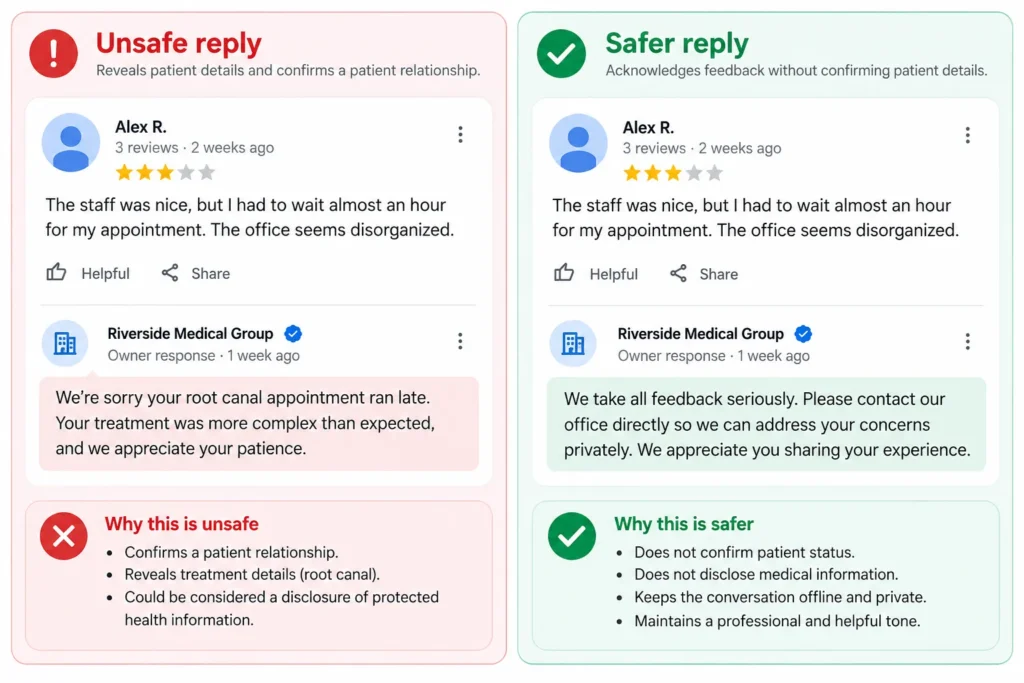
Now picture an AI reply tool. It reads a review, wants to be helpful and writes “We’re sorry your root canal appointment ran long.” That sentence confirms a patient relationship and a treatment. An AI that responds helpfully is the exact failure mode, which makes automated reply tools the highest-risk step in a practice’s content workflow.
Safe reply practice
These are practice suggestions, not legal advice.
- Use templates that contain no patient information.
- Never confirm that a reviewer is or was a patient.
- Keep the reply generic and invite the person to contact the practice offline.
- Have staff read every reply before it posts.
- Keep AI out of the loop for any reply that names a person or a condition.
- Check that your Notice of Privacy Practices and social media policies are current, since OCR flagged both in that case.
Keep patient data out of AI tools
The same caution applies before anything reaches a model. Under HIPAA, a practice may share protected health information with an outside vendor that handles it on the practice’s behalf only after obtaining satisfactory assurance that the vendor will safeguard it, documented in a written agreement, usually called a business associate agreement. An AI writing tool, its model provider or a reply service can all be that vendor.
So before any clinical detail goes into an AI tool, ask your compliance officer or counsel to assess the vendor and confirm that agreement is in place. Without it, send the model questions, never patient records: strip names, dates, record numbers and anything else that could identify a patient. This is general information, not legal advice.
A Safe AI Workflow for a Practice Website
The split only matters if it becomes a routine. Here is the process I’d run on a practice site, one page at a time. Each step has a clear owner, and the physician’s sign-off sits before anything publishes.
A repeatable process from patient questions to publication, with clinical oversight before the content goes live.
Work with general, non-identifying patient questions. Do not send patient records or protected health information to an AI provider without an appropriate privacy and compliance assessment, including required safeguards and agreements.
-
Collect real patient questions
Gather recurring questions from front-desk notes, phone logs, consultations and Search Console queries. Remove patient identifiers before using the information in the editorial workflow.
Owner: Practice staff -
Generate a sourced draft
Give the AI general questions, not patient records. Request citations to authoritative medical sources and document how the draft was produced. Treat generated citations as unverified until checked.
Owner: AI-assisted editorial team -
Physician review and sign-off Human approval gate
A named, qualified physician verifies clinical claims, checks supporting sources and reviews statements about treatments and outcomes. Record the real reviewer’s name, verified credentials and actual review date.
Owner: Qualified physician In this editorial workflow, medical content does not proceed to publication without the designated clinical approval. -
Add schema where it fits
Add appropriate structured data, such as Physician, MedicalClinic or FAQPage, only when it accurately describes visible page content. Special schema markup is not required for Google AI Overviews.
Owner: SEO or publishing staff -
Publish genuinely useful pages
Publish helpful content for real services, conditions and patient questions relevant to the practice. Avoid mass-producing near-identical pages for every city or ZIP code.
Owner: Publishing staff -
Monitor and re-review
Monitor indexing and search queries in Google Search Console. Revisit pages when medical guidance or practice information changes. Update the medical review date only after an actual physician re-review.
Owner: SEO staff + physician
Two steps deserve a longer note. On schema, How to Add Schema to AI Content in WordPress explains why markup must match what readers can see; for a medical page, that means the Physician details have to be real. On step five, Google’s spam policy defines scaled content abuse as many pages generated for the primary purpose of manipulating rankings, and lists “using generative AI tools or other similar tools to generate many pages without adding value for users” as an example. Sites that violate the policies may rank lower or not appear at all.
Where a drafting tool fits
Contentosapp Studio is one example of a WordPress plugin that produces drafts for review: it drops a finished draft into the editor for you to review and publish, and that review step is where the physician signs off. Disclosure: Contentosapp Studio is made by the publisher of this site. It is a content production tool, not a legal or compliance review tool, so it does not make content compliant on its own.
Frequently Asked Questions
What is SEO for doctors?
SEO for doctors, also called medical SEO or healthcare SEO, is the work of making a medical practice findable and trustworthy in the local map pack, organic search results and AI Overviews. It combines a complete Google Business Profile, accurate website pages and physician-reviewed content. Google applies a higher accuracy standard to health topics than to most others.
Can doctors use AI to write website content?
Yes, for drafts and packaging. Google’s guidance says appropriate use of AI or automation is not against its guidelines. A physician must still review and sign off on anything clinical, and AI should not write claims, credentials, author bios or patient reviews. Publish under a named, real reviewer with a review date.
Does Google penalize AI-written medical content?
Not as such. Google targets content made to manipulate rankings and scaled, low-value pages, plus health content that isn’t accurate or consistent with expert consensus. The risk is unreviewed claims and mass production, not the tool. For the broader evidence, see Does Google Penalize AI Content?
Do doctors need special optimization for AI Overviews?
No. Google’s documentation says there are no additional requirements and no other special optimizations necessary. A page must be indexed and eligible to appear with a snippet. You also don’t need special schema.org markup, and AI Overviews often don’t trigger at all, so no one can promise a citation.
Can a medical practice reply to online reviews?
Yes, but never with protected health information. In the New Vision Dental case, a practice paid $23,000 and accepted two years of OCR monitoring after disclosing patient details in Yelp replies. Use templates with no patient information, don’t confirm that someone is a patient, and have staff review every reply before posting.
Can a practice create a page for every city it serves?
Not by mass-producing near-identical pages. Google’s spam policy on scaled content abuse lists generating many pages with AI without adding value for users as an example. Build a location or service page only where the practice really operates or offers the service, with distinct, useful and physician-reviewed content.
Conclusion
Start small. Pick one real patient question from your front desk. Have AI draft the page, with sources, then put it in front of a named physician who checks every claim. Publish it with the physician’s name, credentials and review date, and watch Search Console to see whether it’s indexed and which queries it earns. AI covers the packaging: outlines, meta tags, schema drafts and template replies. The physician covers the claims, the credentials and anything that touches a patient. Do that once, properly, before you scale it, and you’ll know whether the system holds up.
References
External sources
- Tips to improve your local ranking on Google – Google Business Profile Help — https://support.google.com/business/answer/7091
- AI Features and Your Website | Google Search Central | Documentation | Google for Developers — https://developers.google.com/search/docs/appearance/ai-features
- Pesquisa: negócios de Indaiatuba no Google Maps (2026) — https://meunegocioo.com.br/pesquisa-google-maps-indaiatuba-2026/
- Google Search’s guidance about AI-generated content | Google Search Central Blog | Google for Developers — https://developers.google.com/search/blog/2023/02/google-search-and-ai-content
- Creating Helpful, Reliable, People-First Content | Google Search Central | Documentation | Google for Developers — https://developers.google.com/search/docs/fundamentals/creating-helpful-content
- SEO para médicos: Google, Maps e IAs | Meu Negócioo — https://meunegocioo.com.br/marketing-medico/seo-para-medicos/
- Federal Trade Commission Announces Final Rule Banning Fake Reviews and Testimonials | Federal Trade Commission — https://www.ftc.gov/news-events/news/press-releases/2024/08/federal-trade-commission-announces-final-rule-banning-fake-reviews-testimonials
- OCR Fines California Dental Practice for PHI Disclosures on Yelp — https://www.hipaajournal.com/ocr-fines-california-dental-practice-for-phi-disclosures-on-yelp/
- 45 CFR 164.502 – Uses and disclosures of protected health information: general rules | eCFR — https://www.ecfr.gov/current/title-45/subtitle-A/subchapter-C/part-164/subpart-E/section-164.502
- Spam Policies for Google Web Search | Google Search Central | Documentation | Google for Developers — https://developers.google.com/search/docs/essentials/spam-policies
- Contentosapp Studio – AI Content Writer & SEO (BYOK) – WordPress plugin | WordPress.org — https://wordpress.org/plugins/contentosapp-studio/