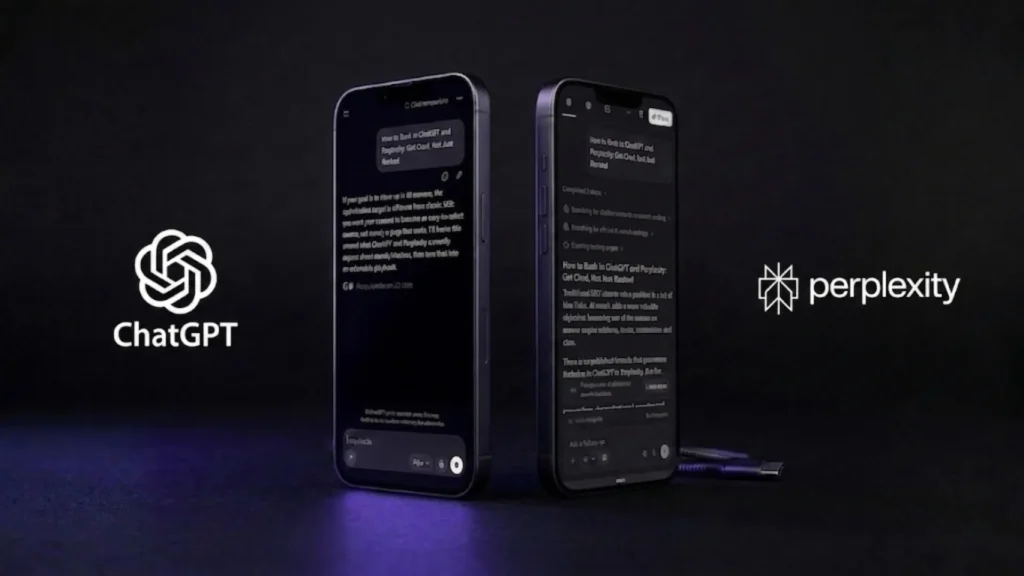
If you’re trying to figure out how to rank in ChatGPT and Perplexity, here’s what should stop you cold first: only 11% of domains cited by ChatGPT are also cited by Perplexity. That single stat means running one “AI SEO” strategy and expecting both engines to surface your content is a losing bet from the start. These are two separate retrieval systems with different indexes, different freshness weights, and different crawlers. You need to optimize for both, independently.
Here’s the deeper problem with how most people frame this: you can’t “rank in ChatGPT” the way you rank on Google. There’s no position 1. No SERP. What you actually want is to become the cited source — the page a model attributes when it synthesizes an answer. That’s a fundamentally different target, and it requires a fundamentally different approach. If you’re watching your organic traffic erode and wondering why your page-one rankings aren’t translating into AI mentions, understanding this shift starts with accepting that question-and-answer retrieval pipelines don’t care about PageRank. The broader strategic framework for this shift is covered in depth in Generative Engine Optimization (GEO): The Complete Guide to Getting Cited by AI in 2026. This article focuses on the execution layer: four specific areas where your content, structure, and technical setup either earn citations or don’t.
- Two separate targets: Only 11% of domains cited by ChatGPT overlap with those cited by Perplexity — you need platform-specific optimization, not a single strategy.
- Citation, not ranking: LLMs don’t have SERPs. Your goal is to become a cited source in synthesized answers, which requires answer-first content structure.
- Passage-level retrieval: LLMs retrieve and score content at the chunk level. A single 120–150 word direct-answer block can make a page citable even if the surrounding content is average.
- Re-ranking by ideal answer similarity: ChatGPT scores retrieved pages against a synthesized hypothetical ideal answer — not the user’s literal query. Write to answer completely, not to match keywords.
- Fan-out querying: One prompt becomes many sub-queries. Topic coverage across your site earns more citations than a single perfectly optimized page.
- llms.txt vs. schema: These operate at different stages — crawl access vs. parseable metadata. Both matter. Confusing them costs you citations.
Google Rankings vs. LLM Citations: Why the Gap Is Widening
Your Google ranking determines how often AI crawlers visit your page. It does not determine whether that page gets cited. This distinction matters more than most GEO content admits. A page sitting at position 8 on Google can be Perplexity’s first cited source if its answer density and named-entity clarity score higher during re-ranking — because LLM retrieval pipelines don’t apply PageRank signals to decide what to surface. They retrieve a candidate set of documents and then re-rank them by how well each one answers the query. ChatGPT Search, launched in October 2024, uses Bing as its primary index, which means Bing crawl authority and Bing Webmaster Tools verification affect whether your content is even in the retrieval pool. Perplexity runs its own index via PerplexityBot. The underlying ranking inputs are different. The re-ranking logic is different. And only 11% of cited domains appear in both engines, which means whatever you’re doing to earn citations on one platform is probably not transferring to the other.
The practical implication: treating Google SEO as a proxy for AI citation leaves most of your citation potential unrealized. If you’ve noticed your AI Overviews traffic drop despite stable rankings, you’re observing this gap in real time — organic position protects you less than it did 18 months ago. According to CrawlRaven’s GEO framework, only 38% of AI Overview citations now come from Google’s top 10, a significant drop from the prior year when top-10 pages dominated citation share. The sites earning citations aren’t necessarily winning on backlinks or domain authority. They’re winning on answer legibility at the passage level. That’s a structural problem, and it has a structural fix.
The share of AI Overview citations coming from Google’s top 10 results has been cut in half in a year — from 76% to 38%. Ranking on page one no longer guarantees you’re the source an AI engine cites.
Source: CrawlRaven, citing Ahrefs’ March 2026 research.
The Structure That Gets You Cited: Direct-Answer Passages and Named Entities
ChatGPT doesn’t read your page the way a human does. It retrieves chunks. According to the OpenAI cookbook’s re-ranking recipe, ChatGPT’s search pipeline generates a hypothetical ideal answer to the user’s question, then scores retrieved passages by their embedding similarity to that ideal answer — not by keyword overlap, not by the user’s literal phrasing. This is the mechanism behind every “write answer-first” recommendation you’ve seen. You’re not writing to match a query string. You’re writing to match a model’s internal representation of a complete, accurate response. The more your passage resembles that ideal answer structurally and semantically, the higher it ranks in the re-ranking pass — and the more likely it gets attributed.
The citation unit is a passage, not a page. A 120–150 word block that opens with a direct declarative answer — subject, verb, answer, no hedging — and contains two or three named entities (specific tools, organizations, dates, or measurable outcomes) is structurally citable. The same information written as a 400-word narrative without a clear answer sentence is not, even if the word count and keyword density are equivalent. Before-and-after comparison: a passage that opens with “There are many factors to consider when evaluating X” gives a re-ranker nothing to score. A passage that opens with “X reduces Y by Z% when applied to [specific context], according to [named institution]” gives it everything. Optimizing at the passage level is the single most underused tactic in AI content strategy right now — and it applies to existing content you can update today, not just new articles you write from scratch.
Audit your existing content for citable passages in three steps
Run this check on any article you want to rank in ChatGPT and Perplexity. First, identify the specific question each H2 section answers — write it down explicitly. Second, check whether the first two sentences of that section answer it directly and declaratively. If they don’t, rewrite the opener. Third, confirm that at least two named entities appear in the first 100 words of the section. If your section mentions “a popular CRM tool” instead of “Salesforce” or “HubSpot,” fix it. Vague references reduce the model’s semantic confidence in what your passage is actually about.
Technical Layer: llms.txt, Structured Data, and What Actually Moves the Needle
llms.txt and structured data both support AI citability, but they operate at completely different stages of the pipeline — and conflating them is one of the most common and costly mistakes in GEO implementation. llms.txt is a crawl-access and navigation signal. It tells AI crawlers which pages on your site are worth indexing, helps them skip low-value content, and signals that you want to participate in LLM retrieval. It doesn’t influence how a retrieved passage is scored or extracted. Structured data — specifically FAQPage, HowTo, and Article schema — operates after retrieval. It gives models parseable, machine-readable metadata that maps questions directly to answers, steps to outcomes, and authors to credentials. For a full breakdown of what llms.txt actually does and how to add it to WordPress in ten minutes, the implementation details are covered separately. But the strategic point stands: if your crawlers are blocked and your schema is missing, you’ve created two separate failure modes that require two separate fixes.
The more immediate lever is schema. FAQPage schema wraps question-answer pairs in structured markup that an LLM can parse directly without inference — it’s the closest thing to handing an engine a pre-formatted citation card. HowTo schema does the same for instructional content. These aren’t just for Google’s rich results; they reduce the ambiguity that causes models to paraphrase your content rather than attribute it. On the crawler side, both ChatGPT and Perplexity have distinct requirements. SHAY Group’s practitioner audit confirms that GPTBot, OAI-SearchBot, ChatGPT-User, and Bingbot must all be unblocked in your robots.txt for ChatGPT Search to access your content; PerplexityBot needs its own explicit allowance for Perplexity. Check your robots.txt before you do anything else — a blocked crawler makes every other optimization irrelevant.
| Factor | ChatGPT Search | Perplexity |
|---|---|---|
| Web index source | Bing (primary) | Proprietary index |
| Required crawlers | GPTBot, OAI-SearchBot, Bingbot | PerplexityBot |
| Freshness weight | Moderate | 3.3× higher than Google |
| Citation overlap with other engine | 11% of domains shared | 11% of domains shared |
| Content format favored | Structured Q&A, listicle | Fresh, factual, direct-answer |
| Location recommendation rate | 1.2% of locations | 7.4% of locations |
| Technical prerequisite | Bing Webmaster Tools verification | Allow PerplexityBot in robots.txt |
Freshness comparison based on median cited-URL age for SaaS/tech content: Perplexity ~32.5 days vs. Google ~108 days — source. Location recommendation rate from SOCi’s 2026 Local Visibility Index — source.
User-agent: GPTBot
Allow: /

User-agent: OAI-SearchBot
Allow: /

User-agent: ChatGPT-User
Allow: /

User-agent: Bingbot
Allow: /

User-agent: PerplexityBot
Allow: /
Building Citation Authority: Sources, E-E-A-T Signals, and Citable Originality
LLMs are not neutral retrievers. Their training data over-represents academic papers, journalistic outlets, and reference sources — content that consistently carries author attribution, institutional affiliation, cited evidence, and publication dates. A niche blog that mirrors that structure shifts its citation probability measurably, even without the domain authority of a media outlet. The minimum viable citation profile looks like this: a named author with a stated credential or domain of experience, a visible publication date, at least one external institutional citation inside the article body, and one original observation or data point that doesn’t appear in competing content. These four elements signal to a retrieval model that your content is a primary source worth attributing rather than a restatement worth paraphrasing.
Off-site signals matter more than most on-page guides acknowledge. According to SHAY Group’s practitioner work, ChatGPT fans a single user prompt into multiple sub-queries before generating an answer, which means your brand needs to appear across a range of related questions — not just on one optimized page. Reviews, editorial listicles, Reddit threads, and YouTube are where ChatGPT forms its brand consensus — making them the highest-leverage signals available, outperforming on-page optimization in isolation. Third-party review profiles correlate with a 3× citation probability increase, and adding statistics to your content correlates with a +41% visibility increase in AI-generated answers. These numbers aren’t guarantees. But they represent the kinds of signals that correlate with citation at scale — and they’re absent from most content strategies that focus exclusively on keyword research and backlink acquisition.
Minimum Viable Citation Profile Checklist
- Named author with a stated credential or area of practice
- Visible publication and last-updated date on every article
- At least one external institutional citation in the article body
- One original observation or data point not in competing articles
- GPTBot, OAI-SearchBot, Bingbot, and PerplexityBot allowed in robots.txt
- FAQPage or Article schema implemented on target pages
- At least one 120–150 word direct-answer passage per major section
Frequently Asked Questions
Does ranking on Google help you get cited by ChatGPT or Perplexity?
Indirectly, yes — but less than you’d expect. Google rankings influence how often AI crawlers visit your pages, since crawl frequency correlates with perceived authority. But once your content is in a retrieval pool, your Google position doesn’t determine citation. ChatGPT re-ranks retrieved pages by how well each passage matches a synthesized ideal answer, not by PageRank signals. A page at position 8 with strong answer density can out-cite a page at position 2 with weaker structure. Optimize for citation legibility separately from organic ranking — they are related but distinct targets.
What does “passage-level optimization” mean, and why does it matter for AI citation?
LLMs retrieve and score content at the chunk or passage level, not the full-page level. When ChatGPT searches the web, it retrieves candidate passages and re-ranks them by embedding similarity to a model-generated ideal answer. A 120–150 word block that opens with a declarative answer and includes named entities is structurally citable; the same information buried in a long narrative paragraph is not. Passage-level optimization means restructuring each H2 section so the first two sentences answer the section’s question directly, with no hedging, no preamble, and at least two specific named references.
How does llms.txt affect whether ChatGPT or Perplexity cites your site?
llms.txt is a crawl-navigation signal — it helps AI crawlers identify which pages are worth indexing and which to skip. It increases the probability your content enters the retrieval pool. But it doesn’t influence how a retrieved passage is scored or cited. Think of it as getting your content into the room; structured data and direct-answer formatting determine whether it gets picked up off the table. Both matter, but at different stages. Treating llms.txt as a ranking lever mistakes its function — it’s a prerequisite, not an optimizer.
What type of structured data is most useful for getting cited by AI engines?
FAQPage schema is the highest-value format for most content sites. It wraps question-answer pairs in machine-readable markup that an LLM can parse directly without inference, reducing the likelihood it paraphrases your content instead of attributing it. HowTo schema serves the same function for instructional content. Article schema adds author, publication date, and topic metadata that reinforces E-E-A-T signals. These aren’t exclusively for Google rich results — they reduce retrieval ambiguity across any LLM that processes structured web content.
Does having a named author make a difference for LLM citation?
Yes, and more than most on-page guides acknowledge. LLM training data skews heavily toward content with explicit attribution — academic papers, journalistic articles, and reference sources all carry named authors and institutional affiliations. Content that mirrors this structure is more likely to be treated as a primary source rather than an anonymous restatement. Add a byline with a specific credential or stated area of experience, a visible publication date, and at least one cited external institution. These elements together constitute what a model needs to treat your content as attributable.
How long does it take to see results after optimizing content for AI citation?
No honest practitioner will give you a fixed timeline, because citation frequency depends on how often users ask relevant prompts, how competitive your category is, and how frequently the engine re-indexes your content. Perplexity weights freshness 3.3× more than Google, so fresh or recently updated content can enter its retrieval pool within days. ChatGPT Search, backed by Bing’s index, moves on a slower crawl cycle — weeks is a more realistic expectation for newly published content. Measure share of voice across a fixed set of representative prompts at monthly intervals rather than checking for individual citations, which fluctuate too much to track meaningfully in the short term.
The SEOs who compound their citation footprint in 2025–2026 won’t be the ones with the highest domain authority. They’ll be the ones who figured out that a 140-word passage, correctly structured, with two named entities and a clear declarative opener, is more citable than a 2,000-word article that answers every adjacent question except the one the model is trying to resolve. Start there: audit your top-traffic pages for passage-level answer density, implement FAQPage schema on the ones that have clear Q&A structure, unblock your AI crawlers, and build one off-site mention per month on a platform your category already trusts. That’s the repeatable system. The compounding starts when you stop optimizing for the algorithm you understand and start writing for the retrieval pipeline that’s replacing it.
References
External sources
- Introducing ChatGPT Search | OpenAI — https://openai.com/index/introducing-chatgpt-search/
- How to Rank on ChatGPT: Practitioner GEO Method | SHAY Group — https://shaygroup.co/blog/how-to-rank-on-chatgpt/
- How to Rank in ChatGPT, Claude, Google AI Overviews & Other AI Tools (2026 Guide) | CrawlRaven — https://crawlraven.com/blog/how-to-rank-in-chatgpt
- Question answering using a search API and re-ranking — https://developers.openai.com/cookbook/examples/question_answering_using_a_search_api
- Why ChatGPT & Perplexity Cite Different Sources (11%) | InfinaCode — https://infinacode.com/blog/chatgpt-perplexity-citation-overlap
- Perplexity Cites Content 3x Fresher Than Google — the Lazy Gap | AI+Automation — https://aiplusautomation.com/blog/perplexity-lazy-gap
- How to Rank in ChatGPT, Perplexity, and Google AI Overview | SOCi — https://www.soci.ai/blog/how-to-rank-in-chatgpt-perplexity-and-google-ai-overview/