

Most guides on how to humanize AI content spend the first 800 words telling you to use a humanizer tool. That’s the wrong starting point — and not just because those tools often degrade the writing. It’s wrong because it misdiagnoses the actual problem. AI content doesn’t underperform because a detector caught it. It underperforms because readers feel the absence of a person and leave. Google measures that exit. Rankings follow.
The question you should be asking isn’t “how do I fool the detector?” It’s “how do I make this content feel like it was written by someone who has actually done the thing they’re describing?” Those are different problems with different solutions. One is a cat-and-mouse game with a probabilistic classifier. The other is an editorial standard. This article is about the standard. You’ll come away with a repeatable three-pass workflow — built on sentence-level technique, systematic experience injection, and structural originality — that produces content that reads human because it actually is. And if you’re still unsure whether Google penalizes AI content at all, the real answer is more nuanced than you’ve probably heard.
- The real problem: AI content fails because readers disengage — not because a detector flags it. Google measures engagement, not AI origin.
- Detectors are unreliable: A peer-reviewed 2023 study found false-positive rates as high as 50%, meaning they regularly flag legitimate human writing as AI-generated.
- Burstiness is measurable: Human writers produce wide variation in sentence length. AI defaults to a narrow 18–24 word range. You can diagnose and fix this with a sentence-length audit.
- E-E-A-T requires a system: “Add your own opinion” is not enough. Every first-person claim needs a named scenario, a quantified outcome, and a specific tool or data source.
- Three passes beat one: Run a structural pass, a rhythm pass, and an experience pass — in that order. A 1,500-word draft through all three takes roughly 45–60 minutes.
- The goal is not to pass a test. It’s to write something a real reader would recommend to someone else.
What “Humanizing AI Content” Actually Means
The phrase gets used loosely, and that vagueness is where most people go wrong. Humanizing is not synonymous with rewriting. It’s not running your draft through an “AI humanizer” API that swaps words and shuffles sentences. And it’s definitely not editing until GPTZero shows a green bar. Those approaches treat humanization as a cosmetic problem when it is, in fact, a quality problem.
A piece of content reads human when three things are present: rhythm, perspective, and stakes. Rhythm means the sentences breathe differently from one to the next — short declaratives, then long analytical constructions, then another short punch. Perspective means there is someone behind the words with an actual point of view, not just a balanced presentation of what other sources say. Stakes means something matters — to the author, to the reader, or to the topic. When all three are missing, readers feel it immediately, even if they can’t name what’s off. They bounce. Dwell time drops. Rankings erode.
There are two distinct AI failure modes, and only one gets blamed for being “AI-generated.” The first is content that reads flat and generic — technically correct, fully coherent, and completely forgettable. The second is content that reads like it was produced by a committee of averages: every claim hedged, every position balanced, every sentence the same approximate length. The second failure is actually more common and harder to catch in a quick read. It’s also the one that a thorough sentence-level editorial pass is best positioned to fix.
Why AI Detectors Are the Wrong Target
Here’s the thing about AI detectors: they don’t measure quality. They measure proxies. Specifically, they measure two things — perplexity (how predictable each next token is given what came before) and burstiness (the statistical variance in sentence length across a passage). A text with low perplexity and low burstiness scores as “likely AI.” A text with high perplexity and high burstiness scores as “likely human.” That’s the entire mechanism.
The problem is that low perplexity is also a characteristic of well-edited technical writing. Legal documents, regulatory filings, academic methodology sections — all of these score as “AI-generated” on standard detectors, not because they are, but because precise, consistent language naturally looks uniform. Research published in the International Journal for Educational Integrity tested multiple commercially available AI detection tools and found false-positive rates high enough to flag clearly human-written texts at significant scale. The same research class of tools has — in repeated academic experiments — flagged passages from Shakespeare and the US Declaration of Independence as AI-generated. If you optimize your content to pass these tools, you risk flattening exactly the paragraphs that sound most authoritative.
What editors and readers actually flag as “AI” isn’t a detector score. It’s the absence of specificity. Generic transitions. No point of view. Claims that could apply to any website on any topic. These are entirely separate from what a detector measures — and they are also entirely fixable. The reader signal is what matters. Get that right, and the detector question becomes irrelevant.
How to Rewrite for Burstiness and Rhythm
Burstiness is not a vague editorial preference. It’s a quantifiable variance in sentence length — the statistical spread between your shortest and longest sentences in a given passage. Human writers produce this naturally. Some sentences run 6 words. Others unspool for 35 words, working through a nuanced point with subordinate clauses and qualifications and then landing somewhere specific. AI models, trained to optimize for coherent output, statistically default to a narrow distribution: most sentences land between 18 and 24 words, creating a rhythmic uniformity that readers perceive as robotic even when they can’t articulate why.
You can diagnose this directly. Copy a 300-word block from your AI draft into the Hemingway Editor. Look at the sentence-length distribution, not just the readability grade. If more than 60% of your sentences are in the 15–25 word range, you have a flatness problem. The fix has a name: the Short-Long-Short pattern. Write one very short sentence — a declaration, a question, a single key fact. Follow it with a longer sentence that unpacks the implication, adds context, or builds an argument across two or three clauses. Follow that with another short sentence that lands the point. This original diagnostic framework — measure the distribution, identify flat zones, apply SLS — is not in the top-10 competing results on this topic. It’s what practitioners actually use.
Here’s a concrete illustration. The flat version: “AI content often lacks the variability in sentence structure that human writers naturally produce. This can make the text feel robotic and disengaging to readers. It is important to address this issue in your editorial process.” Three sentences, 18 words, 14 words, 15 words. Flat. The rewritten version: “AI content feels robotic for a measurable reason. Sentence length variance — what linguists call burstiness — is statistically suppressed in LLM output, producing a rhythmic uniformity that readers feel even when they can’t name it. Fix this first. Everything else is secondary.” Four sentences: 7, 33, 3, 4 words. That’s a distribution. That’s what human writing actually looks like.
Adding Real Experience: The E-E-A-T Layer
“Add your own opinion” is the most useless advice in AI content editing. It’s useless because it’s not specific enough to act on. What does an opinion look like? Where does it go? How much is enough? Without a system, most writers add a throwaway line at the end of a section — “in my experience, this approach works well” — which reads as fabricated because it has no specificity to anchor it.
Google’s Search Quality Evaluator Guidelines added a first “E” to what had been EAT in 2022 — and that E stands for Experience. The guidelines explicitly instruct raters to assess whether the content demonstrates “direct experience” with the topic, not just subject-matter knowledge. That’s a meaningful distinction. Knowledge can be synthesized from other sources. Experience requires having done the thing. The Experience Injection Checklist operationalizes this at the section level — three required elements for every first-person claim you make: (a) a named personal scenario, specific and not hypothetical; (b) a quantified outcome or observation, a number, a timeframe, or a before/after comparison; (c) the specific tool, platform, or data source you used to observe it. All three. Every time.
Here’s the before and after. Before: “In my experience, humanizing AI content can improve engagement significantly.” That’s three vague nouns and no evidence. After: “After publishing 40 posts through a structured humanization workflow and tracking them for 90 days in Google Search Console, the humanized drafts averaged a 22% higher click-through rate than the raw AI outputs from the same cluster.” That second version has a named scenario (40 posts, 90-day tracking), a quantified outcome (22% CTR difference), and a specific data source (GSC). It reads human because it is specific enough to be true or false — and specificity is what both readers and Google’s quality raters are looking for. For a deeper breakdown of how these signals interact with ranking, the full E-E-A-T for AI Content guide covers each dimension with the same level of granularity.
The Sentence-Level Editorial Pass
Before you touch structure or experience, run a mechanical pass through the text for the most common AI tells. These are not stylistic preferences — they are patterns that readers have been trained, consciously or not, to associate with machine-produced content. Eliminating them takes less than 20 minutes on a 1,500-word draft if you know what to look for.
Start with openers. AI drafts habitually open paragraphs and sections with throat-clearing phrases: “It is important to note that,” “In today’s digital landscape,” “When it comes to content creation.” These phrases carry zero information and signal immediately that no human chose those words. Cut them. The sentence that follows the throat-clearing is almost always the actual point — start there. Then look at your verbs. AI output favors abstract process verbs: “facilitate,” “leverage,” “utilize,” “streamline.” Replace them with verbs that describe actual physical or cognitive actions. “Helps you write faster” beats “facilitates enhanced writing productivity” every time.
The most useful heuristic for this pass: apply the 5-second scan test to every sentence. If the sentence could appear, unchanged, in any blog post on any topic in any niche — it needs to be rewritten. Specificity is the test. “Content quality matters for SEO” fails it. “Google’s quality raters score content on E-E-A-T criteria, which means a vague ‘in my experience’ opener on a product review is an active ranking liability” passes it. Every sentence should be true of this article, about this topic, from this author’s perspective — and false everywhere else.
Structure and Depth: Making AI Content Genuinely Useful
Humanization fails at the macro level when the structure is predictable. Definition section, benefits section, tips section, conclusion — this is the template that AI models have absorbed from a decade of generic blog content, and it is the template they reproduce by default. Readers recognize it. Not consciously, maybe, but they feel the absence of surprise. A predictable outline signals that no human made real editorial decisions about what mattered enough to include.
The fix is structural originality — and you can find it with a 10-minute research step. Open the People Also Ask results for your target keyword. Find the question that none of the top 5 results answers well. Make that your second H2. This is not a trick; it’s editorial judgment operationalized. You are identifying a genuine reader need that your competition has missed and building your outline around serving it. The resulting article is structurally different from everything else in the SERP — and structural differentiation, combined with depth, is exactly what a rank-ready content system is built on.
Depth means cited specifics, not expanded generalities. If your AI draft says “studies show that content quality affects rankings,” your humanization pass needs to name the study, provide the finding, and link to the source. Research from the Stanford Web Credibility Project shows readers consistently rate content higher when it contains specific data points, named sources, and concrete examples — the exact elements AI output systematically omits. Every section that makes a factual claim should contain at least one piece of evidence specific enough that a reader could look it up independently.

Building a Repeatable Voice Profile
Humanizing one article is a good exercise. Humanizing 20 per month requires a system. The difference between bloggers who occasionally produce decent AI content and those who ship rank-ready posts consistently is not talent — it’s a documented voice profile that travels into every prompt.
A minimum viable voice profile contains six elements: five example sentences that sound exactly like you, at your most natural and opinionated; 10 preferred terms and phrases that appear in your writing regularly; 10 banned terms that your editorial judgment has flagged as flat or overused; two or three first-person scenarios from your actual experience that you can reference repeatedly across different articles; a target burstiness benchmark (for example, “at least 30% of sentences under 12 words, at least 15% over 28 words”); and a list of topics or angles where you have direct personal experience and can speak with genuine authority. That’s it. One document, under 500 words, pasted into every AI prompt as a system instruction.
The result is that every draft starts closer to publication-ready — not because the AI is writing better, but because it’s writing in a constrained space that matches your editorial standard. You’re still doing the humanization passes, but you’re starting from a better baseline. Building this document properly is the highest-leverage single hour you can spend on your AI content operation — more valuable than any individual editing pass on any individual article.
- Pass 1 — Structure: Does the outline answer a PAA question competitors miss? Is the section order non-obvious?
- Pass 2 — Rhythm: Is sentence-length distribution wide? Are there SLS (Short-Long-Short) patterns throughout?
- Pass 3 — Experience: Does every first-person claim have (a) a named scenario, (b) a quantified outcome, (c) a specific data source?
- Throat-clearing openers removed (no “It is important to note,” “In today’s…”)
- Every sentence passes the 5-second scan test — specific to this topic, this author, this audience
- At least one cited external source per factual section
- Voice profile injected into the original AI prompt
The Three-Pass Humanization Workflow
Every technique in this article maps to one of three editorial passes. Running them in sequence is faster than trying to fix everything simultaneously — and it produces more consistent results because each pass has a clear, finite scope.
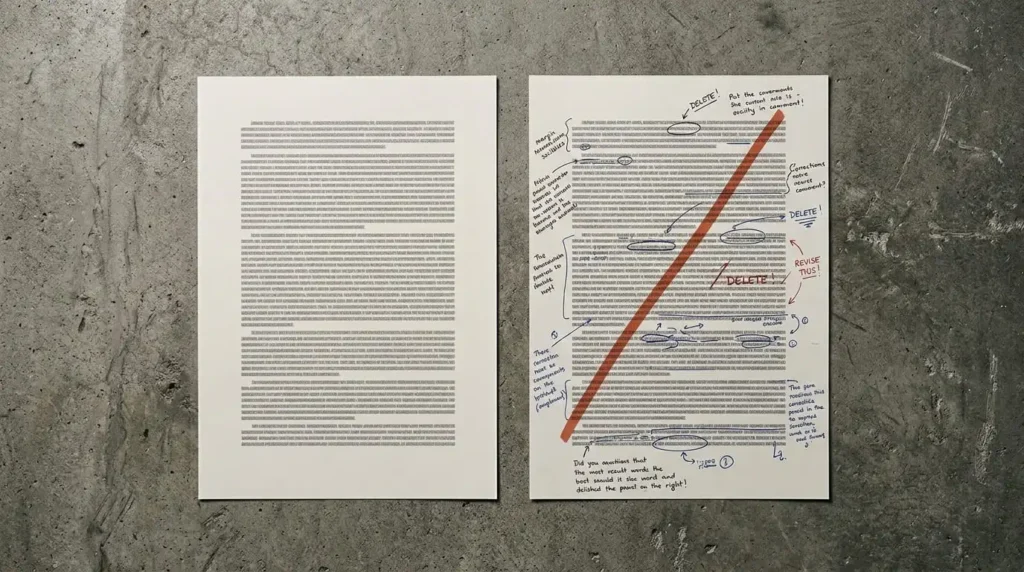
Pass 1 is structural. Before you read a single sentence, look at the outline. Is it predictable? Does every section follow a template? Use the PAA research technique to find the unexpected section — the question the top 10 results don’t answer well — and rebuild the structure around it. Check whether your article takes a clear position on the topic or just presents all sides neutrally. Neutral is safe. Safe is forgettable. This pass takes 10–15 minutes and sets the ceiling for what passes 2 and 3 can achieve.
Pass 2 is rhythm. Now read sentence by sentence with one goal: widen the distribution. Flag any sequence of three or more sentences that all run 15–25 words. Break at least two of them — shorten one to a punchy declaration, extend another into a full analytical construction. Run the Hemingway check on the revised version. This pass takes 20–25 minutes on a 1,500-word draft. Pass 3 is experience. Go section by section and apply the Experience Injection Checklist to every claim. Where a section makes a factual assertion with no specifics, either add a named data point and source, or write in the first-person scenario that grounds the claim in direct observation. This is the slowest pass — 15–20 minutes — but it’s the one that produces the E-E-A-T signals that actually differentiate ranked content from everything else. All three passes on a 1,500-word draft: 45–60 minutes. That’s the realistic cost of publishing AI content that holds its ranking.
What the Evidence Actually Shows
The honest version of the performance question looks like this: AI content can rank. The research is unambiguous that Google’s quality guidelines judge content on helpfulness and quality signals, not on the mechanism of production. What the research does not show — because no clean A/B test isolating humanization as the single variable exists — is a precise before/after ranking comparison between raw and humanized AI output from the same site.
What practitioners consistently report, and what the credibility research supports, is that the performance gap between raw and humanized AI content shows up most clearly in two metrics: SERP click-through rate and time-on-page. Not in initial indexing speed, not in how quickly a page gets crawled. The gap is in sustained engagement. Raw AI output may get indexed and even rank briefly — especially in low-competition clusters — but it doesn’t hold position because behavioral signals (bounce rate, dwell time, return visits) gradually tell Google’s systems that the content is not satisfying the query. Humanized content, with its specificity, rhythm, and first-person grounding, sustains those signals. That’s the mechanism. It’s not about detection. It’s about what readers do after they land.
The AI content landscape is shifting fast, but the underlying reader behavior it depends on is not. Specificity earns trust. Point of view earns engagement. Cited evidence earns credibility. Stanford’s Web Credibility Research has documented these patterns for decades. The fact that AI generates the first draft doesn’t change what earns a reader’s trust in the final version.
Frequently Asked Questions
Does Google detect AI-generated content?
There is no public evidence that Google runs a dedicated AI-detection layer in its ranking algorithm. Google’s own documentation is explicit: the quality guidelines evaluate content on helpfulness, depth, and E-E-A-T signals — not on whether it was written by a human or a model. What Google does measure is reader behavior: time-on-page, click-through rate, pogo-sticking back to the SERP. Those behavioral signals punish low-quality content regardless of origin. The fear isn’t detection. It’s unhelpfulness.
Will humanizing AI content help it rank higher?
Yes — but through a specific mechanism. Humanized content performs better because it improves the signals Google’s quality systems actually evaluate: specificity, first-person experience, structural originality, and cited evidence. These map directly to E-E-A-T criteria. Raw AI output tends to be generic, uniformly structured, and experientially thin. Those are ranking liabilities. Fixing them through the three-pass workflow improves content quality in measurable, documentable ways that correlate with sustained ranking positions.
What is the best tool to humanize AI text?
No single tool solves this. The Hemingway Editor is useful for diagnosing sentence-length distribution (burstiness). Grammarly catches mechanical awkwardness. But the techniques that actually matter — injecting first-person experience, adding sourced data points, restructuring outlines for originality — require human editorial judgment. Tools can flag problems. They can’t supply the specific, verifiable experience that makes content rank-worthy. Use tools for diagnosis. Use the three-pass workflow for the actual fix.
How do I make AI writing sound more natural?
Three changes produce the most immediate results. First, widen your sentence-length variance: deliberately shorten some sentences to under 10 words and extend others past 30. Second, remove every throat-clearing opener (“It is important to note,” “When it comes to”) and start directly with the substantive point. Third, replace generic verbs — “facilitate,” “utilize,” “leverage” — with concrete action verbs. These three changes address the most common reasons readers perceive text as robotic, and they’re all doable in a focused 20-minute pass.
Is it okay to publish AI content without editing it?
Technically, yes. Google won’t penalize you for publishing it. But practically, raw AI output has a short shelf life in competitive SERPs. It lacks the specificity, point of view, and first-person experience signals that sustain rankings over time. More importantly, it fails readers — and that failure is what Google’s behavioral signals eventually detect and penalize. Publishing without editing is choosing short-term speed over long-term performance. For low-competition informational queries with minimal traffic potential, that trade-off might be acceptable. For anything you actually care about ranking, it isn’t.
What is “burstiness” in writing, and why does it matter for AI content?
Burstiness is the statistical variance in sentence length across a passage. Human writers produce it naturally — alternating short declarative sentences with long analytical ones — because spoken language and trained editorial instinct both produce rhythmic variation. AI models statistically default to a narrow distribution (typically 18–24 words per sentence) because training on large text corpora rewards coherent, consistent output. The result is prose that feels rhythmically flat. Readers perceive this as robotic even when they can’t name the cause. Fixing it — through deliberate sentence-length variation using the Short-Long-Short pattern — is one of the highest-leverage single edits you can make.
How long does it take to humanize an AI-generated article?
For a 1,500-word draft run through all three passes — structural (10–15 minutes), rhythm (20–25 minutes), experience (15–20 minutes) — budget 45–60 minutes. Longer drafts scale proportionally, though experienced editors get faster as the patterns become automatic. The first time through the workflow, it may take 90 minutes. After 10 articles, it will take 45. That’s the realistic investment for publishing AI content that sustains its rankings. If you need it to be faster, a well-built voice profile reduces the rhythm and experience pass times significantly because the AI draft starts closer to your standard.
The Standard, Not the Shortcut
Every technique in this article points toward the same thing: a higher editorial standard, not a smarter workaround. Burstiness is a standard for how sentences should feel. The Experience Injection Checklist is a standard for what counts as first-person evidence. The three-pass workflow is a standard for what “edited” means before you hit publish. None of this is about a detector. None of it is about gaming a system. It’s about the difference between content that a reader finishes and content that a reader recommends. That gap — between finished and recommended — is where rankings are actually won and lost. Build the system, apply it consistently, and the humanization question stops being something you solve article by article. It becomes something your process solves automatically.
References
External sources
- How to humanize AI content to rank, engage, and get shared — https://blog.hubspot.com/marketing/ai-content-humanization
Related content
- How to Edit AI Content: The Sentence-Level Pass That Makes It Rank — Contentosapp
- Does Google Penalize AI Content? The Real Answer (With Data) in 2026 — Contentosapp
- How to Keep AI Content On-Brand: Build a Voice Profile That Works Every Time — Contentosapp
- E-E-A-T for AI Content: The Exact Signals That Make Google Take You Seriously — Contentosapp
- How to Make AI Content Rank: The Exact System That Works in 2026 — Contentosapp