
You keep seeing sites with thousands of indexed pages, each one targeting a slightly different variation of the same keyword, from “best running shoes for flat feet” to “best running shoes for marathon.” That’s programmatic SEO at work, and it’s the reason some competitors seem to rank everywhere while you’re still publishing one article at a time.
Programmatic SEO means using templates and data to generate large numbers of search-optimized pages automatically, instead of writing each one by hand. Done right, it turns a single page structure into hundreds or thousands of unique, indexable URLs that each answer a specific, low-competition query. Done wrong, it produces thin, repetitive pages that Google buries or penalizes.
In this guide, you’ll get a straight answer to what programmatic SEO actually is, how it differs from standard technical SEO work, and the mechanics behind building a page template that scales. You’ll also see real programmatic SEO examples, a step-by-step approach to planning your own strategy, and an honest look at whether this tactic still works in 2026 or if it’s become too risky to try.
Why programmatic SEO matters for growing sites at scale
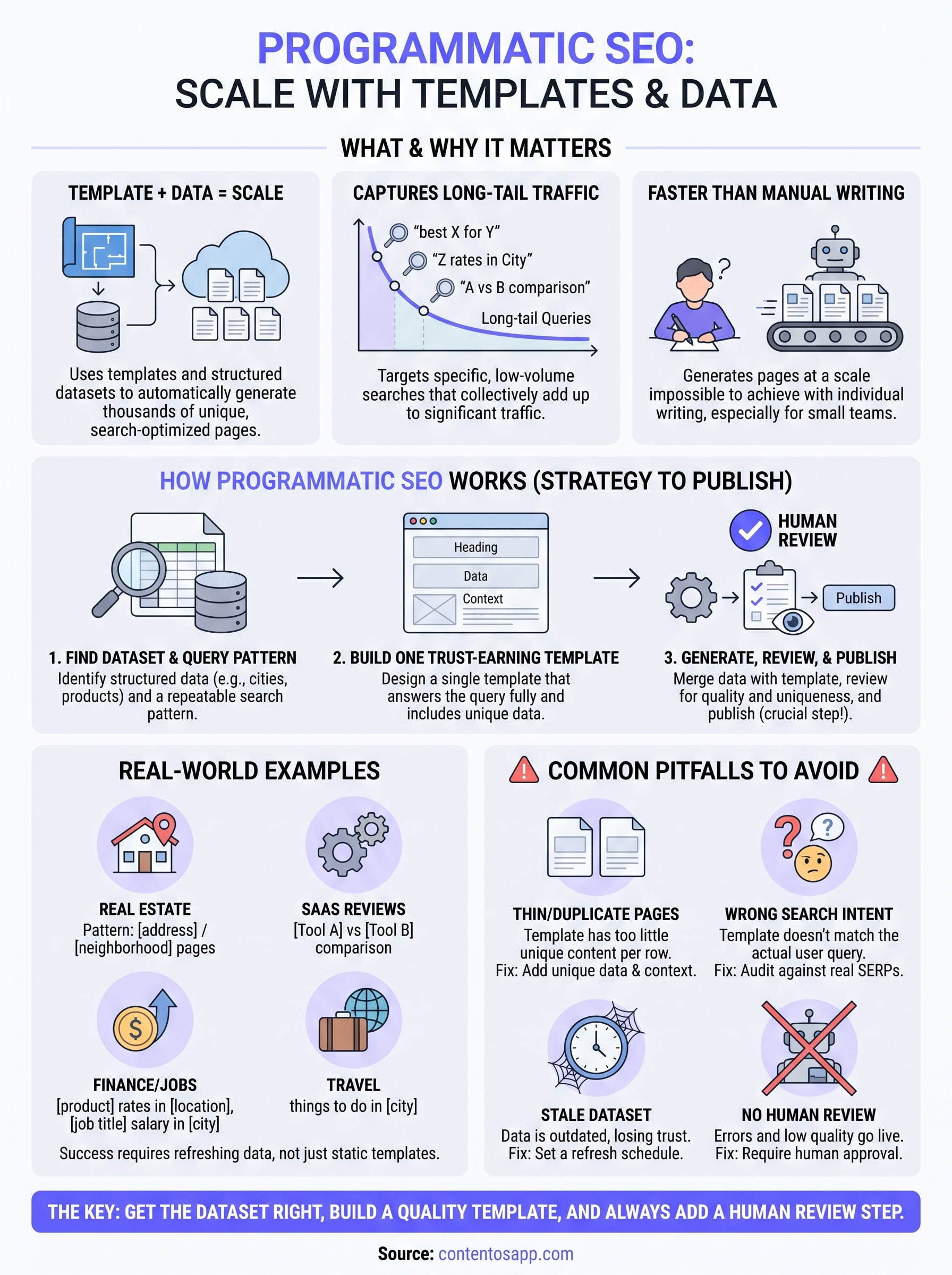
Google processes billions of searches a day, and a huge share of them are what SEOs call long-tail queries: specific, low-volume searches like “mortgage calculator for self-employed” or “is programmatic SEO worth it for a local business.” Individually, each query might only get 20 or 50 searches a month. Multiply that by a thousand variations and you’re looking at real traffic that no single blog post could ever capture. This is the core reason programmatic SEO exists: it lets a site claim hundreds of these small, specific slices of search demand at once instead of chasing one high-competition head term that everyone else is also fighting for.
The math you can’t out-write by hand
Suppose a single writer produces four solid articles a week. That’s roughly 200 articles a year, if nothing else ever gets in the way, and the real numbers from publishing 25 articles in 25 days show how much time each one actually eats. A programmatic template built around a clean dataset can generate that many pages in an afternoon. The gap only widens from there. Sites like Zapier, NerdWallet, and Yelp didn’t rank for tens of thousands of terms by writing each page individually; they built a repeatable structure (a comparison template, a calculator, a local directory listing) and fed it data. This is exactly how does programmatic seo work at its core: one template, one dataset, infinite unique combinations.
Programmatic SEO doesn’t replace good writing, it multiplies a good page structure across every variation your audience is already searching for.
Programmatic SEO vs technical SEO: not the same job
A lot of people conflate the two, but they solve different problems. Technical SEO is about making sure Google can crawl, render, and index a site properly: fixing broken links, speeding up load times, cleaning up your XML sitemap. Programmatic SEO is a content strategy that assumes your technical foundation already works and asks a different question: how many unique, useful pages can you generate from one page template and a structured dataset? You need decent technical SEO for programmatic pages to perform, but technical SEO alone won’t get you the volume of pages that programmatic SEO produces.
| Approach | Primary goal | Typical output | Scale |
|---|---|---|---|
| Traditional content writing | In-depth coverage of a single topic | One article per topic, written by hand | Slow, capped by writer hours |
| Technical SEO | Crawlability, speed, indexation | Site-wide fixes, no new pages | N/A — it’s infrastructure |
| Programmatic SEO | Capture long-tail variations at volume | Hundreds to thousands of templated pages | Fast, capped by data quality |
Why this matters more for small teams than big ones
Counterintuitively, programmatic SEO often matters most for the sites with the least budget, not the most. A solo blogger or a two-person agency can’t compete with a media company’s editorial staff on volume of hand-written content, which is why scaling a small site with AI content without wrecking its rankings is the more realistic path. What they can do is identify a dataset (city names, product categories, comparison pairs) and build one strong template that Google trusts, then let that template do the heavy lifting across every variation. This is where a lot of readers researching programmatic seo services end up: not because they want to outsource the strategy, but because building and maintaining a research-backed template by hand, across dozens of pages, eats the same hours it was supposed to save.
Contentosapp Studio’s 7-agent editorial pipeline was built around this exact gap. Instead of a raw template that just swaps in a keyword, each page still goes through research grounded in live sources, an editorial review pass, and a fail/pass verdict before it ever reaches your WordPress drafts. That’s the difference between running programmatic SEO with AI without tripping Google’s spam filters and programmatic SEO that scales a spam problem. The next section walks through exactly how that process runs, from the initial keyword to a published page.
How programmatic SEO works from strategy to published pages
Every successful programmatic project follows the same basic sequence, whether it’s built by hand in a spreadsheet or run through an automated pipeline. If you’re searching for how to do programmatic seo, this is the actual mechanics, not the theory.
Step 1: Find the dataset and the query pattern
Programmatic SEO starts with a structured dataset, not a keyword list. You need a set of entities (cities, products, job titles, zip codes) that share a repeatable search pattern like “[entity] + cost” or “best [entity] for [use case]”. A mortgage site might pull county-level interest rate data; a software review site might pull feature comparisons from public documentation. Without a real dataset behind it, you’re just spinning up duplicate pages with the keyword swapped in, and Google notices.
Step 2: Build one page template that earns trust
Once the dataset exists, you design a single page template that answers the query completely: a clear heading, the unique data point, supporting context, and a real-URL link back to a hub page. This template is the entire programmatic seo strategy in miniature. Get it right once, and every page inherits that quality. Get it wrong once, and you’ve mass-produced a problem across a thousand URLs instead of one.
A programmatic template is only as good as the worst page it can produce, so test it against your weakest data row, not your best one.
Step 3: Generate, review, and publish at scale
With the template locked, you merge it against the dataset to produce the actual programmatic seo pages. This is where most guides stop, but it’s also where most quality problems start, since raw generation with no review step is how thin content ends up live. A tighter workflow looks like this:
- Pull or refresh the dataset from a reliable source.
- Run each row through the template to draft a page.
- Fact-check any claims or figures against the original source.
- Review the draft for uniqueness and depth before publishing.
- Push to WordPress as a draft, not a live post, for a final human check.
That review step is exactly what separates a working programmatic seo tutorial from a spam factory. Contentosapp Studio builds this checking directly into its pipeline: the Researcher agent grounds each page in cited sources, and the Editorial Reviewer issues a pass or fail verdict before anything reaches your drafts folder. Nothing publishes on its own. The next section shows what this looks like once it’s live, across a handful of real industries.
Real programmatic SEO examples across different industries
Seeing the mechanics in a spreadsheet is one thing. Seeing them live across real sites makes the pattern click. Below are programmatic seo examples pulled from industries that built their traffic almost entirely on templated pages, plus how you might adapt the same idea if you’re hunting for programmatic seo ideas in a smaller niche.

Real estate and local service directories
Zillow doesn’t write a new article every time a house hits the market. It runs one property page template against a live housing dataset, generating a unique URL for every address, city, and zip code combination. A local plumbing or HVAC franchise can copy the same logic on a much smaller scale: one template for “[service] in [city]” pages, populated with local pricing, licensing info, and service-area data pulled from its own franchise list.
The strongest programmatic seo example isn’t the biggest site, it’s the one where every page still answers a real, specific question.
Software comparison and review sites
Capterra and G2 built entire categories of pages around one comparison template: “[Software A] vs [Software B]” repeated across thousands of tool pairings pulled from a features database. A niche SaaS blog can run a scaled-down version of this by comparing tools within one category only, say project management apps under $20/month, instead of trying to cover every software pairing that exists.
Finance, travel, and jobs
NerdWallet’s rate tables, TripAdvisor’s “things to do in [city]” pages, and Indeed’s “[job title] salary in [city]” pages all follow the identical structure: one template, one dataset, thousands of unique URLs. Each page pulls a real, current data point (an interest rate, an average salary, a hotel rating) rather than reusing the same paragraph with a new city name dropped in.
| Industry | Dataset used | Page pattern | Example query it targets |
|---|---|---|---|
| Real estate | MLS listings, local pricing | [address] / [neighborhood] pages |
“3 bedroom homes in [city]“ |
| SaaS reviews | Feature and pricing databases | [Tool A] vs [Tool B] |
“[Tool A] vs [Tool B] pricing” |
| Finance | County or state rate data | [product] rates in [location] |
“mortgage rates in [county]“ |
| Jobs | Bureau of Labor Statistics data | [job title] salary in [city] |
“nurse salary in [city]“ |
| Travel | Local attraction listings | things to do in [city] |
“things to do in [city] this weekend” |
What ties every one of these together is a dataset that gets refreshed, not a template that runs once and sits stale for years. If your “[city]” or “[job title]” page still shows 2023 numbers in 2026, Google and your readers both notice. The industries change, but the discipline behind a working programmatic seo example never does: real data, one solid template, and a review step before it goes live.
Common programmatic SEO pitfalls and how to avoid them
Every site that tries programmatic SEO eventually asks the same question: does programmatic SEO work, or does it just get you flagged? The honest answer is that it works when the pages are genuinely useful and fails hard when they aren’t, which is the same research-first system behind pages that actually rank. Google’s helpful content systems are built specifically to catch pages that look interchangeable, and the data on how Google treats mass-produced, thin content shows a template that swaps one word per page is the easiest pattern for those systems to spot. The pitfalls below are the ones that sink most programmatic projects, and each one is avoidable if you catch it before publishing.

Thin, near-duplicate pages
All but a handful of programmatic failures trace back to the same root cause: a template with too little unique content per row. If your “[city] plumbers” page and your “[other city] plumbers” page differ only by the city name, you’ve built a duplicate content problem, not a scalable strategy. Contentosapp Studio’s Editorial Reviewer agent checks each draft for exactly this before it reaches your drafts folder, catching thin pages before they go live instead of after Google has already noticed.
A template that survives review on paper but produces identical pages in practice isn’t a strategy, it’s a shortcut that Google will eventually unwind.
Skipping search intent per page
Grouping every variation under one rigid template ignores the fact that intent shifts row by row. “Mortgage rates in [county]” and “mortgage rates for [loan type]” look similar but answer different questions, and forcing both into the same structure produces a page that half-answers everything. Match the template to the actual query pattern, not the other way around, and check a sample of pages against real search results before you scale the batch.
Letting the dataset go stale
NerdWallet’s rate tables and Indeed’s salary pages only stay useful because the underlying data gets refreshed on a schedule. A programmatic page built on 2024 pricing or an outdated statistic loses trust fast, both with readers and with Google’s freshness signals. Build a refresh cadence into the project from day one, whether that’s quarterly for salary data or monthly for pricing tables.
Publishing without a human check
Outsourcing the strategy to raw automation, with no review step, is how a good idea turns into a spam problem overnight. Keep a human-in-the-loop review before anything goes live, even if the pipeline behind it is fully automated, and know which cuts and rewrites a draft actually needs.
| Pitfall | Why it hurts rankings | Fix |
|---|---|---|
| Thin/duplicate pages | Triggers helpful content and duplicate content filters | Add unique data and context per row |
| Wrong intent match | Page half-answers the query | Audit template against real SERPs |
| Stale dataset | Loses trust and freshness signals | Set a refresh schedule |
| No review step | Errors and thin pages go live | Require human approval before publishing |
Putting programmatic SEO into practice
Programmatic SEO isn’t a trick, it’s a production system. Get the dataset right, build a template that earns trust on its own, and add a review step before anything publishes, and you’ll capture long-tail traffic that no amount of hand-written blog posts could reach. Skip any of those three pieces and you’re just mass-producing thin pages for Google to bury.
Most sites don’t fail at the strategy part. They fail at the execution: nobody has time to research, write, fact-check, and format hundreds of pages by hand, so quality slips and the whole project stalls. That’s the exact gap Contentosapp Studio was built to close, with real source-grounded research and an editorial pass/fail check on every single page before it ever reaches your drafts folder.
If you’re ready to turn your keyword list into published, human-approved pages instead of another spreadsheet, get Contentosapp Studio and see the 7-agent pipeline run on your own site.