
AI Engine has over 100,000 active installs and a genuinely impressive feature set — chatbots, knowledge base embeddings, MCP support, REST endpoints, function calling. So why are so many WordPress users hunting for AI Engine alternatives for WordPress? Because powerful and useful are not the same thing. Most people shopping for an AI content plugin don’t need to build a SaaS application on WordPress. They need to take a keyword, produce a grounded article, and publish it. AI Engine is brilliant at the former. It’s overkill for the latter.
This article is specifically for users who want a repeatable editorial pipeline — not a platform for wiring custom AI apps into WordPress. If you’re a solo blogger, affiliate operator, or content-focused site owner, the tools below will save you real setup hours without sacrificing output quality. For a broader look at every major player in the space, the full comparison of AI content plugins for WordPress covers the wider field. Here, we stay focused on the alternatives that actually matter for content production.
- AI Engine is a framework, not a pipeline: It’s built for developers wiring AI into custom WordPress apps — most content creators don’t need that depth.
- Top alternatives in 2026: Contentosapp, GetGenie, AI WP Writer, and Opace AI Scribe are the four tools worth evaluating for editorial workflows.
- Bertha AI is deprecated: Its WordPress plugin no longer works with the latest version of WordPress — cross it off your list entirely.
- BYOK doesn’t always mean cheaper: A free BYOK plugin can cost more per article than a structured tool once your time is priced in.
- Contentosapp runs a 7-agent pipeline that researches real sources, writes, reviews, and publishes directly to WordPress — BYOK and free forever.
- The 20-minute test matters: Can you go from keyword to structured HTML draft in one session, without leaving your WordPress admin? That single question filters most tools out fast.
Why Most Users Don’t Actually Need an AI Framework
Read AI Engine’s own description carefully. The plugin explicitly pitches developers on internal APIs, REST endpoints, function calling, and MCP support — and frames its core value as the ability to “build AI features, automate workflows, or create SaaS applications on WordPress.” That is not a content production tool. That is infrastructure. The distinction matters because most people searching for “AI Engine alternatives” are making a category error: they don’t want a different framework. They want a tool that was never a framework to begin with.
For a solo blogger or affiliate operator, AI Engine’s flexibility is overhead — not a feature. Every hour spent configuring API connectors, understanding function calling, or building chatbot flows is an hour not spent producing content that ranks. The tools in this article start from the opposite assumption: you have a keyword, you need a grounded draft, and you want to hit publish today. None of them require developer configuration to generate your first article.

The Best AI Engine Alternatives for WordPress in 2026
| Tool | Type | BYOK & models | Pricing model | Grounds & cites sources? | Best for |
|---|---|---|---|---|---|
| AI Engine (Meow Apps) — baseline | AI framework / chatbot / MCP (+ content) | Yes — OpenAI, Anthropic, Google, xAI/Grok, Mistral, OpenRouter, local | Free core + paid Pro license | No | Developers/power users building AI features (100,000+ installs, 4.9★) |
| AI WP Writer | Workflow + bulk & scheduling | Yes — OpenAI, Claude, Gemini, Grok (multi-model) | Free to connect + your API costs | No | High-volume, scheduled publishing across many posts |
| Contentosapp Studio | 7-agent editorial pipeline (WordPress-native) | Yes — OpenAI, Anthropic, Google Gemini | BYOK free (your API costs) + optional managed plans | Yes — Researcher grounds every claim in a real, cited source | Focused, grounded, rank-ready drafts inside WP (newest entrant) |
| GetGenie | AI writer + SEO (in-editor) | No BYOK — bundled AI | Subscription/credits: free 2,500 words/mo; paid from ~$19/mo (capped) | No (has SERP/competitor analysis) | SEO keyword research & competitor analysis in-editor (80,000+ installs, 4.8★) |
| Opace AI Scribe | Workflow + humanizer (open-source) | Yes — OpenAI, Anthropic | Free (open-source) + your API costs | No | Transparent, fully-editable prompts; humanizer pass |
| Bertha AI | No longer a WP plugin → Chrome extension | n/a | n/a | n/a | Deprecated — skip (WP plugin no longer maintained) |
One column does the heavy lifting: across every tool here, grounding and citing real sources is the rare exception, not the rule — and that’s the single biggest reason AI drafts turn into slop. It’s also the gap a focused editorial pipeline is built to close. (Pricing, models, and install counts verified June 2026 — re-check before relying on them.)
Four tools are worth your time — and one prominent name on many lists is not. Contentosapp is the most pipeline-complete option: a 7-agent system that researches real sources, writes in your voice, designs images, adds schema, and publishes straight to WordPress, fully BYOK and free with your own API keys. It’s the clearest alternative for users who want editorial infrastructure rather than a content widget. The honest trade-off is maturity: it’s the newest entrant here, with a far smaller community and ecosystem than AI Engine’s 100,000-install base — you’re betting on the approach, not a long track record. GetGenie is the best pick if SEO depth is your priority — 80,000+ active installs, rated 4.8, and a live AI Readiness Score that checks NLP keywords, topical authority, headings, and images as you write. It also surfaces competitor content structure directly in the editor, which matters if you’re going after competitive SERPs.
AI WP Writer handles bulk and scheduled content well — it supports OpenAI, Claude, Gemini, and Grok models (multi-provider), auto-generates meta titles and descriptions, and can schedule a year’s worth of articles in advance. Useful at scale; less suited to careful, one-article-at-a-time editorial work. Opace AI Scribe is the right choice for privacy-conscious operators or agencies — fully open-source, with every prompt visible and editable at each stage. Then there’s Bertha AI. It appears on most roundups. Skip it. Bertha’s WordPress plugin is now deprecated and no longer works with the latest version of WordPress — their own site says so. Using it means migrating to a Chrome extension, which is a completely different workflow. It’s not a WordPress plugin alternative in any meaningful sense anymore.
BYOK vs. Credit-Based: The Real Per-Article Cost
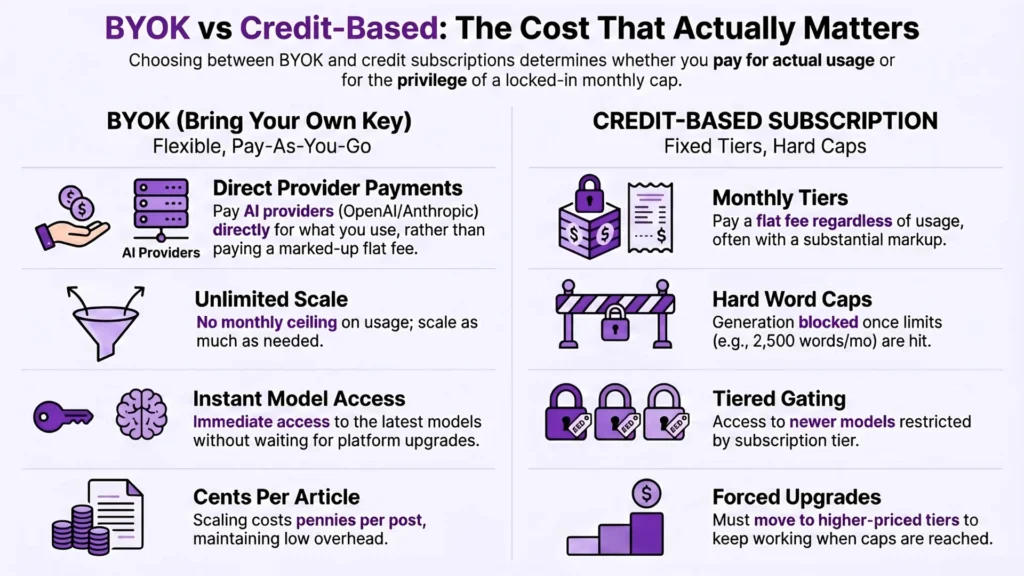
Most alternative comparisons stop at the monthly subscription price. That’s the wrong number to optimize. The math that actually matters is cost per published article — and it’s less obvious than it looks. Opace AI Scribe publishes exact per-token pricing by model directly in its plugin description: Claude Sonnet 4 input runs approximately $0.003 per 1,000 tokens; GPT-5 input runs approximately $0.075 per 1,000 tokens. A 1,500-word article via GPT-5 — roughly 2,000 tokens in, 1,200 tokens out — costs somewhere in the range of $0.33 in raw API spend. That number looks small in isolation.
But here’s what the comparison roundups skip: a raw BYOK plugin with no structured prompting forces you to do the brief, the outline, the tone calibration, and the E-E-A-T layering manually. If that costs you 25 minutes per article, and your time is worth anything, the “free” tool isn’t free. A structured pipeline tool — one that handles brief construction, source research, and editorial review automatically — may add $0.05–$0.10 in API overhead per article but returns those 25 minutes every single time. The cheapest BYOK alternative is not always the lowest-cost workflow. That’s the calculation most operators never run, and it’s the one that should drive your tool selection.
How to Evaluate an Alternative Before You Commit
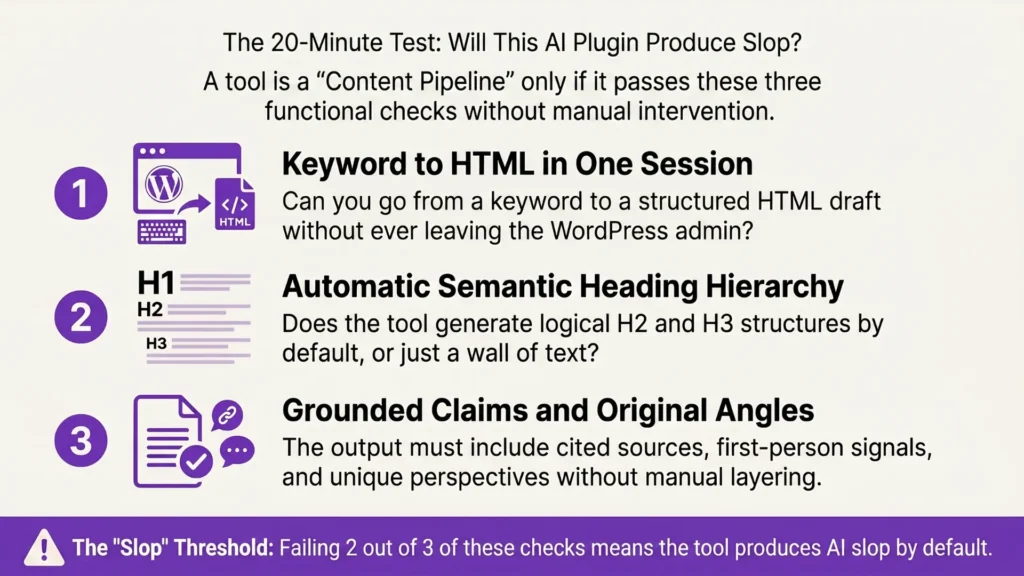
No comparison article — including this one — substitutes for 20 minutes of hands-on testing. Here is the protocol that filters most tools out fast. First: can you go from a keyword brief to a structured HTML draft in one session without leaving the WordPress admin? If the tool requires you to draft in an external editor, copy-paste into WordPress, and then reformat headings manually, it’s a content generator, not a pipeline. Second: does the output include semantic heading structure by default — H2s, H3s, logical hierarchy — or does it dump a wall of text and ask you to organize it? Third: does the draft include first-person signals, cited claims, or original angles without you manually layering them in? If a tool fails two of those three checks, it produces AI slop by default. Model quality is irrelevant if the structural inputs aren’t there.
The single strongest signal is whether the tool forces structured inputs before generating anything at all. Tools that ask only for a keyword and immediately start writing are skipping the work that determines output quality: the intent analysis, the audience definition, the angle selection, the source research. That’s the work Contentosapp’s 7-agent pipeline distributes across specialized stages — Discoverer, Strategist, Researcher, Writer, Editorial Reviewer — before a single word of article prose is produced. It’s also why GetGenie’s competitor SERP analysis panel is genuinely useful: it forces you to engage with the competitive landscape before writing, not after. Tools that skip that step are betting that the model alone is enough. It isn’t.
Frequently Asked Questions
Is AI Engine good for content creation, or is it more of a developer tool?
AI Engine is primarily a developer framework. Its core value propositions — function calling, REST endpoints, MCP support, knowledge base embeddings — are infrastructure features, not editorial ones. You can use it to generate content, but you’ll spend meaningful time on configuration that a purpose-built content plugin handles automatically. If your goal is publishing articles, not building AI-powered WordPress applications, AI Engine is solving the wrong problem for you.
Which AI Engine alternative works best without a coding background?
Contentosapp and GetGenie are the most accessible options for non-technical users. Contentosapp requires only an API key to start producing articles — no credit card, BYOK unlimited, free forever. GetGenie operates as a standard WordPress plugin with a guided editor interface. Neither requires command-line access, custom configuration, or developer knowledge to publish a first article.
Do these alternatives support OpenAI, Anthropic, and Gemini, or are they locked to one provider?
Most of the tools in this comparison support multiple providers. AI WP Writer runs GPT-5, Claude Opus-4.8, Gemini 3.1 Pro, Grok, and more. Opace AI Scribe supports GPT-5, OpenAI o3, Claude Sonnet 4, and Claude Opus 4. Contentosapp connects to OpenAI, Anthropic, and Google Gemini for image generation. Provider lock-in is not a real constraint in 2026 — almost every serious tool has moved to multi-model support.
Can I migrate my existing AI Engine workflows to one of these tools?
Not directly. AI Engine workflows — especially those using function calling, chatbot configurations, or custom MCP setups — are framework-level constructs with no equivalent in content pipeline tools. What you can migrate is your output: if you’ve been using AI Engine primarily to generate article drafts, any of the four alternatives will handle that job without requiring you to rebuild anything. The transition is a fresh start on tooling, not a migration in the technical sense.
What is the cheapest BYOK-compatible AI content plugin for WordPress in 2026?
On paper, Opace AI Scribe and Contentosapp are both free to install with BYOK. Contentosapp is explicit: BYOK unlimited, free with your own API keys. Opace AI Scribe is open-source with no paid tier for the plugin itself. In practice, the real per-article cost depends on which model you run and how structured the prompting is — a tool that generates efficiently in fewer tokens will cost less per article than one that burns a large context window on unstructured generation.
Does Contentosapp replace AI Engine entirely, or does it serve a different use case?
Different use case, almost entirely. AI Engine builds AI-powered WordPress infrastructure — chatbots, knowledge bases, custom API integrations. Contentosapp produces editorial content: keyword-to-published-article pipelines with sourced research, schema, images, and social copy. There is minimal overlap. If you need a chatbot or custom AI form on your site, AI Engine is still relevant. If you need a repeatable system for publishing grounded, rank-ready articles at scale, Contentosapp is purpose-built for that job and AI Engine is not.
Conclusion
AI Engine is not a bad plugin — it’s the wrong plugin for most of the people evaluating it as a content tool. The real question isn’t which framework to use; it’s whether you need a framework at all. For the vast majority of solo operators and affiliate sites, the answer is no. GetGenie handles competitive SEO research. AI WP Writer handles volume and scheduling. Opace AI Scribe handles transparent, fully editable open-source generation. And Contentosapp handles the full editorial pipeline — research, writing, review, images, schema, and publishing — with your own keys and no monthly bill. Pick the one that matches your actual workflow, run the 20-minute test, and stop paying for complexity you’ll never use.
References
External sources
- AI Engine – The Chatbot, AI Framework & MCP for WordPress – WordPress plugin | WordPress.org — https://wordpress.org/plugins/ai-engine/
- Contentosapp – Your editorial team, inside WordPress — https://contentosapp.com/
- GetGenie: Write, Optimize & Track Content with AI — https://getgenie.ai/
- AI WP Writer – SEO content generator, chatGPT, Gemini – WordPress plugin | WordPress.org — https://wordpress.org/plugins/ai-wp-writer/
- Opace AI Scribe: SEO Content Creator & Humaizer for OpenAI & Anthropic – WordPress plugin | WordPress.org — https://wordpress.org/plugins/ai-scribe-the-chatgpt-powered-seo-content-creation-wizard/
- AI Writing solution for WordPress and Chrome — https://bertha.ai/