
Most “best AI SEO tools” lists rank six products by a score nobody can verify, declare a winner, and send you off to buy the wrong subscription. You end up with three platforms that all grade your content and none that handle the job you actually spend Tuesday mornings on. That’s the real problem with how this category gets covered.
This guide takes a different approach. It maps each of the best AI SEO tools in 2026 to the specific job it was built to do — keyword research, technical auditing, content briefing, on-page optimization, AI-search citation tracking, or WordPress publishing. Evidence comes directly from each tool’s official page, verified against the extraction date of September 7, 2026. Where a feature or price couldn’t be confirmed from the source, the matrix says so — “not publicly verified” is a real finding, not a cop-out. There is no overall winner here because the decision genuinely depends on which jobs account for most of your weekly SEO work. Understanding the actual cost of stacking AI content tools starts with knowing which jobs overlap across your subscriptions — that’s the question this guide is built to answer.
Six tools are in scope: Semrush, Ahrefs, Surfer, Frase, Writesonic, and Contentosapp Studio. They are not interchangeable. A team that treats them as alternatives and buys two or three of the same job is burning budget on redundancy.
Key Takeaways
- Organized by job, not ranking: Six tools are compared across six distinct jobs — keyword research, technical auditing, content briefing, optimization, AI-search tracking, and WordPress publishing.
- Overlap is real and costly: Four of these tools include AI-search citation tracking. Subscribing to more than one for that job means paying twice for the same output.
- WordPress publishing: Only Contentosapp Studio has a verified WordPress publishing output among the six tools. Other tools are not publicly confirmed for this job.
- No verified pricing: No tool published a verifiable price in its extracted source. Visit each official pricing page before committing to a subscription.
- The right stack depends on which two or three jobs account for the majority of your weekly SEO work — not on who topped a ranked list.
Six Jobs These Tools Are Actually Built For
The market confusion around AI SEO tools starts with a category problem. “AI SEO tool” gets applied to a keyword database, a content scorer, an autonomous citation agent, and a WordPress publishing pipeline — four fundamentally different products. Before any tool enters the conversation, the six core jobs need to be defined on their own terms.
Keyword and competitive research is about discovering what people search for and how hard it is to rank for those terms. Technical auditing is crawling a site to find structural, speed, and indexing issues before they compound. Content briefing produces structured outlines and optimization targets for writers to execute against. Content optimization scores a draft in real time and tells a writer which terms are under- or over-represented. AI-search monitoring — and this one matters more than most roundups acknowledge — tracks where AI systems like ChatGPT, Perplexity, and Google’s AI Overviews are citing competitors instead of you. This is not rank tracking. It operates at the prompt level: which branded queries trigger an AI recommendation, and whose brand appears in the answer.
The sixth job is WordPress publishing pipeline — turning a completed draft into a formatted, source-attributed, human-reviewed post inside WordPress, without a copy-paste step. This is a workflow job, not a content job. A tool can produce perfect content and still require 45 minutes of reformatting before it appears on your site. That friction compounds at scale, and it almost never shows up in comparison tables. The distinction between these six jobs is the lens through which every tool in this guide is evaluated.
Decision Matrix: One Row per Tool, One Column per Job
Every cell below is traceable to the official source cited, or explicitly labeled. No cell is inferred from marketing tone or assumed from the absence of a denial. “Not publicly verified” means the capability was not described in the extracted official content — it is not a statement that the feature does not exist.
Pricing is absent from every row. No verifiable price figure appeared in any of the six official sources extracted on September 7, 2026. Visit each tool’s pricing page directly before subscribing.
| Tool | Keyword / Competitive Research | Technical Auditing | Content Briefing | Content Optimization | AI-Search Monitoring | WordPress Publishing |
|---|---|---|---|---|---|---|
| Semrush | Verified — 28 billion keywords indexed | Verified — audit module confirmed | Partial — topic research and AI content tools listed; brief export not confirmed | Verified — real-time content scoring | Verified — prompt-level AI Visibility tracking | Not publicly verified |
| Ahrefs | Verified — 41.9 billion keywords tracked | Verified — Site Audit module | Verified — Keywords Explorer and Content Explorer | Verified — AI Content Helper and AI Content Grader | Verified — Brand Radar tracks citations across AI chatbots | Not publicly verified |
| Surfer | Not publicly verified | Not publicly verified | Verified — SEO briefs via Content Editor | Verified — Content Editor (core product) | Label present (“AI Visibility Platform”); monitoring dashboard mechanism not publicly verified | Not publicly verified |
| Frase | Partial — SERP-based research confirmed; proprietary keyword index not confirmed | Verified — site crawl with SEO and AI readiness scoring | Verified — brief-to-draft loop | Verified — draft and approval workflow | Verified — tracks LLM citations across ChatGPT, Perplexity, and Gemini | Partially verified — “publishing, hosting” stated; WordPress plugin integration not confirmed |
| Writesonic | Not publicly verified | Partial — “technical work” stated; crawl scope not confirmed | Not publicly verified | Verified — AI content via agent fleet | Verified — prompt-level AI mention tracking | Not publicly verified |
| Contentosapp Studio | Not publicly verified | Not publicly verified | Not publicly verified | Not publicly verified | Not publicly verified | Verified — seven-stage pipeline publishes to WordPress with source attribution and human review |
Individual Tool Analyses
Semrush
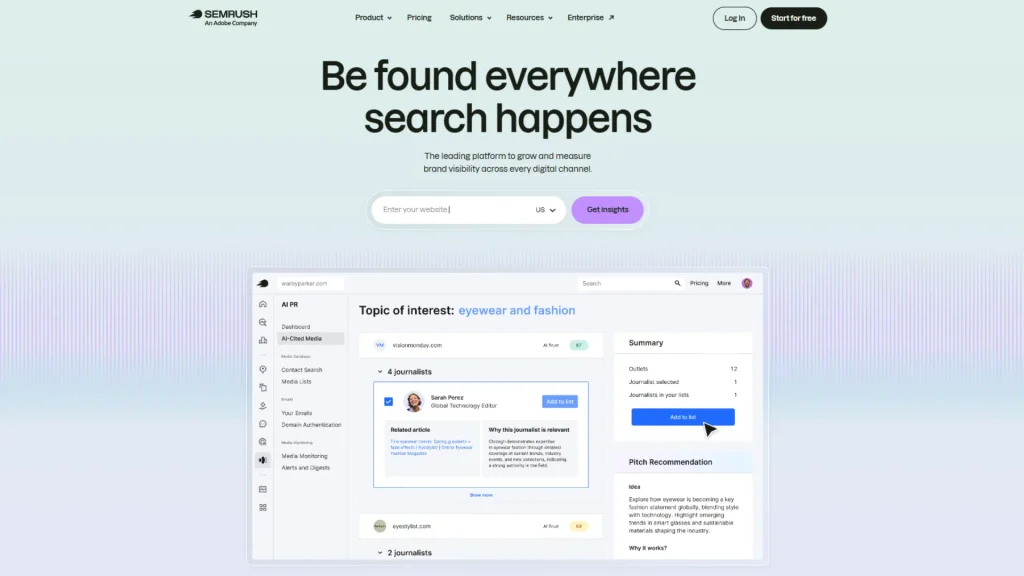
Semrush’s official page positions it as a platform for brand visibility across every digital channel — traditional SEO, AI-answer visibility, advertising, and PR, all in one interface. The 28 billion keyword index is the largest reported figure among the six tools in scope. The AI Visibility module is explicitly described as tracking “prompt-level visibility” and measuring AI market share against competitors — the vendor phrase is “get LLMs to cite your brand.” These are verified vendor claims, not independently audited outcomes.
The core tension in Semrush is scope versus cost. It describes at least nine distinct solutions on its official page — SEO, AI Visibility, Traffic and Market, Content, Local, Advertising, AI PR, Social, and Enterprise. For teams that genuinely need all nine, consolidation has value. For a solo blogger who needs keyword research and nothing else, the platform is almost certainly oversized. Whether AI Visibility tracking is available at base plan levels or restricted to enterprise tiers is not publicly verified in the extracted source. WordPress native publishing is not mentioned anywhere in the extracted content.
Evidence gap: Plan-level pricing, included feature limits, and seat costs are absent from the official source. Whether the AI Visibility module is included at all paid tiers or gated separately is unconfirmed.
Ahrefs
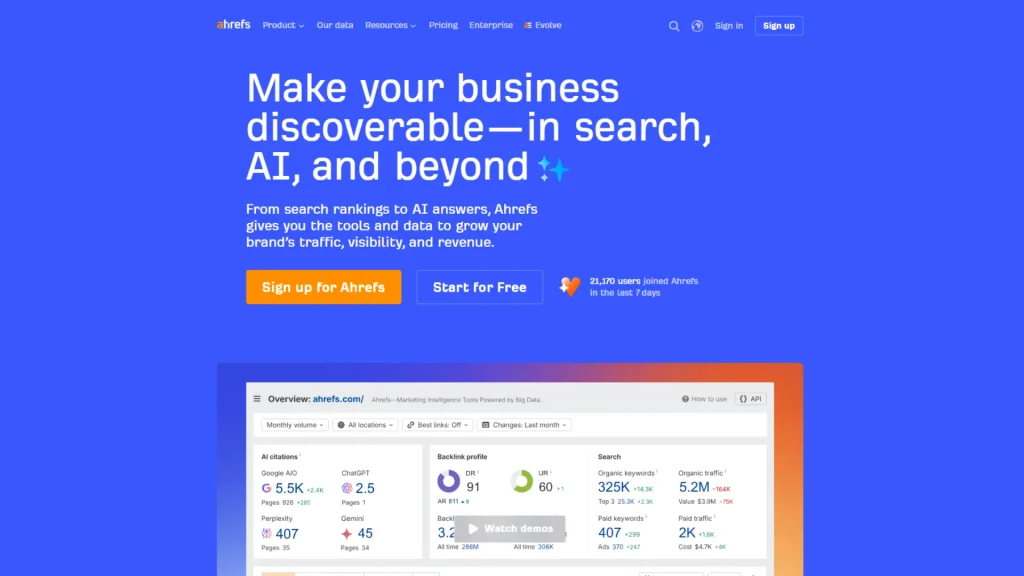
Ahrefs describes itself as “the only AI marketing platform built on a proprietary index of the web,” and the index numbers support that framing: 41.9 billion keywords tracked, 170 trillion pages in its web index, and 400 million monthly AI prompts processed, all per the vendor’s own page. The Brand Radar feature — tracking brand mentions, citations, and sentiment across AI chatbots — is a verified, named feature distinct from traditional rank tracking. Ahrefs also reports that marketers at 44% of the Fortune 500 use the platform, though this is vendor marketing, not an independently audited figure.
The platform covers the most jobs of any single tool in this comparison: keyword research, technical auditing (Site Audit), content briefing (Content Explorer, Keywords Explorer), optimization (AI Content Helper, AI Content Grader), and AI-search monitoring (Brand Radar). Whether that breadth justifies the cost for smaller operations depends on which jobs are actually in use. Letaido — described as “marketing reports, apps, and automations” — appears on the official page but its specific capabilities and pricing are sparse in the extracted content.
Evidence gap: Pricing, plan tiers, and whether Brand Radar is included on standard or enterprise-only plans are not confirmed. WordPress publishing is not mentioned in any extracted content.
Surfer
Surfer’s official page markets the platform as an “AI Visibility Platform,” but the extracted content is dominated by content optimization use cases — specifically the Content Editor, which provides real-time scoring and keyword recommendations for writers. The brief creation capability is explicitly verified: creating SEO-driven briefs is described as a core use of Content Editor, with user testimonials from practitioners including agency operators and independent SEOs. These testimonials are vendor-curated; the traffic growth figures cited by individual users are not independently audited.
The “AI Visibility Platform” label warrants scrutiny. The extracted content does not confirm a monitoring dashboard that tracks where LLMs cite competitors by prompt — this is a different product category from content-optimization scoring. Readers evaluating Surfer for AI-search monitoring specifically should verify directly whether that dashboard exists and what it covers before subscribing. For the specific job of content briefing and on-page optimization, Surfer is well-documented. For keyword research at database scale, technical auditing, and WordPress publishing, the official source provides no supporting evidence. See also this analysis of Surfer SEO alternatives for a direct comparison of optimization-layer options.
Evidence gap: The AI Visibility Platform label is present but the mechanism is not described. Keyword research depth, technical audit capability, and WordPress integration are all unconfirmed.
Frase
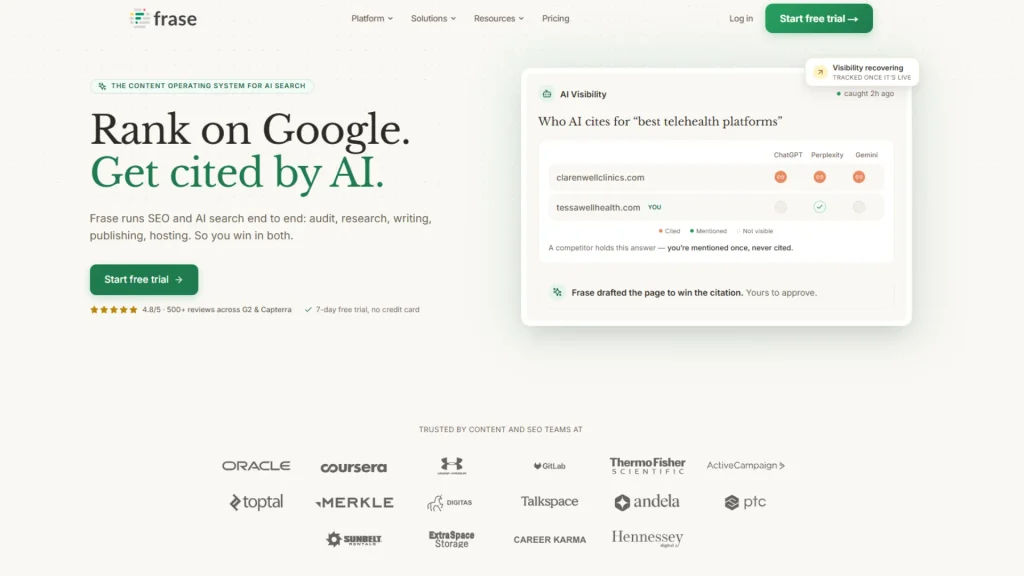
Frase positions itself as a content operating system that runs the full loop: audit, research, writing, publishing, and hosting. The AI visibility monitoring feature is one of the more explicitly documented among the six tools — the extracted interface example shows real-time citation tracking across ChatGPT, Perplexity, and Gemini, with competitor citations visible at the prompt level. The site audit function crawls pages, scores them for both SEO and AI readiness, and prioritizes fixes by impact. The vendor’s framing — “Frase drafts the fixes for your approval” — positions it as a loop rather than a one-shot tool.
The “publishing, hosting” claim on Frase’s official page is where precision matters for WordPress publishers. The source confirms those words appear, but does not specify whether publishing means a WordPress plugin, a REST API integration, a CMS-agnostic export, or a Frase-hosted page. That’s a material distinction for anyone running a self-hosted WordPress site. This comparison evaluating Frase versus Jasper covers related context on how Frase’s research engine differs from a standalone AI copywriter. The 7-day free trial with no credit card required is confirmed from the official page.
Evidence gap: Whether “publishing” refers to WordPress plugin integration or Frase-hosted pages is unconfirmed. Proprietary keyword database (vs. SERP-scraping for research) is unconfirmed. Paid plan pricing is absent from the extracted source.
Writesonic
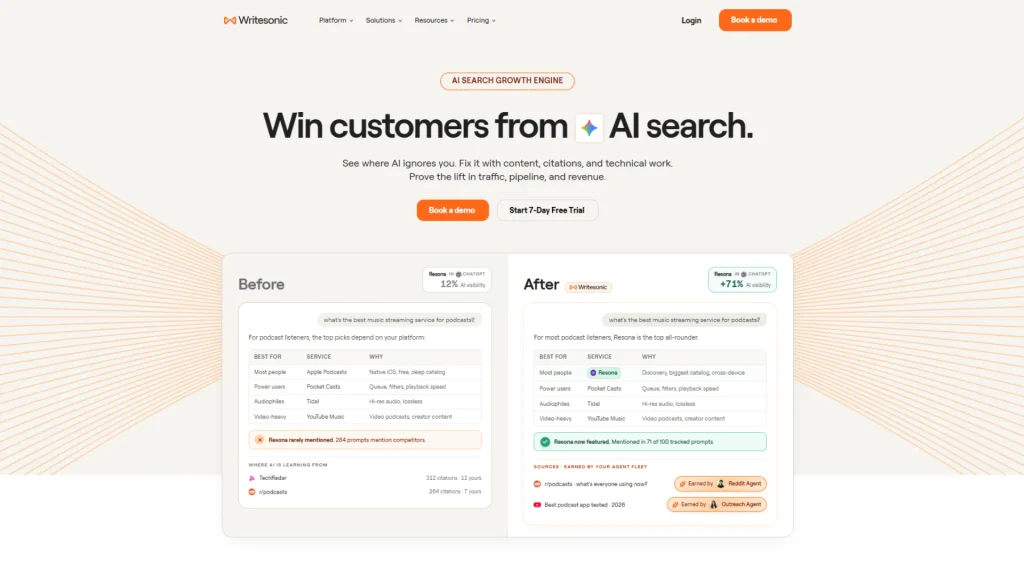
Writesonic’s official page is the most explicitly AI-search-focused positioning of the six tools. The platform is framed as an “AI Search Growth Engine” — it monitors where AI systems ignore a brand, then deploys a Content Agent and Outreach Agent to earn citations and backlinks. The illustrated scenario on the official page shows a before/after in which AI mention rate moves from 12% to 71% for a tracked brand. This is a vendor-illustrated scenario, not a documented independent outcome, and should not be treated as a typical result.
The agent-fleet framing sets Writesonic apart from the other tools in this group — the other platforms provide dashboards and recommendations; Writesonic describes autonomous execution. Whether that autonomous content and outreach activity produces reliable results at the account level, without editorial oversight, is a question the available sources do not answer. Traditional keyword research, content briefing for human writers, and WordPress publishing are not described in the extracted content. Trusted by 10,000+ marketing teams is a vendor claim on the official page. A 7-day free trial is confirmed.
Evidence gap: “Technical work” is listed as a platform capability but the scope — crawl depth, audit detail, fix implementation — is not confirmed. Independent validation of agent-fleet citation outcomes is not available in reviewed sources.
Contentosapp Studio
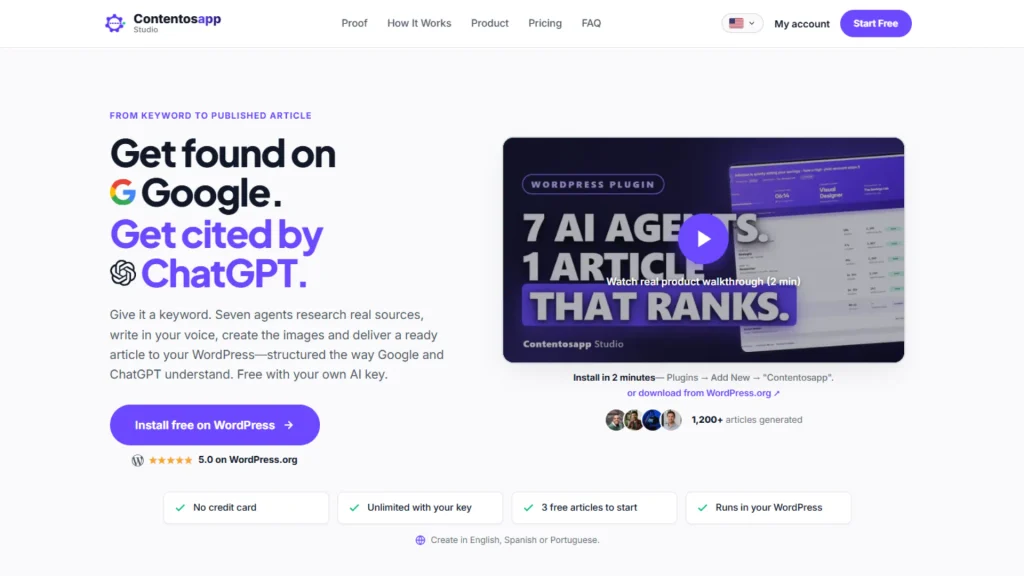
Contentosapp Studio’s official page documents a seven-stage pipeline that drafts, sources, fact-checks, and publishes content to WordPress with human editorial review before publication. The evidence here is direct and observable: a published article exists as output, attributed to a named author, with four open external references cited for specific optimization purposes — GEO/AEO optimization, Perplexity and ChatGPT content signals, Google’s AI-content guidance, and the llms.txt proposal. The pipeline’s source attribution is transparent: each reference is labeled with its purpose and linkable.
The “human-reviewed” gate is an explicit design choice, documented on the official page: “Fact-checked and edited by a human before publication.” This distinguishes the pipeline from fully automated AI publishing workflows. But it also means Contentosapp Studio is not competing directly with autonomous content-at-scale platforms. It is built for publishers who prioritize E-E-A-T signal density and source transparency over volume throughput. Keyword research, technical auditing, content briefing for external writers, and AI-search citation monitoring are not described in the extracted content. Importantly, Contentosapp Studio does not appear in any of the three independent roundup sources reviewed at this evidence date — which likely reflects its current market visibility stage, not its editorial quality.
Evidence gap: Pricing, plan limits, post-volume capacity, and the specific WordPress integration mechanism (plugin, API, or block editor) are not publicly confirmed. AI-search monitoring is not mentioned.
Strengths and Limitations by Job Category
Keyword and competitive research: Semrush and Ahrefs are the only two tools in scope with verified large-scale keyword indexes — 28 billion keywords and 41.9 billion keywords respectively. Both are well-documented for this job. The remaining four tools are not publicly confirmed for database-scale keyword research; Frase appears to work with SERP-based competitive research rather than a proprietary index.
Technical auditing: Three tools show verified technical auditing capabilities — Semrush, Ahrefs (Site Audit), and Frase (page-level SEO and AI readiness scoring). Writesonic references “technical work” but the scope is unconfirmed. Surfer and Contentosapp Studio do not mention technical auditing in their official content.
Content briefing and optimization: Surfer’s Content Editor is the most explicitly documented briefing-and-optimization combination. Frase’s brief-to-draft loop is verified. Ahrefs’ AI Content Helper and Grader are verified as existing features. Semrush includes content scoring tools. Writesonic generates content via agents rather than producing structured briefs for human writers. Contentosapp Studio is not publicly confirmed for external brief output.
AI-search monitoring: This is where the overlap problem is most visible. Semrush (AI Visibility), Ahrefs (Brand Radar), Frase (ChatGPT/Perplexity/Gemini tracking), and Writesonic (prompt-level monitoring) all include some form of this capability. Four tools, one job. Surfer uses the “AI Visibility Platform” label, but the specific monitoring dashboard mechanism is not confirmed in the extracted content. None of these tools’ AI-citation tracking claims are independently audited — the accuracy, latency, and LLM API coverage of each monitoring system cannot be verified from available sources.
WordPress publishing: One tool has a verified, observable WordPress publishing output: Contentosapp Studio. Frase states “publishing, hosting” without confirming the WordPress integration mechanism. The other four tools do not mention native WordPress publishing. For teams evaluating AI content plugins for WordPress, this gap is a practical constraint, not an edge case.
Verified Coverage by Job
Category Gaps: What These Six Tools Don’t Clearly Solve
No single tool among the six covers all six jobs without redundancy. A team that needs deep keyword research, technical auditing, and WordPress publishing currently has no verified single-vendor option. Semrush and Ahrefs cover the research and audit side; Contentosapp Studio covers the publishing end; there is no documented overlap between them.
AI-search monitoring is the category with the largest evidence gap. Four tools claim it, but no independent audit of the accuracy, refresh rate, or LLM API coverage of any of these tracking systems is available in the sources reviewed. A team that chooses a tool specifically for AI-citation monitoring is making that decision on vendor-illustrated scenarios and feature descriptions — not on independently verified tracking precision. That’s a real risk in a purchasing decision, and it won’t resolve until independent benchmarks emerge.
The WordPress publishing mechanism question is unresolved for all tools except Contentosapp Studio. “Publishing” can mean a native WordPress plugin that drops content directly into the block editor, a REST API push, a CMS-agnostic HTML export, or a copy-paste from a separate editor. These are meaningfully different workflows. Only one source — Contentosapp Studio’s official page — provides observable evidence of actual WordPress post output. For every other tool that mentions publishing, the integration type requires direct verification.
Pricing transparency is a structural gap across all six. No tool published verifiable plan pricing in its extracted official content. Costs appear on pricing sub-pages, in sales flows, or in annual-versus-monthly toggles that were not captured in the extraction. This means any total-stack cost calculation would require live verification from each vendor — not something this guide can reliably model without fabricating numbers.
Recommendations by Use Case and Stack Profile
Solo blogger building topical authority on a tight budget. The jobs that matter most are keyword research and content briefing. Surfer covers briefing and optimization with the most documented workflow for individual content creators. Ahrefs or Semrush covers the keyword research side. But both of those research platforms are documented as broad platforms — verify whether a base-tier plan includes the keyword research depth you need before subscribing to one alongside an optimizer. This combination covers Keyword Research and Content Optimization. Note that if you add a tool with AI-search monitoring, you may be paying for a job you don’t yet have enough content footprint to benefit from.
Small SEO agency running technical audits and content briefs for clients. Semrush or Ahrefs covers keyword research, technical auditing, and basic content tooling in one platform. Frase adds the brief-to-draft loop and AI-citation monitoring on top. This combination covers Technical Auditing, Content Briefing, and AI-Search Monitoring. Note that Semrush and Frase both include AI-search tracking — verify which platform’s monitoring is adequate for your reporting needs before paying for both.
WordPress publisher who needs end-to-end: research to publish without copy-paste friction. No single tool in scope covers the full chain. Ahrefs (keyword research and audit) plus Contentosapp Studio (source-backed drafting and direct WordPress publishing) addresses the most jobs without verified overlap between those two tools. This combination covers Keyword Research, Technical Auditing, and WordPress Publishing. The AI content cost per article framework is worth consulting before finalizing any stack — the real cost includes editing time and reformatting friction, not just subscription fees.
Brand or agency monitoring AI-search citation share. Writesonic is the only tool in scope positioned entirely around AI-search growth — monitoring, content production, and citation outreach in one agent-based system. Frase also covers AI-citation tracking alongside content workflow. Using both creates verified overlap in the monitoring job. Choose one based on whether you need an autonomous agent-fleet model (Writesonic) or a human-approval loop with monitoring (Frase), then supplement with a keyword research tool if needed. Every recommendation in this section should close with a verification step: confirm which features are available at your plan level directly with the provider, and identify any feature that appears in more than one tool before subscribing to both.
Frequently Asked Questions
Can AI tools replace traditional SEO software like Semrush or Ahrefs?
Not for the jobs that depend on database scale. Keyword research, competitive intelligence, and backlink analysis still rely on large proprietary indexes — Ahrefs reports 41.9 billion keywords tracked and Semrush reports 28 billion. AI-focused tools like Writesonic and Contentosapp Studio are built for different jobs (citation tracking and publishing, respectively) and do not replicate that infrastructure. The more accurate framing: AI tools extend the stack for specific jobs they weren’t designed to replace.
What is the difference between an AI content optimizer and an AI SEO writer?
An optimizer scores existing content against ranking signals and tells a writer what to add, remove, or rebalance. Surfer’s Content Editor is the clearest example in this comparison — it grades a draft in real time. An AI writer generates draft content from a prompt or brief. Writesonic’s agent fleet generates content autonomously. Frase does both: it produces a brief, drafts against it, and puts the result in an approval queue. The distinction matters because you can pay for both jobs in two subscriptions or find one tool that covers the loop.
How do AI SEO tools track visibility in ChatGPT and Google AI Overviews?
The mechanism varies by tool and is not independently audited in available sources. Semrush describes prompt-level visibility tracking and AI market share measurement. Ahrefs’ Brand Radar tracks citations and sentiment across AI chatbots. Frase monitors citations across ChatGPT, Perplexity, and Gemini in real time. Writesonic tracks which prompts trigger brand mentions. What none of the official sources confirm is tracking refresh rate, LLM API access scope, or detection accuracy. Verify those specifics directly with each vendor before choosing a platform for this job.
Which AI SEO tools work natively with WordPress?
Based on verified official-source evidence, Contentosapp Studio is the only tool in this comparison with a documented WordPress publishing output — its seven-stage pipeline produces posts that are fact-checked and published with source attribution. Frase states “publishing, hosting” on its official page, but whether that means a WordPress plugin or a hosted CMS is not publicly confirmed. The other four tools do not mention WordPress publishing in their extracted official content. For context on the broader WordPress AI tooling landscape, see AI content plugins for WordPress in 2026.
Are AI SEO tools worth the cost for solo bloggers or small agencies?
That depends on which jobs you’re paying for. A solo blogger who needs keyword research and content briefing can potentially cover both jobs with one mid-tier subscription to a platform like Ahrefs or Semrush. Adding an optimizer, an AI writer, and a citation tracker on top — when two of those jobs overlap — is where the bill compounds without proportional benefit. The practical test: list the three jobs that account for most of your weekly SEO time, then check which tools in this guide verify those jobs. This varies by plan — confirm feature availability directly with each provider.
What should I look for in an AI SEO tool if I publish more than 20 articles per month?
At that volume, workflow friction compounds fast. The jobs that matter most are content briefing speed, optimization throughput, and — critically — how the finished content gets into WordPress. Copy-pasting and reformatting 20+ articles per month is a real time cost that rarely appears in feature comparison tables. Check whether the tool outputs directly to WordPress or requires an intermediate export step. Also verify whether any per-article credit caps or word limits apply at your plan level, since these can make a subscription unworkable at scale. That information varies by plan — verify directly with the provider.
Conclusion
The six tools in this comparison are not competing for the same job. Semrush and Ahrefs dominate at keyword research and auditing scale. Surfer and Frase own different parts of the content optimization and briefing workflow. Writesonic is built specifically for AI-search growth. Contentosapp Studio is the only tool with a verified WordPress publishing output. Stack those appropriately and you’re paying for coverage. Stack them carelessly — especially across the four tools that each include AI-search monitoring — and you’re paying for the same job four times.
The practical next step: identify the two or three jobs that account for the majority of your actual weekly SEO work. Check which tools in the matrix verify those jobs. Then, before subscribing to any combination, confirm whether those features are available at the plan level you’re considering — and flag any job that appears in more than one tool on your shortlist. That single check is what separates a useful stack from an expensive one.
References
External sources
- Semrush: Your Unfair Advantage for Growing Brand Visibility — https://www.semrush.com/
- Ahrefs—AI Marketing Platform Powered by Big Data — https://ahrefs.com/
- Positive Surfer – AI Visibility Platform for maximum organic growth — https://surferseo.com/
- Official source for Frase — https://www.frase.io/
- Writesonic | The AI Search Growth Engine. Win Customers. — https://writesonic.com/
- AI Content Pipeline for WordPress | Contentosapp Studio — https://contentosapp.com/
Related content
- Surfer SEO Alternatives in 2026: Cheaper Optimizers and a Better Workflow for WordPress Publishers — Contentosapp
- Frase vs Jasper (2026): SEO Research Engine vs Brand-Voice Copywriter — Which One Does a WordPress Publisher Actually Need? — Contentosapp
- AI Content Cost Per Article: What You’re Actually Paying After Word Caps, Seat Fees, and Editing Time (2026) — Contentosapp
- Best AI Content Plugins for WordPress in 2026: Compared, Ranked, No Slop — Contentosapp