

You didn’t go looking for Writesonic alternatives because the AI writing market suddenly improved. You went looking because Writesonic changed — and the tool you bought for volume blog production now calls itself an AI Search Growth Engine, centered on brand monitoring and citation tracking across ChatGPT, Gemini, and Google AI Overviews. Meanwhile, the Starter plan still caps article generation at 15 per month at $79/month billed annually — that’s roughly $5.27 per AI article before any editing time. For a WordPress publisher trying to build topic authority at scale, that gap between what you need and what the platform now prioritizes is the actual problem.
This article maps six writesonic alternatives to the specific workflow stages they cover — source research and briefs, draft generation, on-page SEO, AI search visibility, and WordPress-native publishing — using data drawn from each tool’s official page, accessed 2026-09-03. No invented scores. No affiliate rankings. Pricing is cited with its billing period and usage limits, because a $9/month plan that burns words at 3× speed on your preferred model isn’t a $9/month plan in practice. The goal here is to help you identify which part of your workflow to replace, not which single app to crown best.
1-Minute Summary
- Why people are leaving: Writesonic repositioned as an AI search visibility platform in 2026. The Starter plan caps article output at 15/month at $79/mo (annual billing), making it a poor fit for volume blog production.
- Lowest entry price: Koala at $9/mo (monthly billing) with 15,000 words and native WordPress push — but the word budget depletes at 2× or 3× speed depending on which model you use.
- Full content loop in one tool: Frase covers audit → draft → CMS publish → rank monitoring, starting at $39–$49/mo billed annually (Starter tier), with native WordPress, Webflow, and Sanity support.
- Free tier or your own key: Contentosapp Studio starts at $0 with 3 managed articles, then either BYOK (your own API key, no platform fee) or a managed plan from $9/month, with human editorial review built into the pipeline.
- No overall winner is declared — every recommendation in this article is tied to a specific documented use case and workflow stage.
| Tool | Research / Briefs | Draft Generation | SEO Optimization | AI-Search Visibility | WordPress Publishing |
|---|---|---|---|---|---|
| Writesonic | — | — | — | ✓ Primary | not verified |
| Contentosapp Studio | ✓ | ✓ | — | — | ✓ |
| Jasper | — | ✓ | — | not verified | not verified |
| Surfer | — | — | ✓ | ✓ | not verified |
| Frase | ✓ | ✓ | ✓ | ✓ | ✓ |
| Koala | — | — | ✓ | ✓ | ✓ Primary |
Why Writesonic Users Are Looking for Alternatives
Writesonic’s own homepage describes the product as an “AI Search Growth Engine” built to help brands win customers from AI search — tracking where ChatGPT, Gemini, and Google AI Overviews mention your competitors instead of you. That’s a coherent product vision. It’s just not the one most WordPress publishers were paying for when they signed up to produce research-backed blog content at volume.
The pricing structure makes the mismatch concrete. The Starter plan at $79/month billed annually gives you 15 AI articles per month, 50 tracked prompts per day, and 10 site audits. The Basic plan at $199/month raises that to 25 articles and 100 tracked prompts. The Growth plan at $399/month goes to 50 articles. For a publisher trying to publish 4 to 6 posts per week, the math stops working long before it gets close to budget. You’re paying an AI visibility platform rate for a volume that a content-production tool should handle at a fraction of the price.
This isn’t a criticism of Writesonic’s direction — GEO tracking and AI citation monitoring are genuinely valuable capabilities. But the platform repositioning means the current plans are structured around brand-monitoring value, not per-article output. That’s the structural reason the Starter plan’s article ceiling exists: at $79/month, the primary deliverable is 50 tracked prompts and 50 answers daily across ChatGPT, Gemini, and Google AI Overviews, with article generation as a secondary feature. If your job is to produce rank-ready content at volume, you need a tool where content production is the core feature — not a secondary one capped at 15 articles to support the main tracking dashboard.
The Five Workflow Stages These Tools Actually Cover
Before evaluating any tool by name, map your actual gap. The alternatives market for Writesonic doesn’t divide neatly into “better” and “worse” — it divides by the workflow job each tool was built to do. The five stages are: (a) source research and brief building, (b) AI draft generation, (c) on-page SEO optimization and content scoring, (d) AI-search and GEO visibility tracking, and (e) WordPress-native publishing with human review controls.
Every tool in this comparison covers some of these stages. None covers all five with equal depth. Surfer is purpose-built for stages (c) and (d) — it optimizes content you already have and tracks AI prompt visibility, but it’s not primarily a drafting engine. Jasper is strongest at stage (b) for multi-channel marketing teams that need enforced brand voice; its WordPress publishing capability is not publicly confirmed in its official source. Frase explicitly covers stages (a) through (e) in a single loop, with native CMS push to WordPress, Webflow, Sanity, and Wix. Koala leads on stage (e) for volume, pushing to WordPress, Shopify, Webflow, and Ghost at its lowest tier. Contentosapp Studio handles stages (a), (b), and (e) via a seven-stage pipeline — Discoverer and Strategist build the research and brief, the Writer drafts, and human editorial review sits before WordPress publication — the only tool in this comparison where human fact-checking is explicitly documented as part of the process.
Understanding which stage is your actual bottleneck tells you which tool to trial first. For a broader look at WordPress-native options, this comparison of AI content plugins for WordPress in 2026 covers the CMS delivery dimension in more depth.
Decision Matrix: Six Tools Across Key Criteria
All data from official pricing pages, accessed 2026-09-03. Cells marked “not publicly verified” indicate that the information could not be confirmed from the extracted official source.
| Tool | Primary Workflow Stage | Entry Price (annual billing) | Volume at Entry | AI Search Visibility | WordPress Publishing | BYOK | Human Review Controls |
|---|---|---|---|---|---|---|---|
| Writesonic | AI search visibility + brand monitoring | $79/mo | 15 AI articles/mo | ✓ (50 prompts/day) | Not publicly verified | Not publicly verified | Not publicly verified |
| Contentosapp Studio | BYOK drafting + human editorial pipeline | $0 (3 managed articles, then BYOK) or $9–$129/mo managed plans | 3–100 done-for-you articles/mo by plan, unlimited under BYOK | AI-search-aware sourcing documented | Pipeline-based (stated) | ✓ Core model | ✓ Explicitly stated |
| Jasper | Brand-voice content + multi-channel campaigns | $59/mo/seat | Not publicly stated | GEO & AI Optimization listed; depth not verified | Not publicly verified | Not publicly verified | Not publicly verified |
| Surfer | On-page SEO optimization + content scoring | $49/mo (Discovery) | 120 documents/mo | ✓ (10 pages tracked at Discovery; 25 AI prompts/week from Standard) | Not publicly verified | Not publicly verified | Not publicly verified |
| Frase | Full loop: audit → draft → publish → monitor | $39–$49/mo (Starter, annual–monthly) | 10 articles/mo; 50 audit pages | ✓ SEO + GEO + ChatGPT, Google AI (Perplexity from Professional) | ✓ WordPress, Webflow, Sanity, Wix | Not publicly verified | Conditional (agent publishes when permitted by user) |
| Koala | High-volume WordPress article production + SEO | $9/mo (monthly) | 15,000 words/mo (1× model baseline)* | ✓ ChatGPT, Google AI Overviews, Perplexity stated | ✓ WordPress, Shopify, Webflow, Ghost, webhooks | Not publicly verified | Not publicly verified |
*Koala word multiplier: The $9/month Essentials plan uses GPT-5.6 Luna as the 1× baseline. GPT-5.6 Terra and Claude Sonnet 5 consume words at 2× — reducing your effective Essentials budget to 7,500 words/month. GPT-5.6 Sol and Claude Opus 5 run at 3×, leaving 5,000 effective words. This is a material pricing fact for cost-per-article calculations.
Individual Tool Analyses
Contentosapp Studio
Contentosapp Studio offers two ways in, not one. The Free plan gives 3 managed articles with no card required, then switches to BYOK — your own API key from your preferred provider, with each article’s cost passing through at the provider’s rate and no platform markup. For publishers who’d rather not manage a provider key, managed plans run $9/month (Starter, 5 articles/month), $49/month (Pro, 30 articles/month), and $129/month (Studio, 100 articles/month) — with no Contentosapp article limit once BYOK is active on any plan. The pipeline itself runs seven stages, and the output is fact-checked and edited by a human before publication.
The sourcing approach is also distinct. A published article on the platform lists four open-access references drawn from sources covering GEO and AEO optimization, practical AI search discovery signals, Google’s guidance on useful content, and the llms.txt proposal — sources chosen to demonstrate AI-search awareness rather than generic link-building. AI-search-aware sourcing is documented as a pipeline stage; specific per-article reference depth beyond what appears in that published example is not publicly verified in the extracted source. For publishers who want AI search signals baked into content sourcing rather than bolted on as a separate tracking dashboard, that’s a structural difference worth noting.
The primary verified limitation: seat limits and the full depth of WordPress integration beyond the seven-stage pipeline output are not publicly detailed in extracted source content. Independent reviews of this specific product are not currently available in the sources assessed for this article. The cost-per-article methodology — the real number after API rates and editing time — is documented in detail at the AI Content Cost Per Article resource, which is the right place to run your own volume math before committing.
Ideal profile: Volume publishers and SEO teams, particularly those producing 30–100+ articles/month, who want full cost transparency, documented human editorial oversight, and AI-search-aware sourcing without a per-seat subscription scaling against them as headcount grows.
Frase
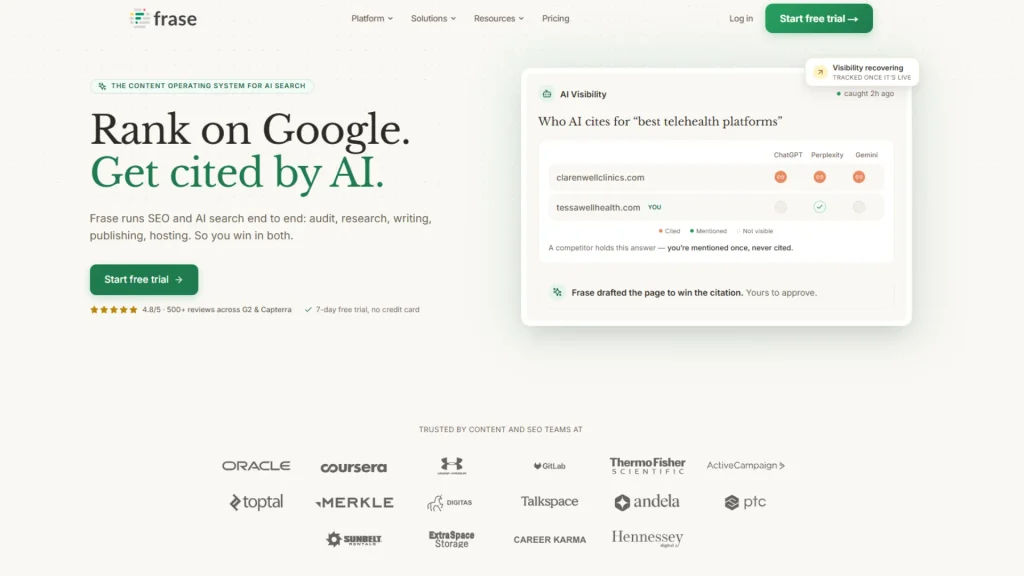
Frase positions itself as “the content operating system for AI search” and is the only tool in this comparison that explicitly runs the full content loop — audit, research, draft, publish to a named CMS list, and monitor for rank decay — within a single subscription. The Starter plan at $39/mo billed annually ($49/mo month-to-month) includes 10 articles per month, 50 audit pages, 1 seat, 1 site, native publish to WordPress, Webflow, Sanity, or Wix, plus AI visibility scoring for ChatGPT and Google AI. The Content Guard feature watches 10 pages for Google rank decay, drafts a fix, and republishes once you approve. That’s an unusually complete default for an entry-tier plan.
The Professional plan at $103/month billed annually ($129/month month-to-month) expands to 40 articles, 250 audit pages, 3 seats, 5 sites, and adds Perplexity to the AI visibility tracking. The agent can publish autonomously when you permit it — Frase’s own description is “the agent publishes on its own when you let it, on any content type”. That framing is worth noting: the human remains the gate. You decide when autonomous publishing is on or off. For teams that want automation with editorial control built into the structure rather than added as an afterthought, this matters.
Verified limitation: BYOK support is not mentioned in the extracted official source. The Scale plan article and seat counts were partially extracted — check frase.io/pricing directly for Scale-tier specifics. At 10 articles per month on Starter, Frase is a tighter fit for editorial teams optimizing quality over output volume than for publishers targeting 50+ articles per month.
Ideal profile: In-house SEO teams and growing SMBs that need a single tool covering research, drafting, CMS publishing, and rank monitoring — especially those running multiple sites who want Content Guard running in the background rather than checking rankings manually.
Jasper
Jasper describes itself as “the execution platform for intelligent marketing” — specifically an agent workspace built for marketing teams running end-to-end campaign workflows. The brand voice capability is the documented differentiator: you can upload your brand’s writing style guide or feed Jasper a piece of content, and the AI analyzes that writing style to mimic your tone of voice. That’s a real structural advantage for agencies or content teams with multiple writers who need brand-voice enforcement as a system, not a style guide that gets ignored.
The Pro plan is $59/month billed yearly or $69/month billed monthly. The Business plan is custom-priced. Jasper also lists GEO and AI optimization as a feature — “get cited by AI, the new front door of search” — though the specific depth of that feature set is not detailed in the extracted source content available for this assessment. Claims of “4.8/5 stars in over 10k reviews” and “100,000+ businesses” are vendor marketing statements, not independently verified figures.
Verified limitations: Pro plan article or word volume limits are not publicly stated in the extracted source. WordPress native publishing capability is not confirmed. BYOK is not mentioned. Per-seat scaling on the Pro plan matters for teams — if you’re adding two or three writers, the $59/month becomes $118 or $177/month before reaching Business-tier pricing. If you’re exploring alternatives in this space, Jasper alternatives for WordPress covers tools that also offer BYOK plugins for rank-ready drafting at lower per-article cost.
Ideal profile: Marketing teams — not primarily solo bloggers — with multi-seat requirements, enforced brand voice needs, and multi-channel campaign content. Less suited to pure WordPress volume publishing.
Koala
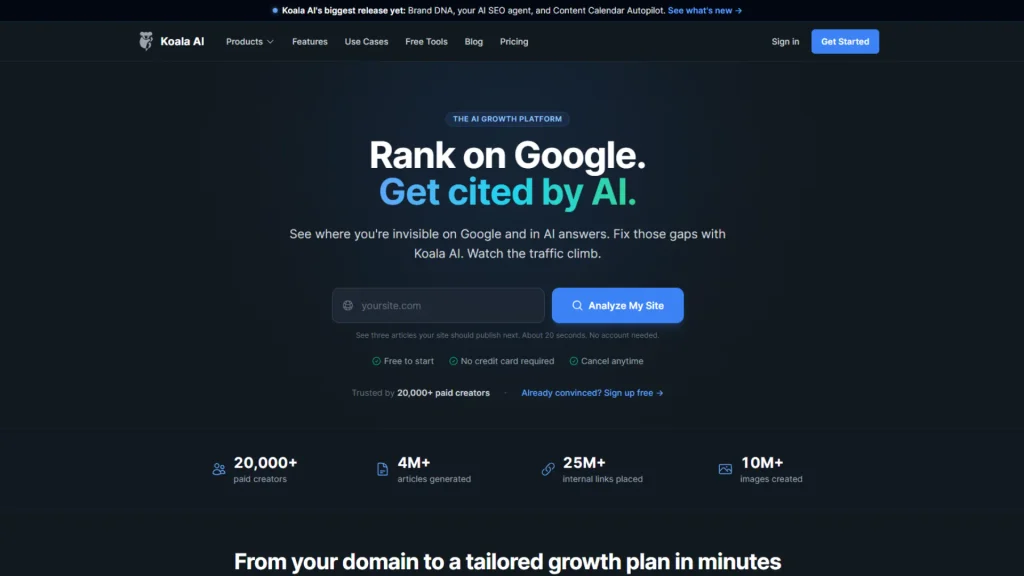
Koala is the entry-price leader in this comparison by a significant margin. The Essentials plan at $9/month (monthly billing) includes 15,000 words/month at the GPT-5.6 Luna baseline, plus native integrations with WordPress, Shopify, Webflow, Ghost, and webhooks from the lowest tier. The Professional plan at $49/month raises word count to 100,000 words, adds KoalaLinks for internal linking across up to 50 sites, Search Console integration, and a Brand DNA preview. The Boost plan at $99/month adds 250,000 words, full Brand DNA, and Content Calendar Autopilot. That word-volume scaling is aggressive compared to the article caps you hit on Frase or Writesonic’s entry tiers.
The word multiplier is the cost variable every Koala user needs to internalize before picking a tier. At Essentials, the 15,000-word budget is calculated on GPT-5.6 Luna at 1×. Switch to Claude Sonnet 5 or GPT-5.6 Terra and words cost 2×, leaving 7,500 effective words per month. Switch to Claude Opus 5 or GPT-5.6 Sol and you’re at 3×, leaving 5,000 words. For a publisher producing 2,000-word articles, Essentials with a 2× model covers roughly 3–4 articles per month — well below what $9/month sounds like at headline level.
Verified limitations: BYOK support is not publicly stated. Explicit human review or editorial approval controls are not mentioned in the extracted source. Seat limits at lower tiers are not publicly detailed. If you’re researching this space further, Koala AI alternatives built for search quality in 2026 gives a comparative view of tools optimized for ranking, not just volume.
Ideal profile: Affiliate publishers and niche-site operators producing high-volume content who primarily use baseline models and want native CMS push without a per-article document credit system. Volume math needs to be run before committing at any Essentials tier.
Surfer
Surfer self-describes as “an AI Visibility Platform for maximum organic growth” — with the explicit positioning “Be The Answer in Google — Everywhere Buyers Search.” The core product is on-page content optimization: the Content Editor scores drafts against real-time SERP data and provides keyword, structure, and coverage guidance. That makes Surfer primarily a stage (c) tool — you bring drafts in from your writing workflow, and Surfer grades and guides them toward higher content scores.
The Discovery plan at $49/month billed annually covers 120 create-or-optimize documents per month and tracks 10 pages — but does not include AI prompt tracking at this tier. AI prompt visibility tracking starts at Standard ($99/month annually) with 25 AI prompts refreshed weekly, and scales to Pro ($182/month) with 50 prompts refreshed daily. There’s also a standalone AI Search Analytics product at $158/month billed annually for brands that only need the tracking layer without the content-optimization feature set. Peace of Mind at $299/month is the first plan with unlimited* documents and API access — the asterisk on “unlimited” is present in the official source, but fair-use conditions are not fully detailed in the extracted content.
Verified limitations: BYOK is not mentioned. WordPress native publishing is not confirmed in the extracted source. Surfer is not a standalone AI writer — it’s an optimization layer for content produced elsewhere. For publishers already happy with their drafting workflow who just need content scoring and SEO guidance, that’s exactly the right tool. For publishers looking to replace a drafting pipeline, it’s only a partial solution. Surfer SEO alternatives in 2026 covers cheaper optimization options and different workflow integrations for WordPress publishers specifically.
Ideal profile: SEO teams and content agencies optimizing existing and new drafts against SERP benchmarks, particularly those who also need AI prompt visibility tracking without maintaining a separate GEO monitoring subscription.
Writesonic (Baseline Reference)
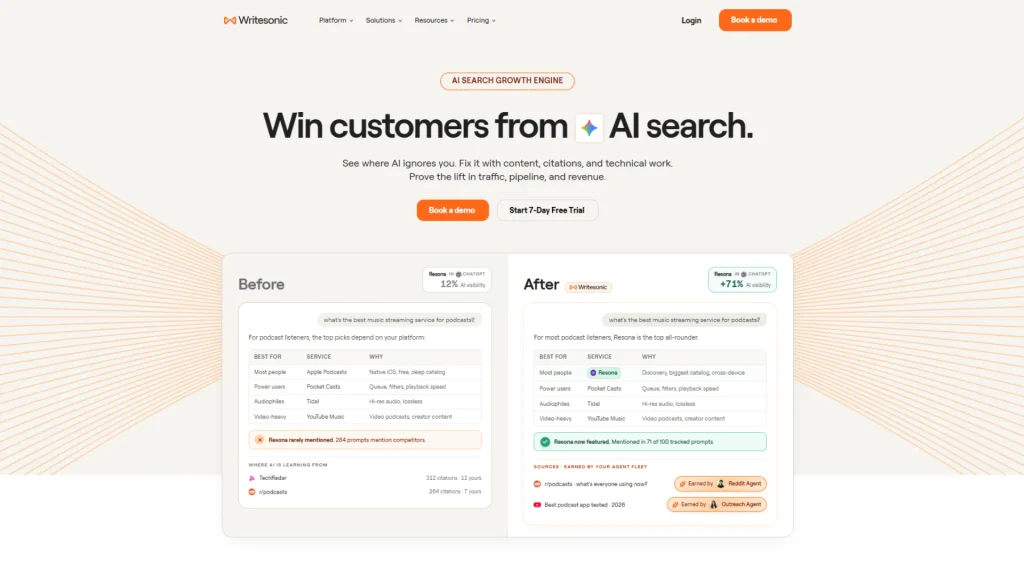
Writesonic is included here as the platform being evaluated for replacement, not as one of the alternatives. Its homepage centers the product on AI search visibility: “Win customers from AI search. See where AI ignores you. Fix it with content, citations, and technical work.” That’s a coherent product for a brand-monitoring and GEO-recovery use case. It’s misaligned with the volume blog production job most WordPress publishers brought to it.
At Starter ($79/month annual), you get 15 AI articles, 50 tracked prompts per day, and 10 site audits with 100 pages each. Basic at $199/month raises articles to 25 and prompts to 100 daily. Growth at $399/month gives 50 articles, 200 prompts, and Sentiment Analysis. The article production caps don’t change the math: at Starter, you’re paying approximately $5.27 per AI article for a platform whose primary value is brand visibility tracking, not content production. If GEO monitoring is your actual job, Writesonic’s current product is a reasonable fit. If content production at volume is the job, the plan structure isn’t designed for it.
Strengths and Limitations by Workflow Stage
Research and brief building: Frase is the strongest documented option here — it audits existing pages for SEO and AI readiness, researches competitor content, and feeds that context directly into the drafting workflow. Contentosapp Studio’s pipeline incorporates sourced references as a documented output behavior, grounding articles in open-access sources before a human editor reviews the draft. Koala lists “deep web research” from the Professional tier upward. Jasper, Surfer, and Writesonic do not focus on source research and brief building as a primary workflow feature in the extracted source content.
On-page SEO optimization: Surfer is the only tool in this comparison explicitly built around content scoring and SERP-guided optimization. Frase includes SEO and GEO scoring across all plans. Koala lists “AI-Powered SEO Optimization” at Essentials, with the AI SEO strategist (keyword, backlink, SERP, competitor data) from Professional upward. Jasper’s SEO guidance depth is not publicly verified in the extracted source. Contentosapp and Writesonic do not document on-page scoring as a primary feature.
WordPress-native delivery: This is a documented strength for Koala (all tiers) and Frase (all tiers). Contentosapp Studio documents pipeline-based delivery, though the depth of WordPress integration beyond the seven-stage output is not publicly detailed. Jasper, Surfer, and Writesonic do not confirm native WordPress push in the extracted sources reviewed for this article. For publishers whose CMS integration is a non-negotiable requirement, this gap in vendor documentation is itself a signal to verify directly with each vendor before committing.
Category Gaps: What No Tool in This Comparison Clearly Solves
Three workflow needs remain unmet — or only partially covered — by the six tools in this comparison, based on publicly documented features as of 2026-09-03.
End-to-end pipeline from sourced research to WordPress publish with human review in one tool, without a custom integration. Frase gets closest on the automation side. Contentosapp Studio gets closest on the human-review side. But a tool that combines real-time source research, AI drafting, human editorial approval, and WordPress push — with E-E-A-T signals documented at each stage — is not publicly available among the six tools assessed.
GEO/AI-search visibility tracking for publishers who also need bulk blog drafting on the same platform, at production pricing. Writesonic’s tracking capability is strong, but article volume caps make bulk drafting prohibitively expensive at scale. Frase and Koala include AI visibility features but position them as supporting elements alongside a content production workflow, not as the primary brand-monitoring dashboard that Writesonic and Surfer’s AI Search Analytics product offer.
Full BYOK with on-page SEO optimization guidance in one native interface. Contentosapp Studio is the only tool in this comparison that documents a BYOK model. But SEO content scoring — the kind Surfer provides — is not documented as a native Contentosapp feature. Combining cost-pass-through API pricing with SERP-guided optimization in a single interface currently requires stitching two tools together.
Jasper’s WordPress publishing depth is unconfirmed. For any multi-seat agency considering Jasper as a WordPress content production platform — not just a campaign content tool — this is a material gap. The official source does not confirm native WordPress push. Before committing five or more seats to Jasper for a WordPress-native production workflow, you’d need to verify the integration directly with Jasper’s team. Building a workflow on an assumed integration that turns out to require a workaround is an expensive discovery to make after purchase.
Category Gaps
Recommendations by Use Case
The profiles below are matched to documented tool capabilities, not to vendor marketing claims. Where pricing is cited, the billing period and plan name are included.
Solo blogger or affiliate publisher, WordPress, 30–100 posts/month, cost-sensitive: Koala at $49/month (Professional, annual billing) provides 100,000 words, native WordPress push, KoalaLinks for internal linking, and Search Console integration. Verify which model you’ll primarily use — Claude Sonnet 5 at 2× halves that budget to 50,000 effective words. If you’re producing 2,500-word posts, that’s 20 articles/month at 1× or 10 at 2×. Run the math at your actual model preference before committing. For a comparable managed plan without word-multiplier math, Contentosapp Studio’s Pro tier at $49/month covers 30 done-for-you articles/month with deeper research and 3 images each — or BYOK for no platform fee at all. Full methodology at AI Content Cost Per Article.
In-house SEO team needing research, drafting, CMS publishing, and rank monitoring in one tool: Frase Professional at $103/month billed annually covers 40 articles, 3 seats, 5 sites, WordPress/Webflow/Sanity/Wix publishing, Perplexity AI visibility, and Content Guard monitoring 75 pages for rank decay. That’s the most complete documented single-tool loop in this comparison for teams at that scale. Start with the 7-day free trial — no credit card required, per the official pricing page.
Marketing agency with multi-seat requirements and brand-voice enforcement: Jasper’s Pro plan at $59/month per seat covers brand voice via style guide upload, 100+ specialized AI agents, and multi-channel campaign pipelines. The per-seat multiplier makes cost scale with headcount — a five-person team runs $295/month at Pro tier before reaching Business custom pricing. Verify WordPress integration depth directly with Jasper before building a WordPress-native production workflow on it.
Publisher needing SEO content scoring layered onto an existing drafting workflow: Surfer Discovery at $49/month billed annually handles 120 documents/month. It doesn’t replace your drafting tool — it grades and guides the output of one. For teams already happy with their writer (human or AI) but lacking SERP-benchmarked quality signals, that’s the specific gap Surfer fills.
Volume publisher (30–100+ posts/month) prioritizing cost transparency and human editorial review: Contentosapp Studio’s Pro plan ($49/month, 30 articles) or Studio plan ($129/month, 100 articles) covers this range directly — or BYOK removes the platform fee entirely, with API cost passing through at provider rates. Either way, the seven-stage pipeline with documented human fact-checking before publication is a structural differentiator none of the subscription tools in this comparison match at the editorial-accountability level. It’s the right fit for publishers who have been burned by AI slop at scale and need a documented, repeatable process — not just a faster text generator.
Frequently Asked Questions
What exactly changed about Writesonic in 2026 — is it still an AI writing tool?
Writesonic is still capable of generating AI articles, but the product’s documented focus has shifted. The homepage now centers on AI search visibility — tracking where ChatGPT, Gemini, and Google AI Overviews mention your competitors and fixing citation gaps with content and outreach agents. The pricing structure reflects that shift: article generation on the Starter plan is capped at 15/month while prompt tracking and site audits are the central deliverables. Whether you call it an AI writing tool depends on which feature set you’re paying for — and at current plan pricing, volume blog production is a secondary feature, not the core product.
Which Writesonic alternative is best for WordPress publishers producing content at scale?
There’s no single answer that applies across all publishers — the right tool depends on your volume, budget, and whether you need human review, SEO scoring, or AI visibility tracking alongside the publishing pipeline. Koala covers WordPress-native volume production at the lowest entry price. Frase provides a more complete loop including rank monitoring. Contentosapp Studio is the only option with documented human editorial review and a BYOK cost model. Identify which of those factors is your primary constraint, then evaluate the one or two tools that address it directly.
What are the limits of Writesonic’s Starter plan and why do they matter?
The Starter plan sits at $79/month billed annually and caps AI article generation at 15 per month. At that price, you’re paying roughly $5.27 per AI article at the ceiling — before any human editing time. For publishers producing 30 or more articles per month, the math doesn’t work. The plan is structured around prompt tracking (50/day), site audits, and AI visibility monitoring, not around content volume. If you need more than 15 articles per month, you’re looking at the Basic plan at $199/month for 25 articles, or Growth at $399/month for 50.
Does any tool on this list handle both research and WordPress publishing without switching platforms?
Frase gets closest. The Starter plan includes research via competitor SERP analysis, AI drafting in your brand voice, and direct publish to WordPress, Webflow, Sanity, or Wix — plus Content Guard monitoring pages for rank decay. The agent can publish autonomously when you configure it to. That’s a documented end-to-end loop within a single subscription. Contentosapp Studio documents a seven-stage pipeline with sourced references and human review before WordPress publication, though the full depth of CMS integration is not publicly detailed in the extracted source.
How does Jasper’s per-seat pricing affect cost for a small team compared to Writesonic?
Jasper Pro at $59/month billed annually is priced per seat. A two-person team pays $118/month; a four-person team pays $236/month. That scales quickly against Writesonic’s Starter at $79/month for one user, or Basic at $199/month for two users. The comparison isn’t clean because the tools serve different primary jobs — Jasper is stronger on brand-voice enforcement and multi-channel campaigns, Writesonic on AI search visibility tracking. But if headcount is your primary cost driver, Jasper’s per-seat model is the variable you need to plan around before committing.
What is BYOK and which tools on this list support it?
BYOK stands for Bring Your Own Key — you connect your own API key from an AI provider (such as OpenAI or Anthropic), and the platform uses that key to generate content. The practical result is that you pay the API provider’s rate directly, with no platform markup on top. Among the six tools in this comparison, Contentosapp Studio is the only one that explicitly documents a BYOK model with no subscription required. BYOK availability is not publicly confirmed for Jasper, Surfer, Frase, Koala, or Writesonic based on the official sources extracted for this assessment.
Do I need GEO tracking, or is traditional SEO content production enough for my site?
That depends on your site’s current traffic model and your audience’s search behavior. If the majority of your traffic comes from people who click through from a Google results page, traditional SEO content production is still your primary lever — ranking in the blue links is where the volume is for most niches. GEO tracking — monitoring whether ChatGPT, Perplexity, or Google AI Overviews cite your site in conversational answers — matters most for brands in actively researched categories where AI-generated answers are displacing traditional results. For most WordPress affiliate and niche-content publishers in 2026, the higher-priority job remains producing rank-ready, research-backed content at a volume and quality that earns organic traffic — then monitoring AI citation as a secondary layer, not a replacement metric.
The pattern in this comparison isn’t really about which tool is better. It’s about the fact that Writesonic moved toward a job most WordPress publishers don’t need as their primary workflow, and the market filled the space with tools that each cover one or two stages well. That means you likely need to answer a simpler question before evaluating any of these alternatives: which single stage of your content pipeline is the actual bottleneck right now? Start there — identify whether you’re stuck at research, drafting, optimization, CMS delivery, or post-publish monitoring — then return to Section 7 and match your profile. Picking a tool because it’s the most-talked-about alternative is how you end up with a new subscription that doesn’t move the needle either.
References
External sources
- Writesonic | The AI Search Growth Engine. Win Customers. — https://writesonic.com/
- Pricing | Writesonic AI Search Visibility Platform — https://writesonic.com/pricing
- Pricing | Koala AI — https://koala.sh/pricing
- AI Content Pipeline for WordPress | Contentosapp Studio — https://contentosapp.com/#pricing
- Official source for Frase — https://www.frase.io/
- Frase official pricing (Starter 39 – 49 / m o t h r o u g h S c a l e 39–49/mothroughScale239–299/mo) — https://www.frase.io/pricing
- Put AI agents to work for marketing | Jasper — https://www.jasper.ai/
- Plans & Pricing | Jasper — https://www.jasper.ai/pricing
- Positive Surfer – AI Visibility Platform for maximum organic growth — https://surferseo.com/
- Positive Surfer – Pricing — https://surferseo.com/pricing
- Koala AI: The AI Growth Platform for Google & AI Search — https://koala.sh/
Related content
- Jasper Alternatives for WordPress: BYOK Plugins That Write Rank-Ready Drafts for Cents (2026) — Contentosapp
- Surfer SEO Alternatives in 2026: Cheaper Optimizers and a Better Workflow for WordPress Publishers — Contentosapp
- Koala AI Alternatives That Actually Rank: 5 Tools Built for Search Quality in 2026 — Contentosapp
- Best AI Content Plugins for WordPress in 2026: Compared, Ranked, No Slop — Contentosapp
- AI Content Cost Per Article: What You’re Actually Paying After Word Caps, Seat Fees, and Editing Time (2026) — Contentosapp