
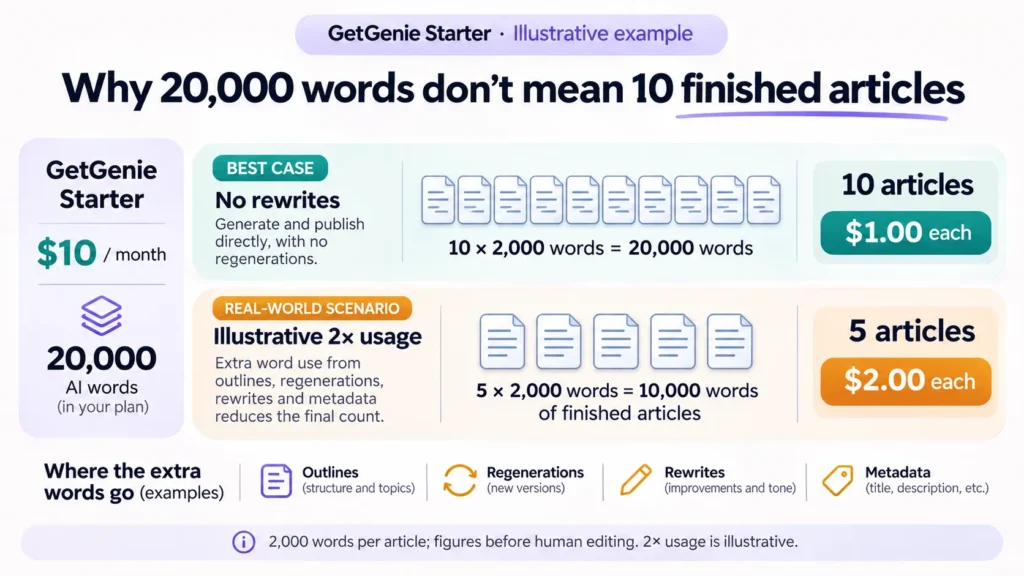
The sticker price of an AI writing tool tells you almost nothing about what one article actually costs. To get the real AI content cost per article, you have to divide the plan price by the articles it actually covers, count the words that regenerations burn, and add the human editing time that every pricing page leaves out. GetGenie’s Starter plan, for example, lists $10 a month for 20,000 AI words. That is ten 2,000-word articles at most, before a single regeneration, and before anyone edits them.
You’re choosing between pricing models that don’t compare directly: per-seat subscriptions like Jasper Pro at $59 to $69 a month per seat, word-capped plans like GetGenie and Koala, and BYOK (“bring your own key”) tools, where your AI provider bills the tokens and the tool may or may not add a subscription on top. Running the wrong model at your volume is a quiet, compounding budget leak. If you’re still shortlisting tools, the Best AI Content Plugins for WordPress in 2026 covers the ranked comparison. If you already have options on the table and need per-article numbers, this is the breakdown. Contentosapp Studio and ContentOS Auto, which appear below, are made by the publisher of this site.
- Pricing models: per seat (Jasper Pro, $59–$69 a month per seat), word caps (GetGenie Starter, $10 for 20,000 words; Koala Starter, $25 for 45,000), and BYOK, where your provider bills the tokens and the tool adds a subscription (Cuppa, from $99 a month) or nothing (a free plugin).
- Word caps at list price: about $1.00 per 2,000-word article on GetGenie Starter and $1.11 on Koala Starter, before regenerations. Koala counts premium models such as Claude Sonnet 5.5 at 2x words.
- Raw tokens are cheap, workflows less so: one 2,000-word draft is about 3 cents of Claude Sonnet 5.5 output tokens, but our seven-agent pipeline with research and review billed $0.44 and $0.47 per article.
- Editing is the biggest line: 20 minutes per article in our own log, or $10–$20 at $30–$60 an hour, more than any tool cost in this guide.
- On cost alone, BYOK on a free plugin beats every subscription here. A flat plan only wins when its price per included article falls below your token cost per article.
The Three Pricing Models — and Why They’re Structurally Different
Before any per-article math makes sense, look at what you’re buying under each model. Jasper’s Pro plan costs $59 a month per seat billed yearly, or $69 billed monthly, and each seat is one user; the price doesn’t change with how many articles you write. That structure rewards heavy users and punishes light ones. GetGenie runs the opposite architecture: its Starter plan lists $10 a month for 20,000 AI words, Writer $19 for 60,000 and Pro $49 for 400,000, with a 10% monthly or 50% yearly discount running when we checked. Koala works the same way: Starter is $25 a month, or $20 billed yearly, for 540,000 KoalaWriter words a year, which is 45,000 a month. What you produce is capped by what you bought.
BYOK tools sit outside both. You connect your own API key, and the provider bills the tokens each article consumes. Some BYOK tools still charge for the interface: Cuppa’s Solo plan is $99 a month billed yearly or $119 monthly, with “Unlimited Words” and “BYOK: Your Keys, Zero Token Markup”, so you pay Cuppa for the app and your provider for the tokens. Others, like our own Contentosapp Studio plugin, charge nothing in BYOK mode, so the provider’s bill is the whole tool cost. A fourth model is growing too: managed per-article plans, where the tool runs the AI for you and the plan covers a set number of articles.
These models resist direct comparison because each one charges for something different. A $69 Jasper seat costs $6.90 per article at 10 articles a month and $2.30 at 30; the per-article number only falls if you publish more. A word-capped plan charges you whether or not you fill the cap. BYOK charges only for the tokens a draft consumes. So on raw cost the ranking barely moves: BYOK on a free tool is cheapest at almost any volume. What changes with volume and team size isn’t who wins on price. It’s whether a subscription’s bundled convenience is worth paying several times more per article.
How Word Caps Translate Into Actual Per-Article Cost
Here’s the number pricing pages don’t show: the words you publish are not the words you consume. Outlines, intro rewrites, metadata and regeneration passes all spend plan words, so dividing the plan’s words by your article length gives you the best case, not the real one.
Start with that best case. GetGenie Starter’s 20,000 words cover ten 2,000-word articles, or $1.00 per article at the $10 list price. Writer’s 60,000 words cover 30, or about $0.63 each. Koala Starter’s 45,000 monthly words cover about 22 articles, roughly $1.11 each at $25 a month or $0.89 on yearly billing. Koala also counts premium models at 2x words when we checked on November 18, 2026, so on Claude Sonnet 5.5 or GPT-6.1 Sol the same plan covers about 11 articles, and the cost per article doubles to $2.22.
Then apply your own regeneration rate. If one published article ends up spending twice its length in plan words, GetGenie Starter covers five articles a month at $2.00 each, and the cap bites the moment you try to publish a sixth. We don’t have a measured regeneration rate for these tools, and neither vendor publishes one, so measure it: in your first month, note how many plan words each published article really used, then redo the division. That’s the trap of word-capped pricing. The sticker number and the number you actually pay move in opposite directions as you regenerate.
The Cost Nobody Shows You: Editing Time
Every per-article estimate online prices the tool. Almost none price the editor. In our own 25-article case study, the human pass averaged 20 minutes per article, and what the editor fixed most was not grammar. At a $30 hourly freelance rate, 20 minutes is $10 per article; at a $60 U.S. editorial rate, it’s $20. That’s before any extra time for regulated topics, original screenshots or interviews.
The compounding effect at scale is where this becomes a budget decision, not a footnote. Here’s what 20 minutes per article looks like next to the token bill of a BYOK pipeline:
| Articles a month | Editing time (20 min each) | Editing at $30/h | Editing at $60/h | BYOK tokens at ~$0.45/article |
|---|---|---|---|---|
| 10 | 3.3 hours | $100 | $200 | ~$4.50 |
| 30 | 10 hours | $300 | $600 | ~$13.50 |
| 50 | 16.7 hours | $500 | $1,000 | ~$22.50 |
The tool cost nearly disappears at volume. The editing cost doesn’t. That’s the math your vendor’s pricing page will never show you, and it’s why choosing the cheapest subscription tier often produces no real savings at all.
BYOK API Pricing: When Bringing Your Own Key Actually Saves Money
BYOK flips the cost structure. Instead of a word bank, you pay the provider’s token rate. At Anthropic’s list prices, checked November 19, 2026, Claude Sonnet 5.5 costs $2 per million input tokens and $10 per million output tokens. A 2,000-word draft is roughly 2,700 output tokens, so one straight completion costs about 3 cents in output on Sonnet 5.5, a fraction of a cent on Claude Haiku 5.5 ($0.50 per million output tokens) and about 5 cents on Claude Opus 5.5 ($20).
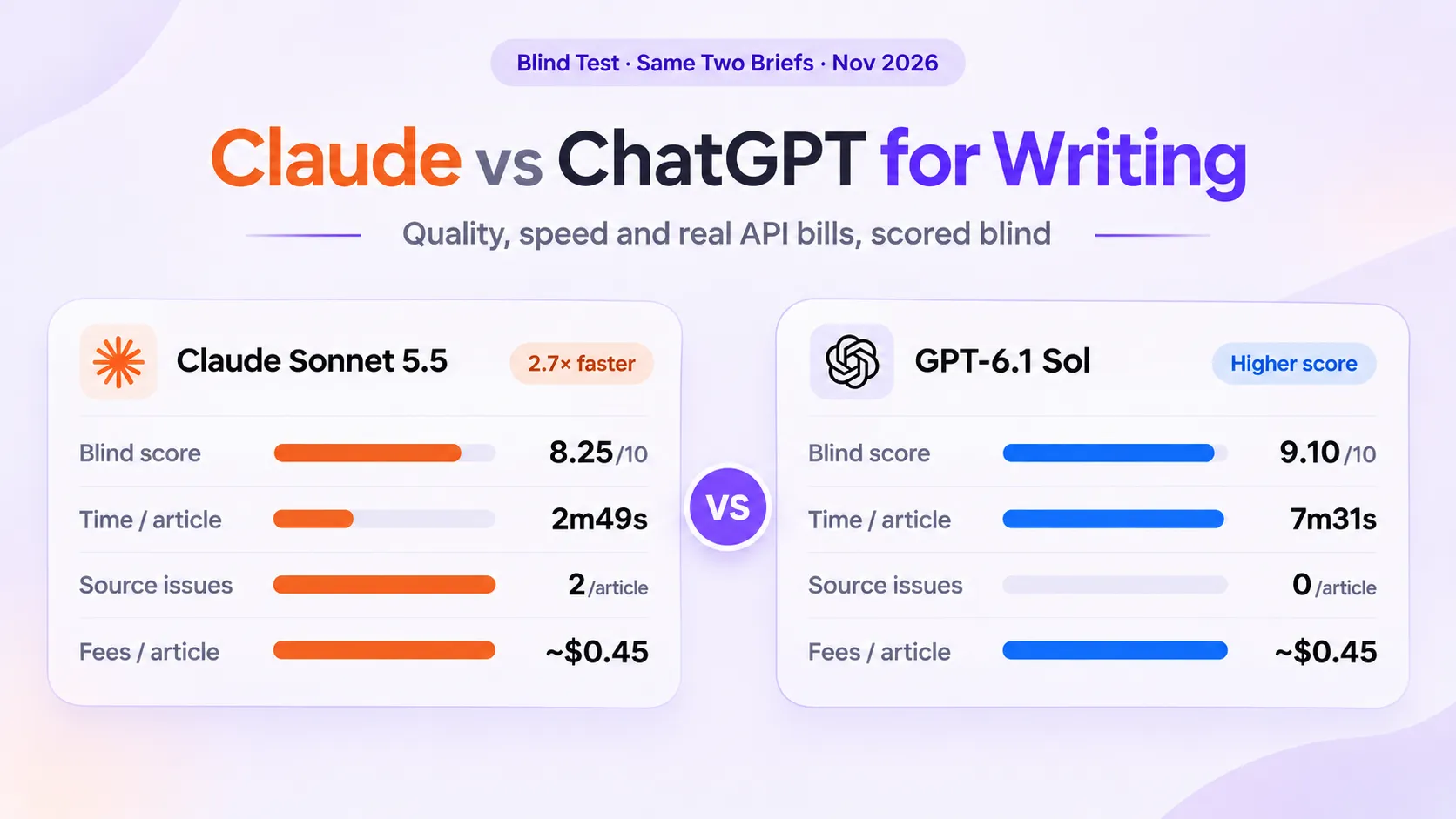
Real workflows cost more than one completion, because research, briefs and review are model calls too. Our seven-agent pipeline (discovery, strategy, research, writing, review, visuals and social copy) billed $0.44 and $0.47 per article on Claude Sonnet 5.5 in our November 2026 Claude vs ChatGPT test, prompt-cache writes included, and two articles on GPT-6.1 Sol billed $0.90 together. Our July case study averaged about $0.20 per article on the setup we used then. That’s the honest BYOK range for a full workflow: cents to under half a dollar, not a tenth of a cent.
There’s a catch, but it isn’t a volume threshold. If your BYOK tool is free, there’s no platform fee to offset, so it’s cheaper than these subscriptions at essentially any volume: even at one article a month, half a dollar of tokens beats a $69 seat. A flat plan can only win when its price per included article falls below your token cost, which none of the plans in this guide does. Our own managed ContentOS Auto plans show the trade-off from the other side: $9 a month for 5 articles, $49 for 30 and $129 for 100 (listed on contentosapp.com), or $1.80, $1.63 and $1.29 per article, with research and images handled and no API key needed. What you buy with any plan isn’t a lower cost. It’s convenience: a hosted UI, no provider account, no rate limits to manage.
| Tool / plan | How you pay | Tool cost per article at 15 a month | Monthly total at 15 | Limit |
|---|---|---|---|---|
| Raw API, one completion (Claude Sonnet 5.5) | Your tokens | ~$0.03 | ~$0.45 | Provider rate limits |
| Contentosapp Studio, BYOK (ours) | Free plugin + your tokens | ~$0.45 (seven-agent pipeline, billed) | ~$6.75 | Provider rate limits |
| GetGenie Writer | Word cap | $1.27 | $19 | 60,000 words (Starter’s 20,000 covers 10) |
| Koala Starter | Word cap | $1.67 ($3.27 on Professional with 2x models) | $25 ($49) | 45,000 words (100,000 on Professional) |
| ContentOS Auto Pro (ours, managed) | Per-article plan | $3.27 (Pro covers 30; Starter covers 5) | $49 | 30 articles |
| Jasper Pro | Per seat | $4.60 | $69 per seat | One user per seat |
| Cuppa Solo | Subscription + your tokens | $7.93 + tokens | $119 + tokens | “Unlimited Words”, 1 brand |
At 15 articles a month, BYOK on a free plugin runs under $7 in tokens while a single Jasper seat runs $69. The real question isn’t price; it’s whether the bundled convenience is worth the difference to you.
At 50 articles a month, 20 minutes of editing per article adds $500 to $1,000 in labor, more than any subscription fee here, and a cost that doesn’t shrink no matter which generation tool you picked. The cheapest tool is rarely the cheapest workflow: an unsourced draft forces a longer human pass to verify and ground every claim, and thin, unedited AI output is exactly what carries search-visibility risk.
There’s no single “cheapest” tier to crown, because cost isn’t where these models differ most. What differs is convenience. A solo publisher happy to paste in an API key pays cents to under a dollar per article at any volume; one who isn’t is better served by a capped or managed plan’s hosted simplicity, knowing that’s a convenience premium, not a saving. Agencies at 50+ articles a month feel both sides hardest: BYOK keeps generation cost small, but the editing line becomes the real budget, so optimize there, not on the generation tool.
Frequently Asked Questions
What is the average AI content cost per article in 2026?
It depends on the pricing model. At list prices checked in November 2026, word-capped plans work out to about $0.63 to $2.22 per 2,000-word article before regenerations, a $69 Jasper seat costs $4.60 per article at 15 a month, and a full BYOK pipeline billed $0.44 to $0.47 per article in our test on Claude Sonnet 5.5. Add 20 minutes of human editing at $30 to $60 an hour and the all-in cost lands around $10 to $25 per article for most of these setups.
Do word-cap plans actually give you the number of articles they imply?
No. The advertised word count is a generation budget, not a publishing budget. GetGenie’s Starter plan lists 20,000 AI words a month, which covers ten 2,000-word articles only if nothing is regenerated; outlines, rewrites and metadata spend words too. Koala also counts premium models such as Claude Sonnet 5.5 at 2x words. Track how many plan words each published article really uses in your first month, then divide.
Is BYOK always cheaper than a subscription plan for AI content?
On raw cost, almost always when the BYOK tool itself is free. Our seven-agent pipeline billed $0.44 to $0.47 per article in tokens, while the subscriptions in this guide cost $1.27 to $7.93 per article at 15 articles a month. A flat plan only wins when its price per included article is below your token cost. BYOK tools that charge their own subscription, such as Cuppa from $99 a month, need both columns added before you compare. The trade-off is convenience: hosted plans spare you an API key and provider limits.
How much does editing add to the real cost of an AI-written article?
In our own 25-article case study, the human pass averaged 20 minutes per article. At $30 to $60 an hour, that’s $10 to $20 per article, which is more than the tool cost of every plan in this guide. At 50 articles a month it adds $500 to $1,000 in labor, and it doesn’t shrink with the generation tool you choose. Editing, not generation, is where most of the money goes.
What does one AI article cost on my own API key?
A single 2,000-word completion is about 2,700 output tokens: roughly 3 cents on Claude Sonnet 5.5 at $10 per million output tokens, under a cent on Claude Haiku 5.5 and about 5 cents on Claude Opus 5.5, before input tokens. A full workflow costs more because research, briefs and review are model calls too; our seven-agent pipeline billed $0.44 and $0.47 per article on Sonnet 5.5 in November 2026.
Which pricing model scales best for agencies publishing 50+ articles a month?
BYOK, on generation cost. At 50 articles a month, a full pipeline at about $0.45 per article is roughly $22.50 in tokens, while word-capped plans need higher tiers and per-seat tools charge per user. A BYOK tool with its own subscription adds that fee once rather than per article. The constraint is editing: 20 minutes per article is about 17 hours a month at that volume, so agencies should optimize templates, style guides and review rather than chase small differences between generation tools.
Does Jasper’s per-seat fee make sense for solo publishers?
Rarely on cost alone. Jasper Pro is $59 a month per seat billed yearly or $69 monthly, which works out to $4.60 per article at 15 articles a month and $2.30 at 30, against about $1.27 on GetGenie Writer or under $0.50 in BYOK tokens. Jasper is built for marketing teams that need shared brand voices, knowledge and collaboration, so it makes sense when those features matter more to you than cost per piece.
Conclusion
Most AI content cost conversations end at the pricing page. The real calculation starts there and runs through word consumption, the seat fee your team triggers the moment you add a second editor, and the 20 minutes of human work that follows every AI draft. Getting the tool cost from $1.27 to $0.45 per article saves you less than a dollar; leaving the editing line unexamined costs $10 to $20 per article, every month. Figure out the volume you actually publish, match the pricing model to it, and budget the editing line explicitly. It’s the only calculation that tells you what AI content genuinely costs.
References
External sources
- Plans & Pricing | Jasper — https://www.jasper.ai/pricing
- Pricing | GetGenie AI — https://getgenie.ai/pricing/
- Pricing | Koala AI — https://koala.sh/pricing
- Pricing | Cuppa AI — https://cuppa.ai/pricing
- Pricing | Claude API Docs — https://platform.claude.com/docs/en/about-claude/pricing
- Contentosapp Studio – AI Content Writer & SEO (BYOK) | WordPress.org — https://wordpress.org/plugins/contentosapp-studio/
Related content
- BYOK AI Writer: What Your Own API Key Really Costs per Article (2026) — Contentosapp
- AI Content Case Study: 25 Articles in 25 Days on WordPress — Contentosapp
- Claude vs ChatGPT for Writing: A Blind Test on the Same Two Briefs — Contentosapp
- GetGenie Alternatives (2026): 5 AI Writers by Cost per Article — Contentosapp
- Koala AI Alternatives (2026): 6 Tools Checked for Sources and Cost — Contentosapp