
The sticker price of an AI writing tool tells you almost nothing about what one article actually costs. Understanding the real AI content cost per article means going beyond the monthly subscription fee — you need to account for word consumption rates, per-seat multipliers, and the human editing time that every vendor conveniently omits. A $5.50/month plan sounds like a bargain until you realize it caps you at 20,000 words — which, after regenerations and retries, might produce 10 usable articles at best. Then add a human editor to each one. The math changes fast, and most AI content cost discussions stop before they get there.
You’re choosing between three fundamentally different pricing architectures: per-seat subscriptions like Jasper at $59/month per user, word-capped or credit-based plans like GetGenie and Koala, and BYOK tools that bill you directly at raw OpenAI or Anthropic API rates. These models are not interchangeable, and running the wrong one at your volume is a quiet, compounding budget leak. If you’re still deciding which tool to shortlist before digging into the cost math, the Best AI Content Plugins for WordPress in 2026: Compared, Ranked, No Slop covers the full ranked comparison. But if you already have options on the table and need the real per-article numbers — this is the breakdown.
- Three pricing models: per-seat subscriptions (Jasper, $59/month), word-capped plans (GetGenie Starter, $6/month for 20K words), and BYOK API access billed at raw token rates.
- Word caps overstate output: regenerations and retries consume 2.5–4× the final word count — a 50K-word plan typically yields 10–16 publishable articles, not 25.
- Editing time is the invisible line item: hybrid AI+human workflows dominate in 2026; 20–45 minutes of editing at $30–$60/hr adds $10–$45 per article on top of any subscription fee.
- BYOK has a crossover point: raw API generation costs $0.08–$0.35 per article, but only beats subscription plans above roughly 30 articles per month.
- Per-seat fees compound fast — a 3-person team on Jasper Business can pay 3× the listed Pro price, a gap no single-line pricing comparison captures.
The Three Pricing Models — and Why They’re Structurally Different
Before any per-article math makes sense, you need a clear-eyed look at what you’re actually buying under each model. Jasper’s Pro plan at $59/month billed annually is a per-seat, unlimited-word subscription — one user pays a flat fee regardless of output volume. That structure rewards heavy users and punishes light ones. GetGenie runs the opposite architecture: the Starter plan caps you at 20,000 AI words per month for $5.50/month (billed annually), the Writer plan at 60,000 words for $10.45/month — what you pay is loosely fixed, but what you can produce is hard-capped. Koala sits in a similar credit-based universe — you buy output, and your throughput is always bounded by what you purchased. BYOK tools sit outside all of this: you connect your own API key and pay the provider’s raw token cost per article, with no word bank and no per-seat fee. Some run as hosted apps (Cuppa, for instance, bills per word on top of the API cost); others, like the WordPress-native Contentosapp Studio, run the BYOK pipeline directly in your editor, so the only cost is the provider’s tokens.
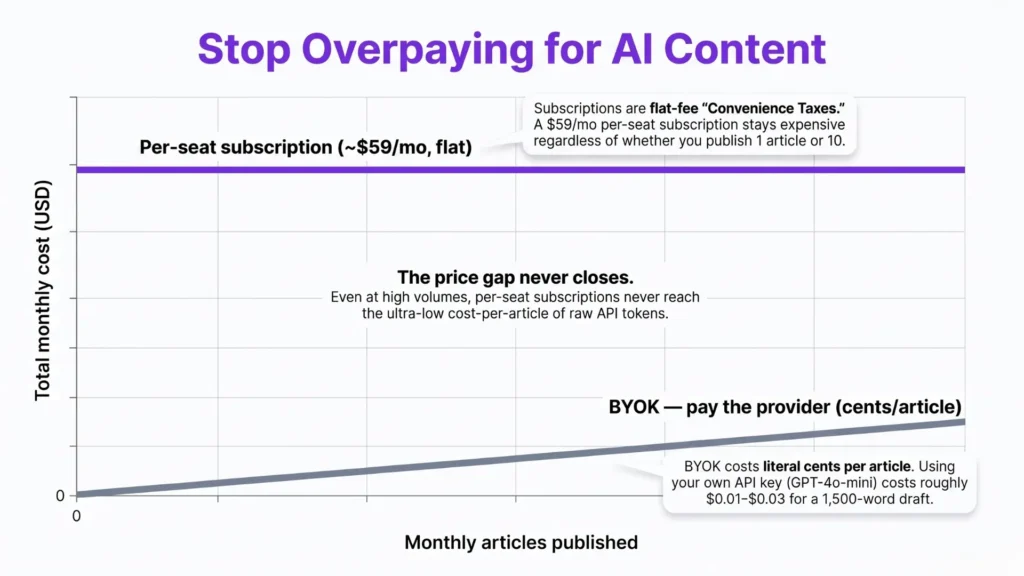
The reason these models resist direct comparison is what each one actually charges for. A $59/month Jasper seat costs $5.90/article at 10 articles a month and about $1.18 at 50 — the per-article number only falls if you publish more, and it never reaches BYOK territory. A word-capped plan charges you whether or not you fill the cap. BYOK charges only for the tokens a draft actually consumes — cents — at any volume. So on raw cost the ranking barely moves: BYOK is the cheapest almost everywhere. What changes with volume and team size isn’t *who wins on price* — it’s whether a subscription’s bundled convenience is worth paying many times more per article.
How Word Caps Translate Into Actual Per-Article Cost
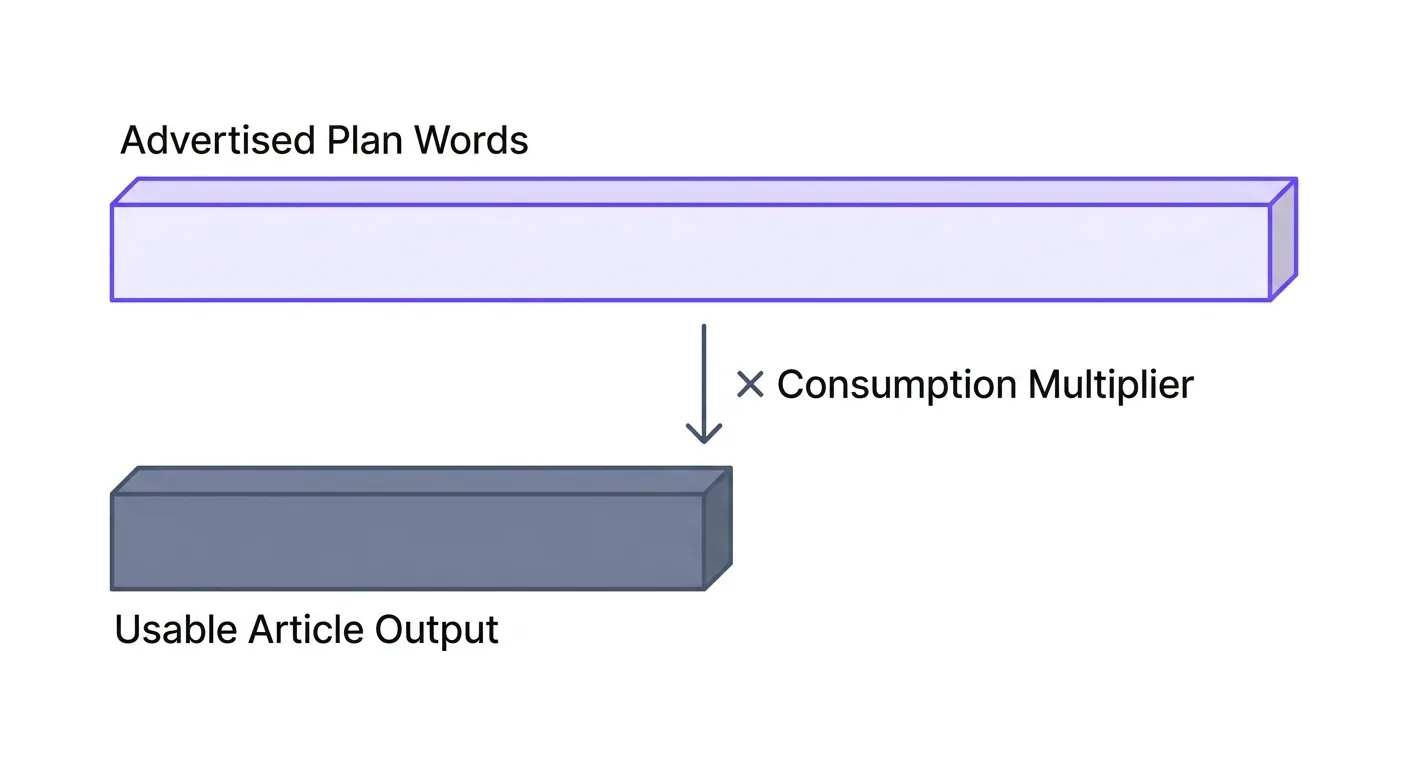
Here’s the number the pricing pages don’t show you: the words you publish are not the words you consume. A 2,000-word article typically burns 5,000–8,000 plan words by the time you account for outline generation, intro rewrites, metadata copy, and regeneration passes when the first output misses the mark. That’s a real-world consumption multiplier of 2.5–4×, and it fundamentally breaks the “divide plan words by article length” math most buyers use.
Run that against GetGenie’s Writer plan — $10.45/month billed annually for 60,000 AI words. At face value, 60,000 ÷ 1,500 = 40 articles. Apply a realistic 3× generation multiplier and you’re closer to 13 publishable articles a month — an effective cost of about $0.80 per article, not the ~$0.26 the raw arithmetic implies. And the cap bites the moment you scale: pushing past ~13 articles forces the Pro tier at $26.95/month, so your per-article cost rises until you fill the larger 400,000-word bucket. That’s the trap of word-capped pricing — the sticker number and the number you actually pay move in opposite directions. (Pricing verified June 2026.) This is the calculation every competing “AI content cost” breakdown skips.
The Cost Nobody Shows You: Editing Time
Every per-article cost estimate published online prices the tool. Almost none of them price the editor. In 2026, hybrid workflows — AI drafts, human edits — are now the default, and that editing labor is a fixed cost disguised as a variable one. Budget 20–45 minutes per article for structural corrections, fact-checking, E-E-A-T signal additions, and internal linking. At a conservative $30/hour blended freelance rate, that’s $10–$22.50 per article. At a standard U.S. editorial rate of $50–$60/hour, you’re looking at $17–$45 per article in labor before a single word hits your CMS.
The compounding effect at scale is where this becomes a budget decision, not a footnote. At 50 articles per month, editing overhead runs $500–$2,250 per month — easily 5–10× the subscription cost of a word-capped plan. Here’s what that looks like in concrete terms:
The tool cost nearly disappears at volume. The editing cost doesn’t. That’s the math your vendor’s pricing page will never show you — and it’s why choosing the cheapest subscription tier often produces no real savings at all.
BYOK API Pricing: When Bringing Your Own Key Actually Saves Money
BYOK flips the cost structure entirely. Tools that support direct API key integration let you bypass the subscription word bank and pay OpenAI or Anthropic directly at token rates. For a 1,500–2,000-word article, that lands at roughly $0.01–$0.03 in raw tokens — GPT-4o-mini near the floor (~$0.01), GPT-4o around $0.02, Claude Sonnet-class about $0.03. Hosted BYOK apps that add a per-word fee on top (Cuppa, for one) push the all-in figure to ~$0.08+, but the token cost itself is just cents. Anthropic’s Pro plan starts at $17/month billed annually, but that is a consumer chat interface, not raw API access — the API billing is usage-based and separate, which is what BYOK actually taps. OpenAI’s API pricing follows a similar token-rate structure, billed purely on consumption with no seat fee layered on top.
There’s a catch, but it isn’t a volume threshold. If your BYOK tool is itself free — a WordPress-native plugin you run with your own key — there’s no platform fee to offset, so BYOK is cheaper than a subscription at essentially *any* volume: even at one article a month, $0.03 of tokens beats a $59 seat fee. What you give up isn’t money — it’s convenience: bundled templates, a hosted UI, team controls, and not having to create an API key. So the real decision isn’t “how many articles before BYOK wins on cost.” It’s “is the subscription’s convenience worth paying many times more per article?” For most WordPress publishers who already manage plugins and keys, it isn’t.
| Tool / model | Pricing type | Cost per 1,500-word article | At 15 articles/mo | Caps? |
|---|---|---|---|---|
| BYOK — GPT-4o-mini | Pay the provider | ~$0.01 | ~$0.15 | None |
| BYOK — Claude Sonnet 4.5 | Pay the provider | ~$0.03 | ~$0.45 | None |
| Cuppa AI | Per-word (bulk) | ~$0.08 | ~$1.10 | Plan-based |
| Koala AI | Per-word (bulk) | ~$0.75 | ~$11 | Plan-based |
| GetGenie | Subscription / credits | ~$1.27 (at ~$19/mo) | ~$19 | Yes — word cap |
| Jasper | Per-seat subscription | ~$3.93 (at $59/mo) | ~$59 | Credit cap |
At 15 articles a month, BYOK runs under $1 while a per-seat subscription runs $59 — and the subscription’s per-article cost only drops if you publish more (it never reaches BYOK’s). The real question isn’t price; it’s whether the bundled convenience is worth ~60×.
At 50 articles a month, even a standard 30-minute edit adds about $1,000 in labor — typically more than any subscription fee, and a cost that doesn’t shrink no matter which generation tool you picked. The tool cost nearly disappears at volume; the editing cost never does. The cheapest tool is rarely the cheapest workflow: an unsourced draft forces a long human pass to verify and ground every claim — and thin, unedited AI output is exactly what carries search-visibility risk.
There’s no single “cheapest” tier to crown, because cost isn’t where these models differ — they all lose to BYOK on raw price. What differs is convenience. A solo publisher happy to paste in an API key pays cents per article at any volume; one who isn’t is better served by a capped plan’s hosted simplicity — knowing that’s a convenience premium, not a saving. Agencies at 50+ articles a month feel both sides hardest: BYOK keeps generation cost near zero, but the editing line (model-independent) becomes the real budget — so optimize there, not on the generation tool.
Frequently Asked Questions
What is the average AI content cost per article in 2026?
It depends heavily on which model and pricing architecture you use. On subscription plans, realistic per-article tool costs range from $0.40 to $5.00 depending on volume and plan tier. BYOK API generation via GPT-4o or Claude Sonnet-class models typically runs $0.01–$0.03 in raw API tokens per 2,000-word article at current token rates. Add a human editor at standard U.S. freelance rates and the all-in cost per article lands between $12 and $50 for most hybrid workflows — regardless of which generation tool you chose.
Do word-cap plans actually give you the number of articles they imply?
No. The word count advertised is a generation budget, not a publishing budget. Because real AI workflows involve regenerations, outline passes, and metadata creation, your actual word consumption per publishable article runs 2.5–4× the final output length. A 20,000-word plan — like GetGenie’s Starter tier — realistically produces 6–10 articles per month at a 2,000-word average, not the 10 that raw arithmetic suggests.
Is BYOK always cheaper than a subscription plan for AI content?
Almost always — on raw cost. A 1,500-word draft costs ~$0.01–$0.03 in tokens, versus $19–$59/month for a capped or per-seat plan. If your BYOK tool is free to run with your own key, there’s no platform fee to offset, so BYOK is cheaper at essentially any realistic volume. The trade-off is convenience, not money: subscriptions bundle templates, a hosted UI and team controls, and spare you from managing an API key.
How much does editing add to the real cost of an AI-written article?
At 20–45 minutes of editing per article and standard U.S. freelance editorial rates of $30–$60/hour, expect to add $10–$45 per article in human labor. On a GetGenie Writer plan where the realistic tool cost is roughly $0.80/article, a single 30-minute edit at $30/hr adds $15 — nearly 20× the tool cost itself. The ratio holds across every pricing model: editing, not generation, is where the money goes. This is the single largest gap between marketed AI content costs and real ones, and it applies equally across every pricing model.
Which pricing model scales best for agencies publishing 50+ articles a month?
BYOK via a tool that supports direct API keys — a hosted app like Cuppa, or a WordPress-native pipeline run with your own key consistently wins on generation cost at 50+ articles/month, where raw API rates produce meaningful savings over capped plans that would require constant tier upgrades. The key constraint is editing overhead — that cost is model-independent and doesn’t compress with volume. Agencies at this scale should focus budget optimization on the editing side (template workflows, style guides, in-house editors) rather than marginal differences between generation tools.
Does Jasper’s per-seat fee make sense for solo publishers?
Rarely. At $59/month for one user with unlimited words, Jasper Pro makes economic sense for solo publishers producing 50+ articles per month who need volume and don’t want to manage API billing. Under that threshold, word-capped plans at $5.50–$10.45/month (billed annually) produce a lower true per-article cost even accounting for the cap. Jasper’s architecture is built for marketing teams that need cross-user brand controls and collaborative campaign workflows — not for a single operator trying to minimize cost-per-piece.
Most AI content cost conversations end at the pricing page. The real calculation starts there and runs through word consumption multipliers, the seat fee your team will trigger the moment you hire a second editor, and — most critically — the 30 minutes of human work that follows every AI draft. Get the tool cost down to $0.40/article and you’ve saved a dollar. Leave the editing overhead unexamined and you’ve left $15–$45 per article on the table every single month. That number compounds. Figure out which volume tier you actually operate at, match the pricing model to it, and budget the editing line explicitly — it’s the only calculation that tells you what AI content genuinely costs.
References
External sources
- Plans & Pricing | Jasper — https://www.jasper.ai/pricing
- Pricing – GetGenie AI — https://getgenie.ai/pricing/
- Koala AI – The Best AI Writer and Chatbot — https://koala.sh/
- Cuppa AI | Rated #1 Profit-Focused Tool for AI-Powered Brand Growth — https://cuppa.ai/
- Plans & Pricing | Claude by Anthropic — https://www.anthropic.com/pricing