
Koala AI is not a bad tool. And to be clear, neither is Cuppa, SEOwriting.ai, or Autoblogging.ai. The reason publishers look for Koala AI alternatives isn’t quality in the abstract — it’s a specific gap: these tools optimize for output speed and volume-per-dollar, which is not the same thing as ranking durability. If your traffic has stalled — or dropped after the 2024 or 2026 core update — the question isn’t whether your tool is cheap enough. It’s whether it was ever designed to produce drafts that hold up in search.
If you’ve already run bulk AI content and you’re watching impressions plateau or creep back down after a “recovery,” this article is for you. These are the Koala AI alternatives that prioritize draft quality over output speed — tools designed to produce a starting point that holds up under editorial review, not one that requires a full rebuild before it’s safe to publish. Five tools, a concrete quality framework, and a decision matrix to match the right one to your actual workflow.
- The core tradeoff: Koala, Cuppa, and SEOwriting.ai optimize for output speed and volume — a real advantage that comes with a ranking-durability cost post-2024 core updates.
- What “rank-ready” actually means: A draft with logical heading structure, verifiable factual claims, no hallucinated statistics, and a tone that survives an editor’s pass — not just fluent prose.
- The hidden cost in tool comparisons: A tool that generates in 4 minutes but needs 45 minutes of editing is not faster than one that takes 12 minutes and needs 10 minutes of cleanup. That gap compounds at scale.
- Research grounding is the structural divide: Only tools that cite named external sources — not SERP summaries — introduce new information signal into your content.
- The five alternatives covered: Contentosapp, AI WP Writer, Opace AI Scribe, GetGenie, and AI Engine — each evaluated on draft quality and total workflow cost.
The Volume Trap: Why Bulk AI Output Is Starting to Cost Rankings
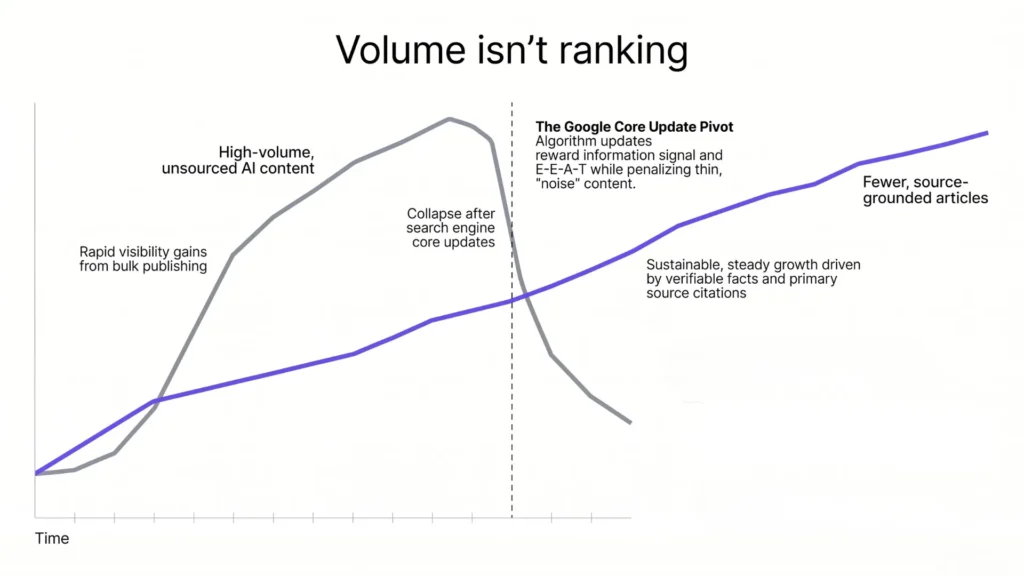
The economics of bulk AI writing are real. At $0.003 per word, you can flood a niche site with content faster than any human team could manage. That math made sense in 2022. It made some sense in 2023. After the March 2024 Google core update — and then the March 2026 update — it started working against publishers who went all-in on volume without quality controls. The pattern is documented: sites that scaled aggressively on unedited, autoblogged content were disproportionately hit, with large drops in organic visibility documented across multiple post-update analyses. The mechanism is not mysterious. Volume multiplies ranking risk when the underlying content fails E-E-A-T signals, because each weak page dilutes your site’s topical authority cluster rather than reinforcing it. You’re not building a content moat — you’re building noise.
This is the claim competing listicles won’t make directly: publishing velocity is now inversely correlated with ranking durability for thin-content sites. Even Cuppa AI’s own homepage names the failure mode explicitly — “Push volume and typos slip in, brand voice drifts, Google flags thin copy.” That’s a vendor acknowledging the category’s core risk in their own marketing copy. And on Koala AI’s platform, one of their most-cited power users describes the output as requiring “a quick round of heavy editing by a professional writer and expert in the field” before it’s publish-ready. Volume tools are starting points, not finished products. The question is whether your starting point is close enough to rank-ready that the editing time is worth it — or whether you’re rebuilding from scratch every time.

What Makes a Koala AI Alternative Actually Worth Switching To
Most alternatives roundups compare features: does the tool integrate with WordPress, does it support SERP analysis, does it have a Chrome extension. Those are useful signals — but they measure capability, not output. A rank-ready draft has five measurable properties: a heading structure that mirrors the SERP’s semantic pattern, factual claims that are verifiable or citable, no hallucinated statistics, a reading level appropriate to the topic, and a tone that survives a competent editor’s pass without a full rewrite. Very few tools clear all five consistently. Most clear two or three. That gap is where ranking durability lives.
The signal most publishers underweight is factual grounding. A draft that reads fluently but contains one fabricated statistic or a misattributed claim isn’t a time-saver — it’s a liability. Google’s Search Quality Rater Guidelines treat accuracy as foundational to both “Expertise” and “Trustworthiness.” Tools that retrieve real external sources per article — rather than generating from SERP summaries of existing content — close this gap structurally. Summarizing what’s already ranking recycles existing claims. Citing a named primary source introduces new information signal. That’s the process architecture difference between a volume tool and a ranking tool, and it’s almost never mentioned in tool comparison articles. For a direct data read on where Google currently draws the line on AI content quality, the breakdown on whether Google penalizes AI content covers the 2026 state of play clearly.
5 Koala AI Alternatives Built for Drafts That Hold Up in Search
The five tools below are all WordPress-native — they run inside your site, not as a separate app you copy-paste from. What separates them from Koala isn’t raw speed; it’s control and sourcing: each lets you shape the draft before it publishes, and one of them grounds every claim in a real, cited source by default. For the full field, the 2026 AI content plugins comparison covers more tools and criteria than fit here. Here’s where each fits:
Contentosapp Studio — Runs a 7-agent pipeline whose dedicated Researcher gathers named external sources for each article (institutional and primary references) and cites them in the draft, so claims are grounded, not invented. WordPress-native; BYOK with OpenAI, Anthropic, or Google Gemini; free with your own key. The honest trade-off: it’s the newest tool here, with a far smaller community and track record than the others, and it produces one quality draft at a time — not 500 from a CSV. Best for publishers who want sourced, editable, rank-ready drafts without leaving WordPress.
AI WP Writer — A BYOK plugin connecting to OpenAI, Claude, and Gemini, with bulk and scheduling on top. You control the model and the draft — the key difference from a fixed bulk generator — but it doesn’t fetch or cite sources for you; grounding is your edit pass. Best for operators who want multi-model BYOK plus scheduling and are comfortable writing a tight brief.
Opace AI Scribe — Open-source and BYOK (OpenAI/Anthropic), with every prompt visible and editable at each stage and a “humanizer” pass that softens the pattern-repetition signals of raw AI text. Like the others, it doesn’t pull and cite primary sources — that stays manual. Best for publishers who want full transparency and control over each generation step.
GetGenie — WordPress-native, with in-editor SEO scoring and live SERP/competitor analysis that pushes you to engage the competitive landscape before writing. Note it’s credit-based, not BYOK (a free tier plus paid plans with word caps), and it optimizes structure rather than grounding claims in cited sources. Best for SEO-led writers who want keyword and competitor data inside the editor.
AI Engine (Meow Apps) — The most-installed AI plugin for WordPress (100,000+ installs), BYOK across a wide set of providers. It’s a flexible AI framework rather than an opinionated editorial pipeline, so output quality leans entirely on your prompting and editing, and it doesn’t ground or cite claims. Best for developers and power users who want one BYOK layer for many AI jobs. (We go deeper in our AI Engine alternatives guide.)

| Tool | Best for | Cost per article | Grounds & cites sources? | Watch-out |
|---|---|---|---|---|
| Koala AI (baseline) | Fast SERP-based articles & affiliate roundups | ~$0.50 / 1,000 words | No | Volume-first; unsourced claims |
| Cuppa AI | Cheapest programmatic / bulk SEO pages | ~$0.05 / 1,000 words | No | Quality varies; thin-content risk at scale |
| SEOwriting.ai | 1-click bulk to WordPress / Shopify | ~$14–$64 / mo (bulk CSV) | No | Basic SEO; no real source grounding |
| Autoblogging.ai | Maximum volume (500 articles per CSV) | Credit-based | No | Pure volume = highest thin-content risk |
| AI WP Writer | BYOK multi-model, editable drafts | Your API cost (cents) | No (manual) | Generic headings without a brief |
| Contentosapp Studio | Research-grounded, rank-ready WordPress drafts | BYOK (~$0.03 / draft) | Yes — cites real sources | Newest/smallest; one quality draft at a time, not 500-CSV bulk |
One column is the whole article: only one of these tools grounds and cites real sources by default. Volume tools optimize for output; that’s the exact gap that turns into thin content under Google’s Helpful Content guidance. (Pricing verified June 2026.)
Matching the Right Tool to Your Workflow Without Overthinking It
Most publishers in this situation fall into one of three profiles, and the tool decision follows directly from which one you are. Profile A: you’re running a content team at 10–20 articles per month with an in-house editor. Your bottleneck is draft quality, not speed — a weak draft costs more in editor time than a slower tool would. Prioritize cost and WordPress fit — a BYOK plugin (Contentosapp, AI WP Writer, or Opace) keeps your per-article cost in cents while staying inside WordPress. Profile B: you’re a solo operator publishing 5–8 articles per month on a budget where every dollar of tooling shows up in margin. Prioritize cost and WordPress fit — a BYOK plugin (Contentosapp, AI WP Writer, or Opace) keeps your per-article cost in cents while staying inside WordPress. Profile C: you’re an agency or site operator running 50+ articles per month who needs volume but can’t afford to carpet-bomb Google with thin content. Be honest about the trade: if you genuinely need programmatic volume, the bulk tools (Koala, Cuppa, Autoblogging.ai) are faster and cheaper per article — but you’re accepting the thin-content risk above. If ranking durability matters more than raw count, scale with a BYOK WordPress plugin (AI WP Writer) or a grounded pipeline (Contentosapp) plus a disciplined edit pass, and publish fewer, sturdier articles.
One practical test worth running before you commit to switching: take the same 800-word brief, run it through your current tool and through the alternative you’re evaluating, then score both drafts against the five rank-ready criteria. If the alternative scores better on four of five — and the editing time is equal or shorter — that’s a sufficient signal to switch. Don’t wait for a core update to make the data decision for you. The SEOwriting.ai platform serving 50,000+ businesses and the AI WP Writer plugin with its scheduled publishing pipeline are both technically capable tools — the question isn’t capability, it’s whether their output clears your quality floor without requiring a full rewrite on the other side.
Frequently Asked Questions
Is Koala AI good for SEO content in 2026?
Koala AI remains a technically capable tool — trusted by over 19,000 content creators and SEOs, and powered by GPT-5 and Claude 4, with real-time SERP analysis and 1-click WordPress publishing. For publishers who have a strong editorial process and fast editing capacity, it produces structurally solid drafts. The risk is in treating it as a publish-without-review pipeline. Even Koala’s most enthusiastic users describe the output as requiring “heavy editing by a professional writer and expert in the field” before publication. If that editing capacity exists in your workflow, Koala is a viable tool. If it doesn’t, the output quality gap shows up in your rankings eventually.
What is the best Koala AI alternative for WordPress affiliate sites?
It depends on your publishing volume and editing bandwidth. For solo affiliate operators publishing fewer than 10 articles per month, a BYOK plugin (Contentosapp, AI WP Writer, or Opace) keeps your per-article cost in cents while staying inside WordPress. For higher-volume affiliate sites where research depth matters — product roundups, comparison guides, review articles — Contentosapp’s source-grounded pipeline (or AI WP Writer / Opace if you’d rather ground sources in your own edit pass) reduces the factual accuracy risk that makes affiliate AI content a liability under Google’s Helpful Content guidance. The short answer: if you’re monetizing with affiliate links, factual accuracy is non-negotiable, and that requirement narrows the field quickly.
Do AI writing tools produce content that passes Google’s helpful content guidelines?
Google’s Helpful Content system evaluates the output, not the tool used to produce it. AI-generated content that demonstrates E-E-A-T signals — verifiable facts, appropriate expertise level, accurate sourcing, and genuine value to the reader — is treated the same as human-written content that meets those standards. The problem isn’t AI authorship. The problem is that most bulk AI tools optimize for plausibility, not accuracy. Drafts that contain hallucinated statistics or unverifiable claims fail the “trustworthiness” dimension of the Quality Rater Guidelines regardless of how well-structured the headings are.
How does Contentosapp compare to Koala for long-form articles?
The primary difference is process architecture. Koala ingests SERP data to calibrate output — which produces structurally strong, topically relevant drafts, but grounds claims in whatever’s already ranking rather than primary sources. Contentosapp runs a 7-agent pipeline where a dedicated Researcher gathers named external sources (government data, institutional references, primary publications) before the Writer agent generates the draft. The output cites those sources inline. For long-form articles where factual depth matters — finance, health, legal-adjacent topics — that sourcing layer is the difference between a draft you can publish and a draft that requires a fact-check pass before it’s safe.
Can I use AI-generated content for affiliate sites without risking a Google penalty?
Google does not penalize content for being AI-generated. It penalizes content that is low-quality, thin, or manipulative — and AI tools make it easier to produce that kind of content at scale, which is why bulk AI publishing correlates with ranking risk. The practical answer: AI-generated content for affiliate sites is fine if the draft is factually accurate, the claims are verifiable, the review criteria are based on genuine product knowledge, and the content serves the reader’s decision-making process rather than just matching keyword patterns. Ten well-edited, research-grounded affiliate articles will outperform 100 autoblogged ones over a 12-month window.
What is the difference between autoblogging tools and research-backed AI writers?
Autoblogging tools — SEOwriting.ai’s 100-article batch-to-WordPress pipeline, AI WP Writer’s year-ahead scheduling system, and similar bulk generation workflows — optimize for output velocity. They generate from SERP summaries and training data, which means they recycle and repackage existing claims efficiently. Research-backed AI writers build a sourcing layer before generation: they retrieve named primary sources, cite them inline, and produce drafts where factual claims have a traceable origin. The practical difference is editing time and ranking durability. Autoblogging output is faster to generate and slower to edit to a publishable standard. Research-backed output takes longer to generate and shorter to edit — and it introduces new information signal into the content, which is what Google’s Helpful Content guidance rewards.
After two major core updates targeting thin AI content, volume is a liability calculation — and the math has shifted. If your current tool is fast but your drafts aren’t clearing the five-criteria quality bar consistently, the switching cost is lower than the ranking cost of staying. Run the brief-comparison test described above. Score the output honestly. The right tool isn’t the one with the best feature list — it’s the one that gets you to a publishable draft with the least total time investment and the fewest factual landmines to defuse on the other side.
References
External sources
- Cuppa AI | Rated #1 Profit-Focused Tool for AI-Powered Brand Growth — https://cuppa.ai/
- Koala AI – The Best AI Writer and Chatbot — https://koala.sh/
- Contentosapp – Your editorial team, inside WordPress — https://contentosapp.com/
- SEO WRITING – AI Writing Tool for 1-Click SEO Articles — https://seowriting.ai/
- AI WP Writer – SEO content generator, chatGPT, Gemini – WordPress plugin | WordPress.org — https://wordpress.org/plugins/ai-wp-writer/