
Most AI writing subscriptions are priced for a product team with a corporate card. You pay monthly, often for a seat, sometimes per word, occasionally for both — and none of those models scale down when you skip a week or up when you hit a publishing sprint. A byok ai writer cuts through that equation entirely: you connect your own API key from OpenAI, Google, or Anthropic, and the token bill goes straight to your provider account. No intermediary markup. No artificial word cap. If you are a solo WordPress publisher or a freelancer running content at volume, the ownership structure is fundamentally different from every subscription tool you have probably already tried and found limiting.
But BYOK is not magic. The interface still has a fee in most cases, your data still travels to a cloud server, and the rate limits that cap how fast you can generate content belong entirely to your API provider — not to you. Understanding what actually separates profitable AI content operations from expensive ones starts with understanding exactly what BYOK changes and what it does not. This article covers the full cost model (both columns, not just the token rate), the real ownership ceiling, and the volume threshold at which BYOK consistently beats a flat subscription.
Key Takeaways: BYOK AI Writers
- What BYOK means: A writing interface that routes your prompts through your own API credentials — you pay the provider directly at token rates, and the interface vendor never touches your usage bill.
- True cost = two columns: API token cost plus the interface fee. Contentosapp Studio's BYOK mode carries no plugin markup or per-article cap — its plugin listing documents roughly $0.20 per article in AI usage across a full seven-agent production pipeline.
- Honest ownership ceiling: Rate limits belong to your API provider, not the writing tool. And BYOK is not a data privacy guarantee — your prompts still travel to provider servers and are processed under the provider's own data terms, not locally.
- Volume threshold and model flexibility: BYOK typically beats a flat subscription above roughly 8–10 articles per month. It also lets you swap providers without switching tools — a cost lever flat subscriptions cannot match, especially when lighter, cheaper models are available from the same provider.
- Contentosapp Studio is the primary WordPress example — BYOK mode works without a license and supports Google Gemini, OpenAI, and Anthropic Claude.
- Token pricing changes faster than most published comparisons — always verify current tiers directly on your provider's pricing page before building cost projections.
What a BYOK AI Writer Actually Is (and Isn’t)
A BYOK AI writer is a purpose-built writing interface that authenticates against your own API credentials with a chosen provider — OpenAI, Anthropic, Google Gemini — and routes every request through that key directly. The interface handles the UX, prompting logic, and (in more capable tools) the full editorial pipeline. The API key handles model access and billing. These are two separate ledgers. That separation is the entire point: the interface vendor cannot mark up your token usage, and you are not locked to whichever model they happen to have negotiated a bulk deal with. As confirmed by independent BYOK implementations, requests leave with your key and your chosen model name — no hidden hops, no platform layer collecting margin between you and the provider.
What BYOK is not: it is not free, it is not local computation, and it does not require engineering skills. The interface may still carry a subscription fee — often meaningfully lower than an all-in AI writing tool — and your prompts still travel to the provider’s cloud infrastructure. Contentosapp Studio, for example, installs as a standard WordPress plugin and accepts your API key in a single settings field; the full setup takes about five minutes with no code required.
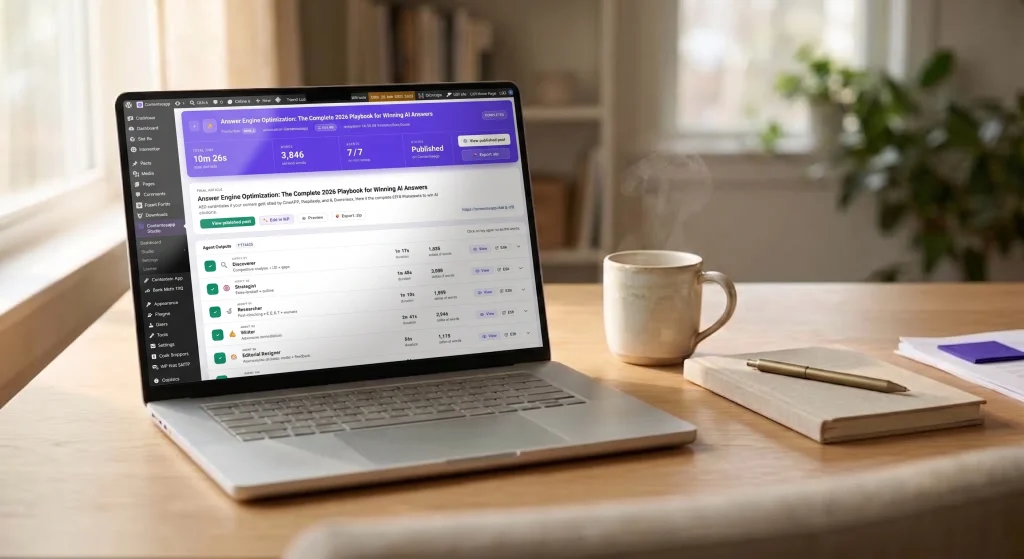
The bigger distinction is what BYOK is not in category terms: it is not direct API access via a playground or curl command. A BYOK writer adds a structured writing pipeline on top of your key — prompting logic, brand voice, SEO structure, multi-agent sequencing — so you get purpose-built editorial output rather than a blank text completion.
Two Separate Ledgers
UX, prompting logic, editorial pipeline
Billed by the writing tool vendor
Model access, token billing
Billed by your provider directly
Two separate ledgers — the interface vendor never sees or marks up your token bill.
What the Combined Cost Model Actually Looks Like
The single most common mistake in BYOK evaluation is treating token cost as the total cost. It is not. The full equation has two columns: the API token cost billed by your provider, and the interface fee charged by the writing tool itself. Look at both. Contentosapp Studio’s BYOK mode carries no plugin markup and no per-article cap — meaning the interface fee in this specific case is $0 for BYOK users operating without a license. The AI usage cost comes entirely from your provider. The plugin listing documents roughly $0.20 per article across a 25-article, 25-day production run — a figure that reflects the full seven-agent pipeline (Discoverer, Strategist, Researcher, Writer, Editorial Reviewer, Visual Designer, Social Media), where each agent makes its own API call. That is a materially more honest benchmark than a single-prompt token estimate, because a real multi-agent workflow costs more than a raw completion. For current token pricing ranges, lightweight models from the major providers can cost a fraction of frontier models — the gap between cheapest and most capable can be 10× or more in output token cost. Always verify current tiers directly on the OpenAI API pricing page before projecting costs, since model names and pricing tiers change faster than published comparisons.
The provider-choice dimension is a genuine cost lever, not just a marketing bullet point. That gap between a budget model and a frontier model can be 10× or more in token cost, which means your effective per-article spend is partly a model selection decision. A BYOK interface that supports multiple providers lets you make that decision per project rather than being locked to whatever model the platform chose. This is the cost argument that flat-subscription tools cannot match: they bundle the model cost into the plan, making it opaque, and they give you no lever to pull when you want cheaper inference for a batch of low-stakes articles. For a deeper look at where hidden subscription costs accumulate, the per-article cost breakdown covers word caps, seat fees, and editing time — the line items that rarely appear in a pricing page headline.
| Cost Component | BYOK (Contentosapp Studio, BYOK mode) | Typical Flat-Subscription AI Writer |
|---|---|---|
| Interface / platform fee | $0 in BYOK mode | $29–$99+/month |
| AI token cost | Pay-as-you-go to provider | Bundled in plan (opaque) |
| Per-article cost (real-world) | ~$0.20 per plugin listing | Depends on word cap / credit tier |
| Volume ceiling | Provider rate limits only — no plugin cap | Determined by plan tier |
| Model choice | User-controlled (Gemini, OpenAI, Claude) | Locked to vendor default |
Per-article figure sourced from the Contentosapp Studio plugin listing, which references a 25-article internal production run. Raw token pricing is not shown in this table — verify current model rates at the OpenAI API pricing page and your chosen provider’s equivalent page before building cost projections.
What BYOK Actually Controls — and What It Still Doesn’t
Rate limits are set by the API provider at your account tier, and your BYOK writing tool has zero ability to change that. A new OpenAI account starts on lower tokens-per-minute and requests-per-day ceilings. If you are planning a high-volume sprint — 50 articles in a week — your bottleneck is not the writing interface. It is your API account tier. Contentosapp Studio’s own listing states this plainly: any limits come from your provider account, pricing, quota, and terms. There is no plugin cap, but the provider cap is real. A second risk that almost no competing BYOK article acknowledges: model deprecation. The model you build a production workflow around today will eventually be retired and replaced. Providers routinely introduce new naming conventions as they release updated model families, and writers who hard-coded earlier model names into their workflows have absorbed that disruption directly. Before committing to any BYOK tool at scale, verify how it handles model transitions — whether it updates default prompt sequences automatically when a model version is deprecated, or whether that responsibility falls on you.
The data privacy question deserves a straight answer, because competitors consistently oversell this. BYOK removes the interface vendor from your data path — they do not see your prompts, your article drafts, or your brand context. That is a real and meaningful change. But it is not the same as local processing or end-to-end privacy. Your request leaves your device and travels to whichever provider you selected — OpenAI, Google, Anthropic — and that provider processes your content under their own data terms. The meaningful privacy gain is that the writing tool company is no longer in the chain. The API provider still is. For most WordPress publishers, this distinction is fine. For publishers working with legally sensitive content, health information, or confidential client material, it is the distinction that matters — and it should be evaluated against each provider’s enterprise data agreements rather than assumed to be solved by BYOK alone.
What BYOK Gives You
- No interface markup on token usage
- Model choice across providers
- No artificial volume cap from the writing tool
- Interface vendor removed from your data path
- Cost that scales with actual usage, not seat count
What BYOK Doesn’t Give You
- Higher API rate limits than your account tier
- Protection from model deprecation
- Local data processing or full privacy
- A guarantee the interface handles model transitions gracefully
The Break-Even Point: When BYOK Starts Winning on Cost
The worked example anchors the math. The Contentosapp Studio plugin listing documents approximately $0.20 per article in total AI usage — across all seven pipeline agents, not just a single writer call. With the BYOK interface fee at $0, the monthly total at common publishing volumes looks like this against a representative flat-subscription tool at $29/month. These figures are directional — verify token pricing at your chosen provider before building projections, as rates shift with new model releases:
| Monthly articles | Flat subscription total ($29/mo) | BYOK total (~$0.20/article) | Winner |
|---|---|---|---|
| 5 | $29.00 | ~$1.00 | BYOK |
| 10 | $29.00 | ~$2.00 | BYOK |
| 20 | $29.00 | ~$4.00 | BYOK |
| 50 | $29.00 | ~$10.00 | BYOK |
Table is directional. Per-article cost based on Contentosapp Studio’s plugin listing figure of ~$0.20/article with a $0 BYOK interface fee. Flat-subscription figure is illustrative of a mid-tier tool; actual pricing varies by vendor. Token costs vary by model tier — verify at your provider’s current pricing page before projecting.
At the $0 interface-fee structure that Contentosapp Studio uses in BYOK mode, the model wins at every volume — even at five articles per month, you spend roughly one dollar versus twenty-nine. But that is not the full comparison you should run. The real question is what you are giving up at the lower price point. A budget flat-subscription tool in the $10–$15/month range with basic single-agent output can temporarily match BYOK on total monthly spend for a publisher producing under eight articles per month, especially if they select a premium model tier that pushes their per-article token cost well above the plugin listing’s estimate. BYOK is specifically advantaged for high-volume WordPress publishers — ten or more articles per month — as well as multi-site operators, freelancers who bill by volume, and anyone who needs to switch providers without re-onboarding to a new tool entirely. That last point is an underrated operational argument: when a provider releases a new model tier that undercuts your current cost significantly, a BYOK setup lets you switch in a single settings field rather than waiting for your subscription platform to negotiate and integrate the new model. For publishers ready to evaluate specific tools against each other on these criteria, the BYOK AI writing tools comparison for WordPress tests the field honestly so this article does not have to replicate that work here.
Monthly Total: BYOK vs. $29/mo Flat Subscription
Contentosapp Studio BYOK mode, ~$0.20/article, $0 interface fee
Against a $29/mo tool, BYOK wins at every volume shown. The real threshold is against cheaper, lighter subscription tiers — the article’s working estimate is roughly 8–10 articles/month before BYOK reliably beats a budget-tier tool too.
Frequently Asked Questions
What does BYOK mean in an AI writing tool?
BYOK stands for “Bring Your Own Key.” In the context of an AI writing tool, it means the software connects to your personal API account with a provider — OpenAI, Google Gemini, Anthropic Claude — using credentials you supply. Every request the tool sends goes through your key, so the token usage appears on your provider bill directly. The writing tool company does not intermediate the API calls or add a markup on top of the provider rate.
Is a BYOK AI writer actually cheaper than a subscription-based tool?
It depends on your publishing volume and the interface fee of the specific BYOK tool. When the interface fee is $0 — as in Contentosapp Studio’s BYOK mode — the total monthly cost is essentially just your token bill. The plugin listing documents roughly $0.20 per article across a full seven-agent production pipeline, which beats most flat subscriptions at almost any reasonable publishing volume. But if the BYOK interface carries its own monthly fee, you need to add both columns before comparing. BYOK is not universally cheaper — it is specifically cheaper for publishers producing consistent volume on a $0 or low-cost interface.
Which AI providers can I connect to a BYOK writing tool?
Provider compatibility depends on the specific tool. Contentosapp Studio supports Google Gemini, OpenAI, and Anthropic Claude. Other BYOK writers may support a narrower or broader set. The meaningful point is that BYOK by design lets you swap providers without changing your writing workflow — so if a new model tier offers a better price-to-quality ratio, you can switch at the key level rather than migrating to a different tool entirely.
Does using my own API key keep my writing data private?
Partially — and the correct answer is more precise than most BYOK marketing suggests. Your prompts and article drafts no longer pass through the writing tool vendor’s infrastructure. They go directly from your site to the API provider you selected. That removes one party from your data chain. But your content is still processed on the provider’s servers (OpenAI, Google, Anthropic) under their respective data use policies. BYOK is a billing and control model. It is not local processing, and it is not a full data privacy solution. If you work with sensitive content, evaluate each provider’s enterprise data agreements separately rather than assuming BYOK resolves the question.
How many articles can I realistically write per month with my own API key?
There is no cap imposed by the BYOK writing interface when it operates in true BYOK mode. The ceiling is set entirely by your API provider account: your tokens-per-minute limit, requests-per-day limit, and the spending cap you configure on your API account. New accounts on most providers start on lower rate tiers. If you are planning high-volume production, request a rate limit increase from your provider before you hit the ceiling mid-sprint. Contentosapp Studio’s listing makes this explicit — any limits come from your own provider account, pricing, quota, and terms, not from the plugin.
Do I need coding skills to set up a BYOK AI writer in WordPress?
No. Tools built specifically for WordPress publishers — Contentosapp Studio being the primary example — install as standard plugins and accept the API key in a settings field. There is no code to write, no server to configure, and no API documentation to parse. You generate the key on your provider’s dashboard, paste it into the plugin settings, and select your model. The step-by-step setup guide covers the full process if you want a walkthrough before committing.
Conclusion
The ownership argument for a BYOK AI writer is real, but it is more precise than most tools advertise. You gain direct provider billing, model flexibility, and removal of the interface vendor from your data path — not a privacy guarantee, not unlimited rate limits, not immunity from model deprecation. The cost advantage is meaningful and consistent once you clear roughly eight to ten articles per month at a $0 interface fee, and it widens linearly as volume grows. Token pricing changes faster than any published guide can track, so the smart move is to treat the provider’s current pricing page as the only number that matters at decision time. If you want to see how the ownership model fits inside a full seven-agent content pipeline built for WordPress publishers, the Contentosapp Studio plugin runs BYOK mode without a license — run the math on your actual publishing volume before you commit to anything else.
References
External sources
- BYOK AI Writing Tool — your keys, your providers, per scene · Foreverse · Xinmeng — https://foreverse.app/byok-ai-writing
- Contentosapp Studio – AI Content Writer & SEO (BYOK) – WordPress plugin | WordPress.org — https://wordpress.org/plugins/contentosapp-studio/
- Pricing | OpenAI API — https://developers.openai.com/api/docs/pricing
- Plans & Pricing | Claude by Anthropic — https://claude.com/pricing#api
- Gemini Developer API pricing | Gemini API | Google AI for Developers — https://ai.google.dev/gemini-api/docs/pricing
Related content
- How to Use Your Own AI API Key in WordPress: The Honest BYOK Guide — Contentosapp
- BYOK AI Writing Tools for WordPress in 2026: Genuine Ones, Honestly Tested — Contentosapp
- AI Content Cost Per Article: What You’re Actually Paying After Word Caps, Seat Fees, and Editing Time (2026) — Contentosapp
- Agentic AI for WordPress in 2026: Site Operators vs. Content Pipelines Are Not the Same Thing — Contentosapp