
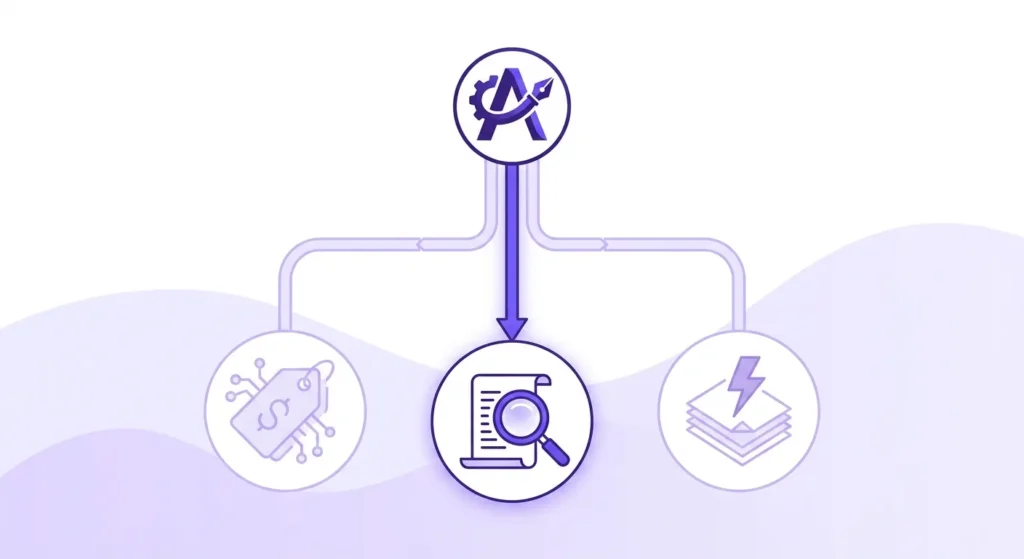
You already know what GetGenie does. The reason you’re searching for getgenie alternatives is whether it’s still the right tool for what you’re actually trying to accomplish. For a lot of WordPress publishers, the answer turns out to be no — not because GetGenie is bad, but because its credit-based architecture creates a very specific ceiling that shows up fast the moment you run a real content operation. Twenty thousand AI words per month. Twenty-five keyword analyses. Five topical maps. Those numbers feel fine until you’re three weeks into a content calendar and you’ve already blown through them.
This article isn’t a generic roundup listing every AI writing tool with a SaaS pricing page. It segments the options by use case — research-first pipelines for competitive SERPs, BYOK setups for operators who want to pay API cost only, and speed-first tools for volume affiliate publishing. If you want the full landscape of AI content plugins in one place, the best AI content plugins for WordPress in 2026 article covers that. Here, the focus is narrower: which tool actually solves the problem GetGenie isn’t solving for you, and why.
- GetGenie Starter limits: 20,000 AI words, 25 keyword analyses, and 5 topical maps per month — a word budget that most content calendars exhaust within two weeks of real publishing.
- Research-first tools: KoalaWriter and SEOWriting.ai ingest live SERP data before generating, which changes what the AI actually writes — not just how fast it writes.
- Genuine BYOK: AI Engine for WordPress routes API calls directly to OpenAI, Anthropic, Google, or Mistral. No vendor credit ceiling, no markup on tokens — ever.
- KoalaWriter’s hidden word math: The Essentials plan advertises 15,000 words per month, but that halves to roughly 7,500 effective words when you use GPT-5.2 or Claude 4.5 Sonnet.
- If you’re rewriting more than half of every GetGenie draft, the tool is already costing more than its subscription price suggests. The credit math section below makes that concrete.
Why GetGenie Users Switch: The Credit Ceiling and Draft Quality Problem
To be clear about scale first: GetGenie runs on 80,000+ active installs with a 4.8-star rating from 118 reviews on WordPress.org — it’s popular for a reason, and actively maintained. The Starter plan sits at $6/month billed annually — genuinely affordable on its face. But the credit architecture is what trips people up. You get 20,000 AI words per month, 25 keyword analyses via the Blog Wizard, 30 related/NLP/semantic keyword analyses, and 5 topical maps. (The pricing page quantifies SERP-analysis credits only on the Free plan — 5 per month; paid-tier SERP limits aren’t stated in retrievable form, so we don’t guess them.) Run three articles a week with a proper research pass and a rewrite on each, and the word budget is gone in ten to fourteen days. What looked like a $6 tool starts requiring a plan upgrade — or a decision to skip the research steps that make the output actually rank.
The second problem is less about credits and more about architecture. GetGenie’s core model generates from a prompt. You enter a keyword, configure some options, and the tool drafts from there. That works fine for low-competition queries where a fluent, well-structured draft can compete on its own. It breaks down on anything competitive, where the gap between what’s ranking and what a cold-prompt draft produces is real and significant. The tool isn’t generating with awareness of what the top-10 results cover — which topics, which entities, which semantic clusters. That editing burden lands on you.
Both failure modes are real, and they’re distinct. If you’re hitting the credit ceiling, the fix is a different pricing model — flat-rate or BYOK. If your drafts are thin and competitive SERPs are the goal, the fix is a different pipeline model — one that reads the SERP before writing, not after. The alternatives below are sorted by which problem they actually solve.
Research-First Alternatives: Tools That Read the SERP Before They Write
The functional distinction here matters more than most comparison articles let on. A research-first tool ingests live SERP data — the top-10 results, their headings, their semantic coverage — before a single token of your article gets generated. The model doesn’t start cold. It starts aware of what’s already ranking, which subtopics appear across multiple results, and which entities the content is expected to cover. The downstream editing burden is genuinely different. You’re trimming and sharpening a draft that’s already SERP-aware, not adding substance to a draft that missed the whole conversation.
KoalaWriter is the clearest example of this architecture in the GetGenie replacement market. The Essentials plan runs $9/month and includes real-time factual data, AI-powered SEO optimization, live Amazon data for affiliate articles, and direct WordPress and webhook integration. That’s a credible feature set at an accessible price. The critical caveat: word count is based on GPT-5 Mini usage. If you switch to GPT-5.2 or Claude 4.5 Sonnet, the word count for each article is counted as 2× higher — meaning the Essentials plan’s advertised 15,000 words collapses to roughly 7,500 effective words per month when using the better models. That’s a number worth knowing before you commit.
SEOWriting.ai approaches the research-first model differently. According to its own site, it auto-analyzes SERP competitors before generating content, optimizing for both traditional search and AI engines like ChatGPT and Perplexity. The WordPress integration is direct: generate an article and publish or schedule it to a connected site in one click. It also offers 20+ pre-trained models for affiliate content — product roundups, reviews, how-to guides — which is a meaningful differentiator for publishers whose content types are predictable. The free tier exists, which makes it easy to test before spending anything.

BYOK Alternatives: Genuine Cost Control or Marketing Label?
BYOK — Bring Your Own Key — appears on a lot of plugin feature lists. Most of the time it’s a label, not a structural guarantee. The question to ask is simple: when you enter your OpenAI API key into the tool, does that key hit the OpenAI API directly, or does it route through the vendor’s server with a potential markup? The difference is both a cost issue and a privacy issue. True BYOK means your API calls go direct, your bill comes from OpenAI (or Anthropic, or Google), and the vendor takes no per-token cut. Anything else is a proxy with marketing language.
AI Engine for WordPress is the most genuinely BYOK implementation in this comparison. Install the plugin, connect your own API keys for OpenAI, Anthropic, Google, Mistral, and more, and every API call your site makes goes directly to those providers. There is no vendor credit ceiling because there are no vendor credits — billing passes entirely to the underlying provider. That’s a structural difference, not a feature difference. Beyond the cost architecture, AI Engine is also a full AI framework: chatbots, content generation, AI forms, knowledge bases with embeddings, function calling, and MCP support for desktop clients connecting via OAuth. It’s not just a writing assistant — it’s an AI layer for the entire WordPress site.
At current API rates, generating a 2,000-word article draft costs a small fraction of what any credit-based plan charges per article when you factor in keyword analysis, SERP pull, outline, and draft credits consumed — check openai.com/api/pricing for the exact figures since model pricing changes regularly. For publishers running 15–20 articles per month, the math favors BYOK decisively at volume. The AI content cost per article breakdown covers this in more detail, and the BYOK AI writing tools for WordPress comparison goes deeper on which tools actually implement it correctly. For AI Engine specifically, “genuinely BYOK” is the right descriptor — the plugin connects every major provider directly, with no vendor intermediary in the token path.
Speed-First Alternatives: For Volume Publishing With Less Competitive Keywords
Not every WordPress publisher is chasing competitive informational queries. A large segment — affiliate sites targeting long-tail, near-zero-competition keywords — needs throughput over research depth. For a 700-word buying guide on a DR-15 site targeting a keyword with 40 monthly searches and no real SERP competition, you don’t need a research pipeline. You need to publish fast, publish consistently, and let the topical coverage compound over time.
SEOWriting.ai sits in this category as well as the research-first bucket. The bulk article generation feature — auto-post up to 100 articles in a batch to WordPress automatically — is built for exactly this kind of operation. Enter your keywords, configure the settings, click run, and the platform schedules the posts to your connected site. That’s a genuine throughput capability. The figure of 50,000+ businesses and bloggers using the platform is vendor-reported and should be read as a marketing claim rather than an independent benchmark — but the bulk-post feature itself is real and demonstrable.
The honest caveat for speed-first tools: pointed at competitive SERPs, they produce AI slop at scale. That’s not a bug in their design, it’s a feature being misapplied. If you’re building a topical authority site in a competitive niche and expecting bulk-generated drafts to compete with research-backed long-form content, you’ll spend more time cleaning up than you saved generating. Use speed-first tools for what they’re designed for — high-volume, low-competition, affiliate-oriented publishing — and they work. Use them everywhere and you’ll be rebuilding your content strategy in six months.
The Real Cost Per Article: Credit Math No One Shows You
Here’s what comparison articles almost never do: calculate what one publishable article actually costs in GetGenie credits across a realistic workflow. Let’s run the math. A standard informational article on a competitive keyword requires one keyword analysis via Blog Wizard (1 of your 25/month), one outline generation, one first draft, and typically one rewrite pass on sections that are too thin. The AI word burn across draft, rewrite, and any additional generation: conservatively 3,000–5,000 words consumed per 1,500-word published article.
On the Starter plan at $6/month annually, your 20,000 AI words support 4–6 articles at this consumption rate. Your 25 keyword analyses support 25. The hard ceiling is the word budget — you’re out after four to six properly researched articles per month, not the 25 the analysis credits might naively suggest.
At $6/month, that’s $1.00–$1.50 per article in tool cost — still cheap in isolation. But upgrade to the Writer plan at $11.40/month for 60,000 words to get real headroom, and the math shifts: you need to publish more to justify the plan.
Compare this to KoalaWriter’s Essentials at $9/month with no SERP analysis credit cap — you get research pulls on every article you write, limited only by the word count. Or to AI Engine on BYOK, where your generation cost is entirely API-based with no vendor ceiling. The credit-per-article calculation is the most useful number when evaluating GetGenie alternatives, and almost no comparison article ever runs it. Now you have it. The AI content cost per article framework extends this math across tools and team sizes if you need a deeper model.

Research-First vs. One-Prompt: Why the Pipeline Architecture Matters for Rankings
This is worth making explicit. When a tool ingests the top-10 SERP results before generating, the model produces output that’s already topically calibrated. It surfaces entities and subtopics Google is actively rewarding in that SERP. It doesn’t miss the supporting clusters that appear across five of the top-10 results. You still edit — but you’re editing for voice, depth, and accuracy, not for structural gaps. That’s a fundamentally different editing task.
A cold-prompt tool — GetGenie’s core model, and most standard AI writing assistants — starts from your input only. The model’s training data includes general knowledge about almost everything, but it has no runtime awareness of what’s specifically ranking on that query right now. It produces fluent prose. It follows a reasonable structure. And it may miss two or three entire subtopic clusters that every competing result covers, simply because those clusters weren’t prominent in the prompt. You don’t discover the gap until you’re editing, or worse, until you check rankings six months later.
| Pipeline Model | Editing Burden After Generation | Best Use Case |
|---|---|---|
| Research-first (live SERP ingestion) | Low–Medium (voice, depth, accuracy) | Competitive informational queries |
| One-prompt (cold generation) | Medium–High (structure, gaps, entities) | Low-competition or templated content |
| BYOK (user controls model + prompt) | Varies by prompt engineering | Power users with custom workflows |
This isn’t just a UX preference. It’s an E-E-A-T and Information Gain argument. A draft that arrives SERP-aware is closer to demonstrating experience and authority on the topic because it’s already shaped around what the topical ecosystem looks like. A cold draft requires you to supply that expertise manually — which is fine if you have it, but time-intensive and frequently missed under deadline pressure.
Side-by-Side Comparison: GetGenie vs. Top Alternatives
| Tool | Pipeline Model | WordPress Integration | Starting Price | BYOK | Best For |
|---|---|---|---|---|---|
| GetGenie | One-prompt | Native plugin | ~$6/mo (annual) | No | All-in-one: SEO + keyword + writing |
| KoalaWriter | Research-first (SERP + Amazon data) | Yes (webhook/WP) | $9/mo (monthly) | No | Long-form SEO content, affiliate |
| AI Engine | BYOK (you configure) | Native plugin | Free (API cost only) | Yes (genuine) | Developers, cost-conscious operators |
| SEOWriting.ai | Research-first + bulk | Yes (auto-post) | Free tier available | No | Volume affiliate publishing |
| Surfer SEO | Research-first (NLP scoring) | Plugin available | See surferseo.com | No | Content optimization + scoring |
| Frase | Research-first (brief → outline → draft) | No native plugin | See frase.io | No | Research-heavy long-form content |
| Contentosapp Studio | Research-first, 7-agent editorial pipeline | Native plugin (writes & publishes inside WP) | Free (BYOK — you pay only your provider) | Yes (genuine) | Research-grounded drafts with real, clickable citations |
Pricing verified July 2026 from each vendor’s public page; where a page doesn’t state a price in retrievable form, we say “see site” instead of guessing.
A note on how to read this table: the “Best For” column is the most important one. Pipeline model and BYOK support are structural facts — they don’t change based on your use case. Price and WordPress integration are practical filters. The use case column tells you whether the tool was designed to solve your problem or someone else’s. Don’t pick a tool optimized for volume affiliate publishing and expect it to produce research-grounded content that competes on high-intent informational queries. It wasn’t built for that.
Which Alternative Is Right for Your Situation
Three publisher profiles map cleanly to three different tools. The right choice depends on your publishing frequency, your keyword difficulty targets, and how much technical setup you’re willing to do once.
Profile 1 — Competitive niche site, 4–8 articles per month, DR 30+, informational queries: You need research-first. GetGenie’s one-prompt model will leave structural gaps in drafts that you’ll spend hours closing. KoalaWriter’s Essentials plan at $9/month gives you SERP-aware generation and native WordPress publishing. Use GPT-5 Mini to stretch the word count, and upgrade to Professional at $49/month when you consistently run out of words. The research depth at entry-level pricing is hard to beat.
Profile 2 — High-volume affiliate network, 50–200 articles per month, cost control is the constraint: BYOK via AI Engine is your answer. No credit ceiling, no per-article vendor cost. Your API bill scales with your volume, but the unit cost per article is a fraction of what any credit-based plan charges at the same volume. It requires more setup than a turnkey SaaS tool — you’re configuring prompts, managing models, integrating workflows manually. If that’s a reasonable ask for your operation, AI Engine is the most structurally honest BYOK implementation in the WordPress ecosystem.
Profile 3 — Solo blogger, long-tail keywords, low competition, monthly publishing: SEOWriting.ai’s free tier is the starting point. Minimal investment, direct WordPress publishing, and enough tooling to produce rank-ready content on low-competition queries without a steep learning curve. If volume picks up and you want bulk generation, the paid tiers unlock the 100-article batch feature. You don’t need a research pipeline at this stage — the keywords you’re targeting don’t require it.
Switching From GetGenie Without Breaking Your WordPress Workflow
The practical transition question most people skip: what do you do with your current GetGenie subscription? If you’re mid-billing-cycle, the credits you’ve paid for don’t refund. The honest answer is to run out your remaining SERP analyses and keyword analyses on content you’ve already planned, use the AI words for drafts and rewrites on those pieces, and install your replacement alongside GetGenie in WordPress without deactivating it yet. Most alternatives — KoalaWriter via webhook, AI Engine as a standalone plugin, SEOWriting.ai via its own WordPress integration — coexist with GetGenie in the same dashboard without conflicts.
Set your GetGenie renewal date as a hard deadline. Two weeks before that date, install the free tier or trial of your shortlisted alternative and run two or three real articles through it — a keyword you care about, competitive enough to matter, full workflow from research to publish. That’s your actual test. Don’t evaluate on a dummy keyword against a content type you don’t produce. Real output on real content is the only meaningful benchmark. If the alternative produces a draft you’d publish after light editing, you’re done. Cancel GetGenie before renewal.
If you’re building a multi-site operation and want editorial workflow infrastructure inside WordPress — not just a writing plugin — the Contentosapp ecosystem was built for exactly that: an editorial team structure embedded in WordPress, not bolted on from a SaaS interface. Worth a look if single-plugin limitations are part of why you’re evaluating alternatives in the first place.
Frequently Asked Questions
Is there a free alternative to GetGenie for WordPress?
Yes. SEOWriting.ai offers a free tier with no credit card required — enough to test the generation quality on real keywords before committing to a paid plan. AI Engine for WordPress is also free as a plugin; you only pay for the API calls you make through your own OpenAI, Anthropic, or Google account. Both are functional starting points, not just feature-locked previews.
Can I use GetGenie with my own OpenAI API key?
GetGenie does not offer a genuine BYOK mode under its current pricing structure. All AI generation on the platform runs through GetGenie’s own credit system — you cannot connect your own API key and bypass their credit metering. If BYOK is a hard requirement, AI Engine for WordPress is the alternative purpose-built for it.
What is the best AI writing plugin for WordPress SEO in 2026?
There’s no single answer — the best tool depends on your use case. For research-first long-form content on competitive queries, KoalaWriter is hard to beat at entry-level pricing. For genuine cost control at scale, AI Engine’s BYOK architecture has no credit ceiling and no vendor markup. For bulk affiliate publishing, SEOWriting.ai’s batch-to-WordPress feature is a real differentiator. The comparison table in this article maps each tool to the use case it was actually designed for.
How does Koala AI compare to GetGenie for blog posts?
KoalaWriter generates with live SERP and real-time factual data — GetGenie’s core model generates from your prompt alone. For competitive informational blog posts, that pipeline difference matters: KoalaWriter’s drafts arrive with better topical coverage out of the box. The trade-off is the word-count multiplier: when using GPT-5.2 or Claude 4.5 Sonnet, each article consumes 2× the word count, so the Essentials plan’s 15,000 words becomes roughly 7,500 effective words on premium models. Factor that in when comparing plans.
Does SEOWriting.ai integrate directly with WordPress?
Yes. According to its own product documentation, SEOWriting.ai can auto-post up to 100 articles in a batch to a connected WordPress site automatically. Articles can be published immediately or scheduled. The integration is direct — no third-party connector required — which is a meaningful differentiator for publishers running high-volume operations.
What happens to my GetGenie credits if I cancel my plan?
Credits are tied to your active subscription. If you cancel before the end of your billing period, unused credits typically expire at the end of that billing cycle — they don’t carry over and are not refunded. The safest approach is to time your cancellation for the day before renewal, having fully used your credits in the preceding weeks. Always verify the specific cancellation and refund terms directly on the GetGenie pricing and account pages before acting.
Which GetGenie alternative works best for affiliate content sites?
SEOWriting.ai is the most purpose-built option for affiliate content. The platform offers 20+ pre-trained models specifically for affiliate content types — trained on product roundups, reviews, and comparison formats — and the bulk auto-post feature handles volume at a scale that no single-article-generation tool can match. If your affiliate operation is large enough that per-article API costs matter, AI Engine’s BYOK model becomes competitive. KoalaWriter also includes live Amazon data on its plans, which is useful for product-focused affiliate articles.
The right GetGenie alternative isn’t the one with the most features — it’s the one whose architecture matches how you actually produce content. If SERP analysis credits are your ceiling, a research-first flat-rate tool solves that. If per-word vendor costs are your ceiling, BYOK passes the billing directly to the underlying API with no markup. If throughput is the goal and keyword difficulty is low, speed-first bulk publishing tools were built for that workflow. Run one real article through your shortlisted tool before your next GetGenie renewal date. The output quality — and the editing time it demands — will tell you everything the pricing page won’t.
References
External sources
- Pricing – GetGenie AI — https://getgenie.ai/pricing/
- Koala AI Pricing — https://koala.sh/pricing
- SEO WRITING – AI Writing Tool for 1-Click SEO Articles — https://seowriting.ai/
- AI Engine – The Chatbot, AI Framework & MCP for WordPress – WordPress plugin | WordPress.org — https://wordpress.org/plugins/ai-engine/
- GetGenie – AI Content Writer with Keyword Research & SEO Tracking – WordPress plugin | WordPress.org — https://wordpress.org/plugins/getgenie/
Related content
- Best AI Content Plugins for WordPress in 2026: Compared, Ranked, No Slop — Contentosapp
- AI Content Cost Per Article: What You’re Actually Paying After Word Caps, Seat Fees, and Editing Time (2026) — Contentosapp
- BYOK AI Writing Tools for WordPress in 2026: Genuine Ones, Honestly Tested — Contentosapp