
Author: Alessandro Freitas

  • How to Make AI Content Rank: The Exact System That Works in 2026

    How to Make AI Content Rank: The Exact System That Works in 2026

    Most AI content fails before the first prompt is written. Not because Google hates AI — but because the people publishing it treat the output as the finished product. That’s the mistake. And it’s fixable. Figuring out how to make AI content rank is less about which tool you fire up and more about the system you build around it.

    If you’ve already read our breakdown of whether Google penalizes AI content, you know the answer is no — provided the content meets quality thresholds. Google’s own position makes the line explicit: AI used primarily to manipulate rankings is spam, but AI used to help produce genuinely useful content for people is not. This article is about hitting those thresholds, every single time you publish. The difference between content that climbs and AI slop that flatlines isn’t the tool. It’s the process: a research doc built before any AI session, a structure Google can parse as a semantic outline, a hard editorial gate before anything gets scheduled, and a clean on-page layer to finalize the signal. Four steps. Here’s how to run them.

    Key Takeaways
    • Research before AI: The ceiling of your AI output is set by the quality of your brief. Build a research doc — with intent analysis, SERP gaps, and 3–5 primary sources — before you open any AI tool.
    • Structure signals topical depth: Your H2/H3 tree works as a semantic outline that Google parses independently from body copy. A structurally complete header hierarchy tells crawlers your content covers the full query space.
    • Editorial review is a hard gate: Human review is a pass/fail checkpoint, not light cleanup. Every factual claim needs a traceable citation; every article needs at least one piece of first-hand evidence missing from the top-10 results.
    • On-page closes the loop: Primary keyword in the title and first 100 words, LSI entities in H2s, at least two contextual internal links, and a meta description written for intent — not keyword density.
    • The failure mode is not using AI. It’s treating the AI draft as the finished product and hitting publish without a system around it.

    Step 1: Build the Research Doc Before You Open Any AI Tool

    The single biggest reason AI content fails to rank is not the prose quality — it’s the input. Your AI tool can only synthesize what you give it. Feed it a vague topic and a keyword, and you get a generic summary of whatever dominated its training data. Feed it a structured research brief with original data, documented SERP gaps, and a clearly articulated angle, and the output ceiling rises dramatically. Before you write a single prompt, you need a document that contains: the primary keyword and its verified search intent, a list of what the current top-10 results are NOT covering (your differentiation points), at least one piece of first-hand evidence you own (a personal test result, a screenshot, real data from your niche), and 3–5 authoritative external sources you’ve actually read. That last point matters more than people admit. The research doc is where you decide what the article will say. The AI is just the drafting engine.

    Google’s self-assessment questions for content quality are worth reading before you build this doc, because they define what “original information, reporting, research, or analysis” means in algorithmic terms. The question isn’t whether you used AI — it’s whether the finished article provides something a reader could not get from any other page currently ranking. If your research doc contains genuine insight gaps and primary evidence, the AI draft will reflect that. If it doesn’t, no amount of prompt engineering compensates. Most AI content fails at this stage, before the tool is even opened.
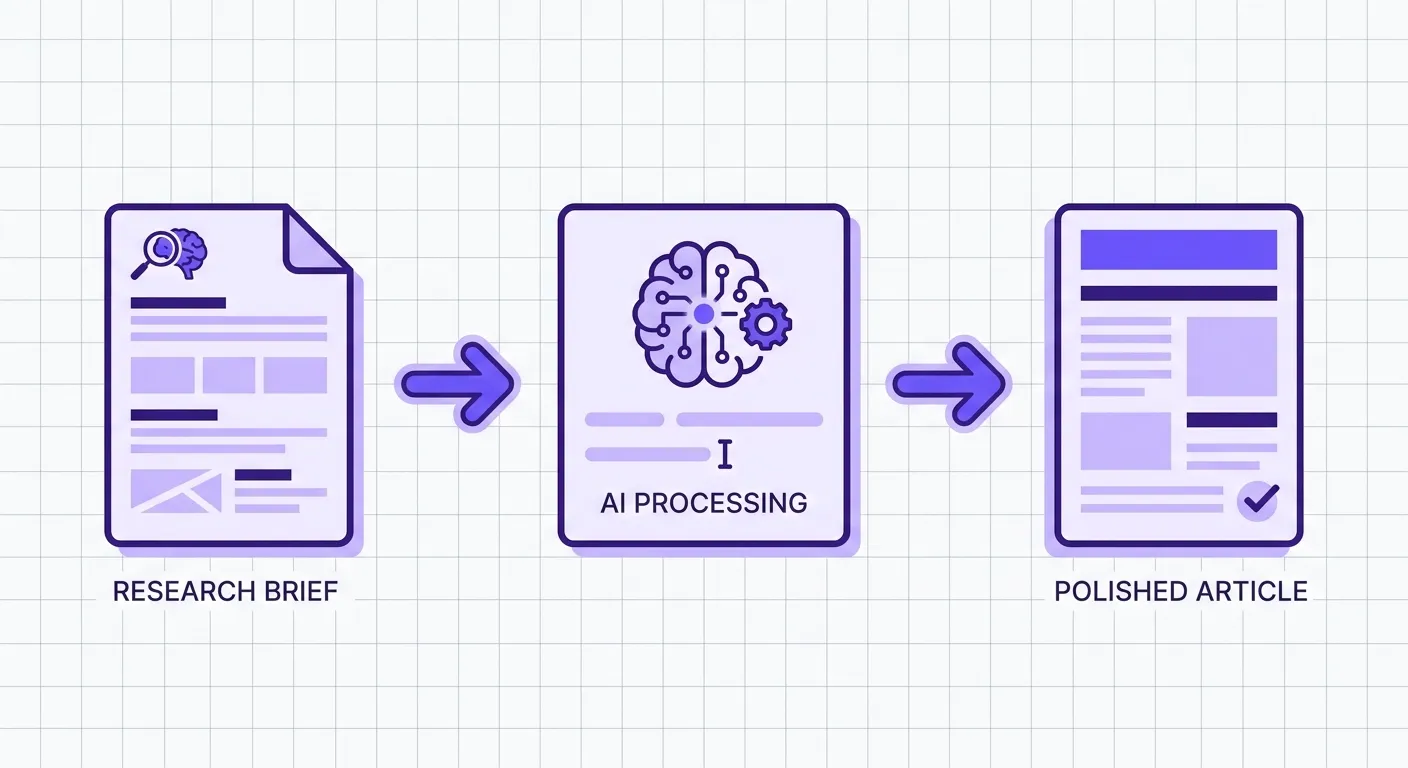
    Building a research brief before using AI tools to create rank-ready content
    Feeding a weak brief into an AI tool produces weak output — the research doc is the real quality gate, not the model you choose.

    Step 2: Structure That Signals Topical Depth to Google

    Header hierarchy is usually discussed as a readability convention. It’s not just that. Your H2/H3 nesting functions as a semantic outline that crawlers parse independently from your body copy — it’s one of the primary signals Google uses to infer whether a page addresses a topic completely or only skims it. Read your H2/H3 tree in isolation. Does it answer the full set of implied subtopics the query carries? Does it progress logically from definition to context to method to outcome? A shallow H2 tree — four generic headings with no H3 specificity — signals surface-level treatment. A semantically complete tree signals depth, even before a crawler processes a single paragraph. This is where most AI-generated articles leave ranking signal on the table: the AI writes reasonable body copy but produces a flat, generic structure because the prompt didn’t specify otherwise.

    For a practical illustration: an article targeting “how to make AI content rank” with only H2s like “Use the Right AI Tool,” “Write Good Content,” and “Optimize for SEO” signals almost nothing. An H2/H3 tree that covers research methodology, structural completeness, editorial review criteria, and on-page signals — with H3s that name specific steps — communicates topical authority at the structural level before Google reads a word of body text. Article structured data, specifically the author field with a linked, verifiable author URL, adds another layer here: it tells Google’s crawlers at the machine level who wrote the piece and where to verify that author’s credentials. This is an underused E-E-A-T lever that most AI-content guides never mention, because they treat E-E-A-T as purely an editorial concept rather than a technical implementation.

    Step 3: The Editorial Review — The Gate Between AI Draft and Publish

    The editorial review is not a polish pass. It’s a hard gate. Treat it that way, and you’ll publish less content — but what you publish will rank. Call it a Rank-Ready Review: a structured checklist with yes/no criteria that every article must pass before it gets scheduled. Here’s what the checklist covers. Does every factual claim in the article link to a primary source you can verify? Is there at least one piece of first-hand evidence — a real example, a personal test, original data — that does not appear anywhere in the current top-10 results? Does the author bio or byline establish relevant experience for this specific topic? And critically: is this article demonstrably more useful than the current number-one result for the query? If any of those is a “no,” the article isn’t ready. It goes back for revision, not to the publish queue.

    This framing matters because Google’s ranking systems explicitly reward content demonstrating expertise, experience, authoritativeness, and trustworthiness — not content that was produced efficiently. The editorial review is where E-E-A-T actually gets built. Not in the AI prompt. A content operation without a defined review gate isn’t a system; it’s a publication queue with no quality control. Picture the failure pattern most solo publishers fall into: months of unreviewed AI drafts going live, and almost no organic traction to show for it — not because the writing is bad, but because nothing in the process forces originality, real sourcing, or first-hand proof onto the page. Now add a genuine editorial gate to that same workflow: an introduction rewritten in a real voice, a first-hand example the top-10 results don’t have, every factual claim traced to a source. That’s the difference between content that’s merely indexable and content that’s actually rankable. The draft was never the bottleneck. The gate is what decides whether any of it earns a position.
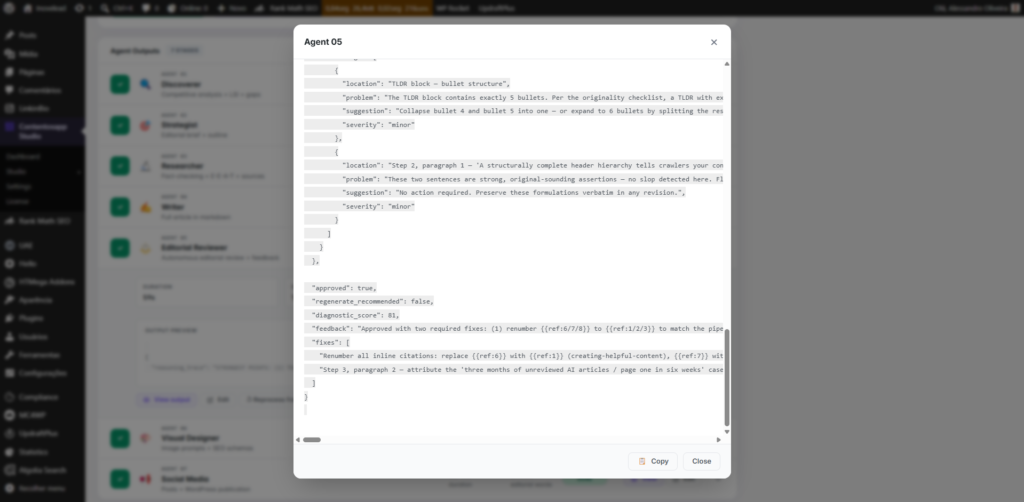
    Contentosapp Studio Editorial Reviewer agent output showing a structured pass/fail review of an AI draft across factuality, sourcing, and originality before the article is approved
    The editorial gate, built in: every draft runs through a structured review — claims checked, originality and sourcing scored — before it’s cleared to publish. Step 3 as a system, not a manual habit.

    Step 4: The On-Page Signals That Finalize Rank-Readiness

    Once the research is solid, the structure is semantically complete, and the editorial gate has been passed, the on-page layer is what finalizes the ranking signal. This is not where you compensate for weak content — it’s where you ensure strong content is properly indexed and understood. The non-negotiables: your primary keyword appears in the title tag and within the first 100 words of body copy (naturally, not forced). LSI entities and topically related terms appear organically in H2s and throughout the body — not stuffed, but present enough that a crawler can confirm the page’s subject. You have a minimum of two contextual internal links pointing to semantically related content on your site, including your pillar article where relevant. Your meta description is written to match search intent for the specific query, not to pack in keyword variations.

    The deeper principle here is that on-page optimization only multiplies content that already has value. Apply it to AI slop and you’re wasting time. Apply it to a research-backed, editorially reviewed article with a clean semantic structure, and every signal reinforces the others. This system — research doc, structural completeness, editorial gate, on-page layer — is not four separate tasks. It’s one workflow, designed to produce content that meets Google’s quality bar at every checkpoint. The goal isn’t to publish more articles. It’s to build a repeatable process where every article you do publish has a legitimate shot at ranking.

    Frequently Asked Questions

    How much human editing does AI content actually need to rank?

    There’s no universal answer, but a practical baseline is this: every factual claim needs to be verified and sourced, the introduction often needs a complete rewrite to establish genuine voice and context, and at least one section needs original first-hand evidence inserted. For most AI drafts, that’s a 30–45 minute editorial pass per article — not a full rewrite, but not a quick proofread either. The common failure mode is treating the AI output as 95% done. It’s usually 60–70% done. The final 30–40% is where the ranking signal lives.

    What’s the difference between rank-ready AI content and AI slop?

    Rank-ready AI content has a research-backed brief behind it, a defined editorial gate it passed before publishing, verifiable citations, and at least one piece of evidence or insight not found in competing results. AI slop is what happens when the output is published without any of those steps — generic, sourceless, indistinguishable from the other ten articles covering the same topic in the same way. Google’s self-assessment checklist for content quality is the fastest way to benchmark where your content falls on that spectrum.

    Does AI content need backlinks to rank, or is on-page enough?

    For lower-competition informational queries — which is where most solo bloggers and affiliate marketers should be starting — on-page quality and topical authority within your site structure can get you to page one without significant external links. But backlinks accelerate that process, especially for queries with established, high-authority incumbents. Don’t treat on-page work as a substitute for link acquisition. Treat it as the prerequisite: content that isn’t rank-ready won’t benefit from backlinks anyway.

    How do I add E-E-A-T to AI-generated articles without having expert credentials?

    You don’t need formal credentials — you need demonstrated experience. First-hand examples, real test results, documented experiments, and named sources all signal experience to Google’s quality systems. Beyond editorial content, implementing Article structured data with a linked author profile tells crawlers at the machine level who wrote the piece and where to verify that person’s background. Most AI-content guides skip this entirely. It’s one of the most actionable E-E-A-T levers available, and it takes about 20 minutes to implement correctly.

    Can I use AI for the research phase, or only the writing phase?

    You can use AI to assist with research — generating topic outlines, identifying subtopic gaps, summarizing source material you’ve already gathered — but it should not be your primary research tool. AI models hallucinate citations, invent statistics, and summarize training data rather than current SERP reality. Use AI to structure and draft; use your own reading and source gathering to fill the research doc. The research doc should contain information you’ve personally verified before the AI touches it.

    How long does it take for AI content to rank after publishing?

    For informational queries with moderate competition, expect 3–6 months for meaningful organic movement, assuming the content passes a legitimate editorial review and the site has some existing authority. Fresh sites with no backlink profile or topical authority signals can take longer. Publishing frequency matters less than publishing quality — one well-executed, research-backed article per week outperforms five AI drafts pushed live without editorial review. Patience plus a repeatable system beats volume every time.


    The system described here is not complicated. But it does require discipline — specifically, the discipline to not treat the AI output as done when it comes out of the tool. Research before prompting. Structure before drafting. Editorial review before scheduling. On-page optimization before publishing. Run that loop consistently, and AI content becomes a genuine competitive advantage. Skip any of those steps, and you’re producing content that will be outranked by whoever doesn’t skip them. The question isn’t whether AI content can rank. It already does, for sites that build a system around it. The question is whether yours will.

    Editorial review checklist for AI content before publishing to meet Google E-E-A-T standards
    An AI draft that skips the editorial gate is a liability — E-E-A-T gaps and factual drift are invisible to the model that created them.

    References

    External sources

    1. Google Search’s guidance about AI-generated content | Google Search Central Blog | Google for Developers — https://developers.google.com/search/blog/2023/02/google-search-and-ai-content
    2. Creating Helpful, Reliable, People-First Content | Google Search Central | Documentation | Google for Developers — https://developers.google.com/search/docs/fundamentals/creating-helpful-content
    3. Learn About Article Schema Markup | Google Search Central | Documentation | Google for Developers — https://developers.google.com/search/docs/appearance/structured-data/article

  • Does Google Penalize AI Content? The Real Answer (With Data) in 2026

    Does Google Penalize AI Content? The Real Answer (With Data) in 2026

    If you’ve ever hesitated to hit “publish” on an AI-drafted article because you half-expected Google to detonate your traffic, you’re not alone. The question of whether does google penalize ai content has been generating contradictory Reddit threads, YouTube hot takes, and agency blog posts for three years straight — most of them repeating each other without going back to what Google actually documented. So let’s do that. The short answer: Google does not penalize AI-authored content. It penalizes content that fails quality tests — and AI happens to make it very easy to fail those tests at scale. That distinction is everything. Get it wrong and you’ll either avoid AI entirely (slower, harder, unnecessary) or use it recklessly and watch your rankings crater.

    This article is built on Google’s own policy language, not third-party summaries of that language. You’ll see the exact phrases Google uses in its Search Central documentation, why those phrases matter, and how they map to real enforcement patterns from the 2022–2024 Helpful Content Updates. By the end, you’ll have a clear framework for using AI as a content tool without putting your site at risk — including a step-by-step workflow you can put to work on your next article today.

    Key Takeaways: Does Google Penalize AI Content?
    • The real verdict: Google’s systems penalize content that fails quality standards — not content that was written by AI. The distinction is explicit in Google’s own documentation.
    • The policy trigger: Google flags “scaled content abuse” and content created primarily to manipulate rankings — these are behavioral definitions, not technology definitions.
    • What actually got sites hit: Sites that lost 50–90% of organic traffic in the Helpful Content Updates published thin, unoriginal, mass-produced content. AI was the production tool. Thinness was the cause.
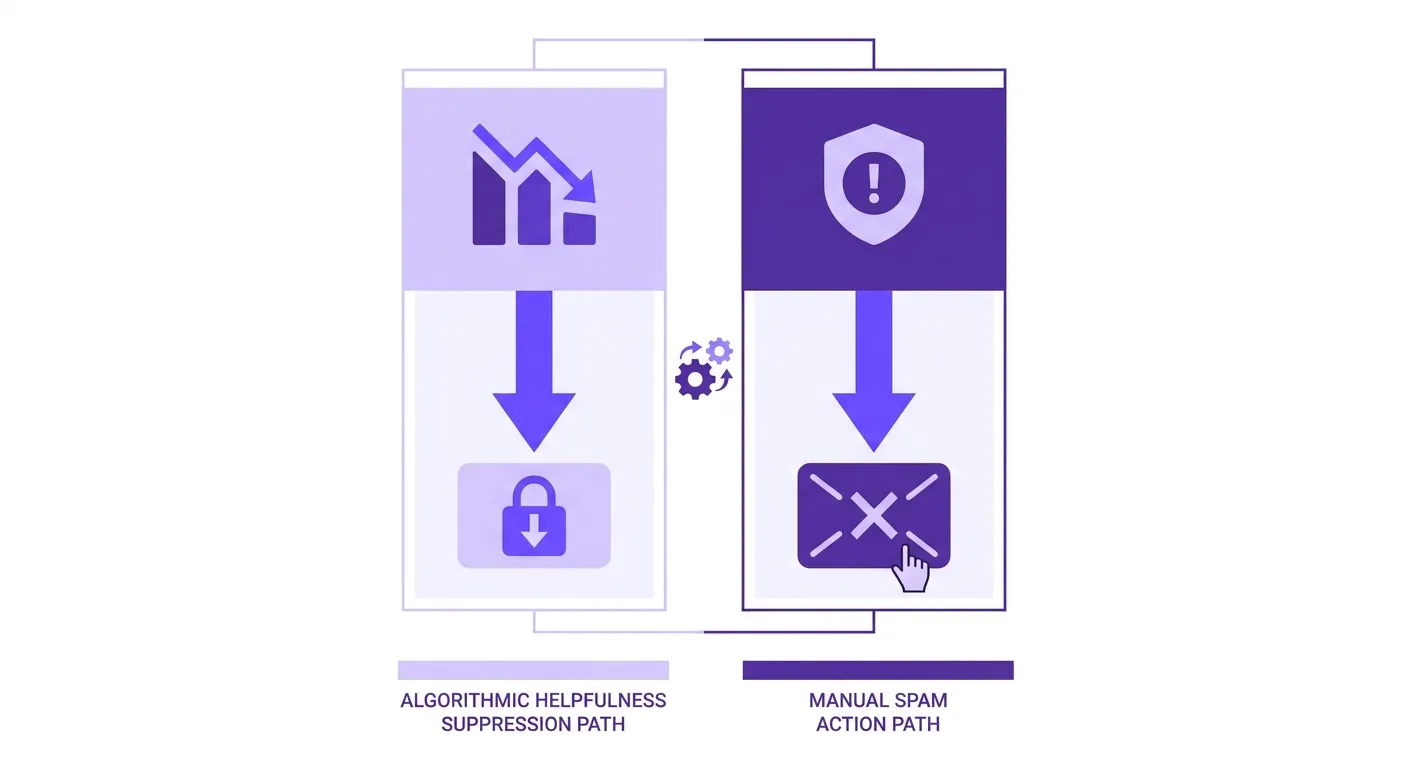
    • Two separate enforcement paths exist: Algorithmic helpfulness suppression (gradual, recoverable) and manual spam action (deindexation). Most SEO advice conflates them — the recovery path is completely different.
    • Site-level trust signals matter: A well-edited AI article on an authoritative domain behaves differently than the same article on a thin affiliate site with no author information.
    • The safest AI workflow adds original data, a credentialed author byline, and human fact-checking — not just a rewrite pass.

    What Google’s Policy Actually Says About AI Content

    Most SEO articles summarize Google’s guidance with something like “Google doesn’t care if AI wrote it, just make it good.” That’s directionally correct but imprecise in ways that matter. Here’s what Google actually wrote, word for word: Google’s Search Central Blog states directly that “our focus on the quality of content, rather than how content is produced, is a useful guide that has helped us deliver reliable, high quality results to users for years.” The word “produced” is doing real work there. Authorship method is explicitly excluded from the ranking criteria.

    But the same post includes a critical qualifier: “using automation — including AI — to generate content with the primary purpose of manipulating ranking in search results is a violation of our spam policies.” Note the precise phrasing. The violation is the purpose — not the tool. Content created primarily for people is fine. Content created primarily to occupy keyword space is a spam policy violation regardless of whether a human or an AI generated it. The policy is behavioral, not technological.

    This is where Google’s own terminology gets important, and where most competing articles miss the point. Google’s spam documentation does not use the phrase “AI content” as an enforcement category. The named violation is “scaled content abuse” — a pattern defined by volume, homogeneity, and absence of per-page editorial care. A single AI-assisted article reviewed by a human expert does not meet that definition. Five hundred near-identical city-pages auto-generated to chase local keyword variants does. The distinction is meaningful, and your strategy should be built around it.

    The Sites That Got Hit: What the Evidence Actually Shows

    Here’s the data that settles it. Ahrefs analyzed the AI footprint of top-ranking pages and found that 86.5% of them contain at least some AI-generated content — and that the correlation between how much AI a page used and where it ranked was 0.011: statistically, no relationship at all. If Google were penalizing AI authorship, that number would be sharply negative. It isn’t. AI-assisted pages rank at the top of Google every day; what separates the winners from the casualties isn’t the tool.

    Look at the documented casualties from the 2022–2024 Helpful Content Updates and the March 2024 Core Update, and a consistent pattern emerges. Sites that lost 50–90% of organic visibility shared specific characteristics: high publishing velocity, minimal per-article depth, no original data, no identifiable author expertise, and content that closely mirrored the structure of existing top-ranking pages without adding anything new. AI was the production method for many of these sites. But it wasn’t the cause of the penalty.

    The pattern shows up again and again in post-update analyses and in the accounts publishers shared across SEO communities after the 2024 updates. The sites that cratered weren’t defined by using AI — they were defined by what they shipped: high publishing velocity, near-duplicate articles assembled from the same top-ranking sources, no original data, and no identifiable author behind the work. Sites in the same niches that published less but added original testing, real author bios, and first-hand detail tended to hold or recover. The variable that predicted the outcome wasn’t “used AI” versus “didn’t use AI.” It was whether each page contained something that required human judgment or first-hand experience to produce.

    This is the causal chain you need to internalize. AI makes it fast and cheap to produce content at volume. That speed removes the natural friction that previously forced publishers to think carefully about each piece. When that friction disappears, you get homogeneous, low-originality content at scale — exactly what Google’s helpful content system is designed to suppress. The AI is the accelerant. The fire was always thin content.

    Diagram showing Google's two-track enforcement: helpfulness suppression vs. spam policy manual action for AI content
    Sites hit by algorithmic suppression and those hit by manual action require completely different recovery strategies — conflating them is one of the most common mistakes site owners make after a traffic drop.

    How Google’s Systems Detect Low-Quality Content

    Here’s the question most readers actually want answered: does Google run your article through an AI detector before deciding whether to rank it? The short answer is no — not in any confirmed way as of 2026. Google has not disclosed an AI-detection classifier in its ranking system, and Google’s own documentation confirms the focus is on quality signals, not authorship provenance. This matters because a lot of the fear around AI content is really fear of a detection mechanism that doesn’t publicly exist.

    What does exist is the quality rater system. Google employs human Search Quality Raters who evaluate pages using the E-E-A-T framework — Experience, Expertise, Authoritativeness, Trustworthiness. These raters don’t check whether a page was written by AI. They check whether the page demonstrates genuine knowledge, accurate sourcing, and credible authorship. Their ratings don’t directly change individual rankings but feed into how Google calibrates its algorithmic quality signals over time. Understanding what a rater looks for is more useful than worrying about AI detection.

    The algorithmic side of this is SpamBrain — Google’s AI-powered spam-detection system. As Google confirmed, SpamBrain targets spam “however it is produced.” SpamBrain is pattern-based and looks at signals like content similarity across pages, publishing velocity, and the absence of brand signals. It does not flag “AI writing style.” It flags patterns consistent with scaled, low-attention publishing. The practical implication: one carefully produced AI article is invisible to SpamBrain. A domain publishing 50 thin AI articles a week with no editorial differentiation is not.

    What “AI Slop” Looks Like to Google’s Systems

    The phrase “AI slop” is informal, but it maps onto something Google defines precisely in its helpful content guidance. Google’s self-assessment checklist asks directly whether content is “mass-produced by or outsourced to a large number of creators, or spread across a large network of sites, so that individual pages or sites don’t get as much attention or care.” That’s AI slop, operationally defined. It’s not about who typed the words — it’s about whether the content received genuine editorial attention.

    The specific quality failures that characterize AI slop are consistent and identifiable. No original data or research. No expert perspective not already present in the top-ranking competitors. Padded structure that addresses the keyword without answering the actual question behind it. Factual claims that can’t be traced to a primary source because the AI hallucinated plausible-sounding details. A Google quality question cuts to this directly: “Does the content provide original information, reporting, research, or analysis?” If the honest answer is no — if everything in your article could have been assembled by reading the top five results — you have a problem regardless of whether a human or an AI wrote it.

    Run this self-audit on your next AI draft before publishing. Can you point to one claim in the article that isn’t in any of the top five ranking results? Does a real person with verifiable credentials stand behind the content? Is there a single fact that required original research, testing, or first-hand experience to include? If you’re answering no to all three, what you have is a restatement of existing information — and that’s exactly what Google’s helpful content system is designed to not surface. Fix the content, not the tool.

    E-E-A-T and AI Content: What Google’s Quality Raters Are Actually Checking

    E-E-A-T gets discussed constantly in SEO circles, but usually at the article level: does this piece of content show expertise? That’s one layer. The layer most people miss is that Google evaluates E-E-A-T at two distinct levels — the individual content piece and the publishing site as a whole. For AI-heavy publishers, the site-level evaluation is often more important than any individual article’s quality, because it’s the context through which every article on the domain gets interpreted.

    At the content level, the hardest E-E-A-T signals for pure AI output to satisfy are Experience and Expertise. Experience means documented first-hand involvement with the subject. An AI cannot have tested a product, treated a patient, or managed an ad campaign — it can only describe what those experiences involve based on training data. Expertise means demonstrable credentials or a documented track record. Neither of these signals is impossible to include in an AI-assisted article; they just have to be added by a human. A brief expert quote, a note about the author’s specific background, or a reference to a real test you ran all supply what the AI draft cannot generate on its own.

    Trustworthiness is the E-E-A-T signal that AI content most commonly fails on, and it’s the most fixable. Google’s guidance asks whether content presents “clear sourcing, evidence of the expertise involved, background about the author or the site that publishes it.” That means named sources for factual claims. It means an author byline that links to a real person with a verifiable background. It means the page itself looks like it was produced by someone accountable for its accuracy. These aren’t cosmetic — they’re the signals quality raters use to decide whether a page deserves trust.

    Why Site-Level Trust Signals Matter More Than You Think

    Here’s an assertion you won’t find in most AI content guides: a rank-ready, well-edited AI article placed on a topically authoritative domain with a real editorial track record will perform differently than the identical article placed on a three-month-old affiliate site with no About page and anonymous authorship. Google’s quality systems don’t evaluate content in isolation. They evaluate the container — and the container sends its own signals independent of any individual article’s quality.

    This is the Information Gain that most publishers using AI miss entirely. They focus on optimizing individual articles while neglecting the site-level trust architecture that determines how those articles are interpreted. A site with documented author credentials, earned backlinks from editorially selective sources, a clear About page, explicit contact information, and a history of original reporting or testing carries institutional authority that protects even imperfect content. A thin affiliate site carries none of that — and even a well-produced AI article inherits the credibility deficit of its host domain.

    The practical audit checklist for site-level trust looks like this. Do you have author bio pages that link to verifiable credentials — published work, professional profiles, or demonstrated expertise in the niche? Does your About page explain who runs the site and why they’re qualified to cover these topics? Are you earning backlinks from sources that editorially vet what they link to, not just directory submissions? Do you have a contact method that a reader or journalist could use to verify claims? These questions mirror what Google’s quality rater guidelines ask evaluators to consider when assessing the site behind a piece of content — and the answers affect every article you publish, AI-assisted or otherwise.

    Checklist diagram of site-level E-E-A-T trust signals that influence how Google evaluates AI-assisted content
    E-E-A-T evaluation happens at the site level, not just the page level — a single well-optimized article sitting on a thin-authority domain still carries structural risk.

    A Practical Workflow: From AI Draft to Rank-Ready Article

    The workflow matters more than the tool. Here’s a sequence that addresses every quality failure pattern described above — not theory, an actual step-by-step process.

    Step 1 — Research before you prompt. Identify the specific angle your article will take that isn’t already in the top five results. This is your Information Gain. It can be original data, a first-hand test result, an expert quote you sourced yourself, or an analysis of a primary source document that competitors haven’t cited directly. If you don’t have this before you open your AI tool, your article will be a rephrasing of existing content.

    Step 2 — Prompt for structure and first draft. Use the AI to build the article skeleton and fill in the sections you’ve already mapped. At this stage, the AI draft is a starting point, not a finished product. Treat it the way you’d treat a research assistant’s notes — useful raw material, not publishable content.

    Step 3 — Layer in first-hand signals. Add the original angle you identified in Step 1. If that means a paragraph about your own testing experience, write it yourself. If it means embedding a quote from an expert you interviewed, add it now. This is the step that separates rank-ready content from AI slop.

    Step 4 — Verify every factual claim. AI tools hallucinate. Before publishing, trace every statistic, quote, and specific claim back to a named primary source. If you can’t find it, rewrite the claim as a general observation or cut it. A single verifiably false claim destroys trust.

    Step 5 — Edit for voice, depth, and engagement. The edit isn’t about the percentage of the text you changed. It’s about whether the published article contains judgments, examples, and perspectives that required human reasoning to include. If the only thing you changed was phrasing, you haven’t edited — you’ve restyled.

    Step 6 — Attach a credentialed author byline. The author named on the page should have a bio that demonstrates relevance to the topic. This is the final trust signal that a quality rater looks for and that AI alone cannot supply.

    What Happens If You Get Hit: Manual Actions vs. Algorithmic Drops

    Not all traffic drops are the same, and treating them the same leads to the wrong recovery strategy. There are two distinct enforcement mechanisms, and they work differently.

    A manual action means a human reviewer at Google assessed your site and determined it violated a specific policy — scaled content abuse, deceptive practices, unnatural links. You’ll receive a notification in Google Search Console under “Manual Actions.” This is uncommon for most publishers, but when it happens, the impact is severe — pages or the entire domain can be removed from search results. Recovery requires a real content audit, removal or major improvement of the violating content, and a reconsideration request submitted directly through Search Console.

    An algorithmic drop is different. No notification. No manual review. Your rankings fell because a core or helpful content update re-evaluated the quality signal of your content and decided it was less helpful than competitors. This is far more common for AI-heavy publishers. The recovery path is also different: you can’t submit a reconsideration request for an algorithmic demotion. You fix the content, publish new content with stronger quality signals, and wait for the next update cycle to re-evaluate the domain.

    The diagnostic is straightforward. Open Search Console and check the Manual Actions report first. If it’s clean, cross-reference your traffic drop date against Google’s published update timeline. If the drop correlates with a named update, you’re dealing with an algorithmic quality signal, not a penalty in the legal sense. Use the self-audit questions from the earlier section to identify which content is underperforming and why — then prioritize updating those pages rather than publishing new ones.

    Full disclosure, because it’s the whole point: the first draft of this article was produced by an AI pipeline, then fact-checked and edited by a human before it went live. That edit caught a confidently written statistic with no traceable source — and cut it. That’s the line between “AI-assisted” and “AI slop” in one sentence: the AI wrote fast; a human made sure every claim could survive scrutiny. It’s the same standard this article asks you to hold every draft to.

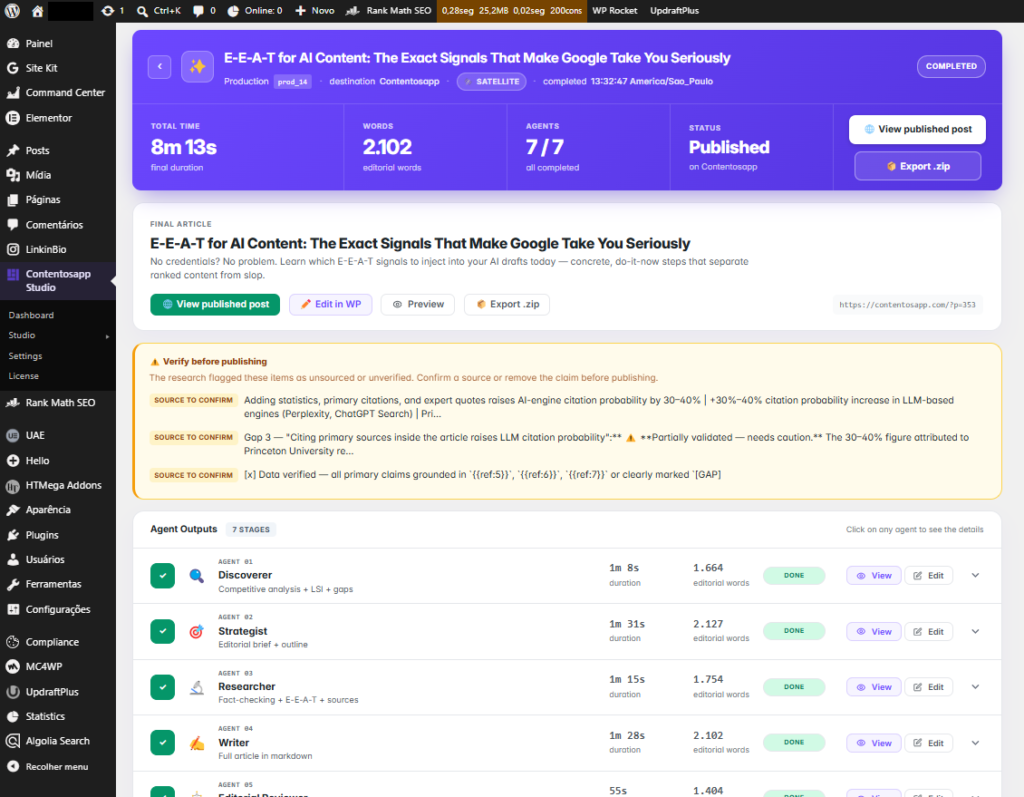
    Contentosapp Studio's "Verify before publishing" panel flagging claims in an AI-drafted article for human fact-checking before the post goes live
    Exactly what the disclosure above describes: before anything publishes, the pipeline surfaces the claims that need a human check — the same gate that caught (and cut) an unsourced statistic in this very article.

    Frequently Asked Questions

    Does Google penalize websites for using AI-generated content?

    No. Google does not penalize websites for using AI to produce content. Google stated explicitly that its “focus on the quality of content, rather than how content is produced” guides how it ranks results. The enforcement trigger is intent and quality failure — content created primarily to manipulate rankings, or content that is thin, unoriginal, and mass-produced — not AI authorship. A single, well-researched, human-reviewed AI article on a credible domain faces no structural disadvantage.

    Can Google detect if content was written by AI?

    Google has not confirmed that it uses an AI-content classifier in its ranking system as of 2026. Quality raters evaluate pages using the E-E-A-T framework — looking at signals like sourcing, author credentials, depth, and originality — not by checking authorship provenance. The practical implication is that “does this look like AI wrote it?” is the wrong question. The right question is “does this content demonstrate genuine expertise, original analysis, and trustworthy sourcing?”

    What is the difference between AI content and AI slop?

    AI content is any content assisted or produced by an AI tool — a broad category that includes everything from auto-generated weather data to expert-reviewed affiliate guides. AI slop is the subset of that category characterized by: no original insight, no verifiable claims, no human editorial judgment, recycled structure from competing pages, and often published at volume. Google’s quality guidance operationalizes this as content that is “mass-produced… so that individual pages or sites don’t get as much attention or care.” The tool isn’t the differentiator. The presence or absence of editorial care is.

    Did the Helpful Content Update specifically target AI-written articles?

    Not by definition. The Helpful Content Update targeted content created primarily for search engines rather than for people — a quality standard that predates AI tools entirely. Sites that lost traffic after the 2022–2024 Helpful Content Updates published content matching a specific failure pattern: high volume, low originality, no identifiable expertise. Many of those sites used AI as their production method. But the update hit low-quality human-written content too. AI accelerated the production of low-quality content; the update targeted the low quality, not the AI.

    Is it safe to use ChatGPT or Claude to write blog posts in 2026?

    Yes, with the right workflow. Both tools can produce useful first drafts. Neither can produce rank-ready content on its own. The safety comes from what you add: original research or testing, expert attribution, verified factual claims, and a credentialed author byline. The risk comes from treating the raw AI output as a finished product and publishing at volume without editorial review. One carefully produced AI-assisted article is low-risk. Three hundred thin AI articles published in 90 days is the pattern Google calls scaled content abuse. The fix isn’t publishing less — it’s auto-publishing reviewed drafts safely instead of running an unattended generation firehose.

    What does E-E-A-T mean for AI-assisted content?

    E-E-A-T — Experience, Expertise, Authoritativeness, Trustworthiness — is the framework Google’s quality raters use to evaluate content. For AI-assisted content, Experience and Expertise are the signals that require human input: documented first-hand involvement with the subject, or verifiable credentials. Trustworthiness is often the most fixable signal — it comes from clear sourcing, accurate claims, and transparent authorship. AI drafts naturally lack all three. Human editorial review supplies them. The goal isn’t to hide AI involvement; it’s to ensure the published article meets the E-E-A-T standard regardless of how the draft was produced.

    How do I know if my site received a manual action for AI content?

    Open Google Search Console and navigate to the “Manual Actions” report under “Security & Manual Actions.” If Google’s review team flagged your site, the notification will appear there with a description of the specific policy violation. A clean Manual Actions report means your traffic drop — if you have one — is algorithmic, not a manual penalty. These are meaningfully different situations that require different responses. Algorithmic drops are far more common and are addressed by improving content quality and waiting for the next update cycle to re-evaluate the domain.


    The fear that Google will destroy your site for using AI is real, but it’s pointed at the wrong target. Google’s systems aren’t hunting for robot fingerprints in your prose. They’re hunting for the absence of human judgment — thin content, zero originality, scaled production with no per-page editorial care. That’s been true since before large language models existed. AI just makes it faster to produce that kind of content at scale, which is why the warnings feel louder now. Your job isn’t to avoid AI. It’s to make sure everything you publish with AI’s help contains something a human had to think about, verify, or experience first. Do that consistently, and you’re not just safe from penalties — you’re building the kind of content that earns rankings instead of just hoping for them.

    References

    External sources

    1. Google Search’s guidance about AI-generated content | Google Search Central Blog | Google for Developers — https://developers.google.com/search/blog/2023/02/google-search-and-ai-content
    2. Creating Helpful, Reliable, People-First Content | Google Search Central | Documentation | Google for Developers — https://developers.google.com/search/docs/fundamentals/creating-helpful-content
    3. Scaled content abuse / March 2024 | Google Search Central | Documentation | Google for Developers — https://developers.google.com/search/blog/2024/03/core-update-spam-policies
    4. Guidance de gen-AI | Google Search Central | Documentation | Google for Developers — https://developers.google.com/search/docs/fundamentals/using-gen-ai-content
    5. Ahrefs — AI content does not hurt rankings — https://ahrefs.com/blog/ai-seo-statistics/